
How I reinterpreted the monster manual (and how you can do it as well)
January 19, 2018, 11:24:49 PM
By Belchion
Monsters are a traditional and welcome staple for fantasy RPGs. The monsters from the D&D Monster Manual have even become cliché in many regards, both for good and for ill. A couple of bloggers have started to newly interpret the existing monsters, myself among them.
(Note: I blogged in German, but reading my blog is not necessary to understand this article. If you do not speak German and want to read my blog, you can use DeepL to translate my posts. When I tested their automatic translation on my posts, it achieved sensible results.)
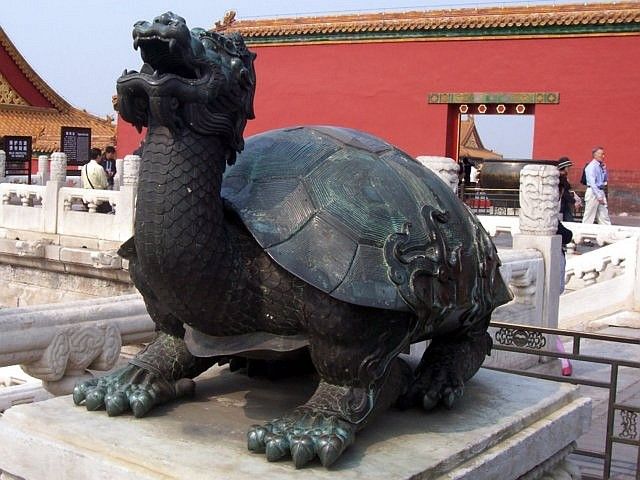
My goal was not to to change monsters just for the sake of it. Instead, I wanted to look at monsters from different angles and turn them into something more useful for my games. If I liked a monster, I would often just add some ideas for how to employ said monster creatively, instead of changing the monster more fundamentally.
A good example of this approach is the dragon turtle. Since I liked the dragon turtle, I did not change its description at all. I just added the idea that merfolk might use them to sink ships or for armoured transport, as well as an adventure seed called 'Great Aunt Dragon Turtle'.
First, I always looked the monster's description up in an encyclopedia like Wikipedia or Encyclopedia Britannica, but I also visited some encyclopedias that specialise in folklore or RPG settings. Here I tried to discern how the monster was typically used and what alternative uses existed. For example, was the monster's name also used for a vehicle, a piece of software, or weapon system? If so, what did this choice of name imply? Did it appear in other media, and what role did it play there? In one case I even read a PhD thesis because it offered an excellent overview of frogs in art.
Where words were too archaic or particularly common I looked them up in a dictionary, too, either to learn about their history or to find synonyms.
I took sparse notes with a reminder where I got the ideas from. Those notes would be put randomly on a piece of paper, to be connected by coloured pencil later once I started to connect the dots. I made sure not to drown in detail, but keep it short and specific.
Another very important tool was the picture search. I would enter either the monster's name or, if I did not find anything or just too much stuff, a synonym, and I'd then look at whether there was anything out of the ordinary. As an example of a monster inspired by a particular picture, look at the goblin.

Putting the Corpse back into "Corpse Flower?" (Photo by Rod Waddington)
My posts always started with a paragraph about the monster's typical use. In a few sentences, I would describe it and how it was employed in adventures. If I renamed my version of the monster, I would also mention the original name. This allowed readers to identify the original monster I'd used quickly.
As a second step, I usually offered some insight into the monster's uses outside the RPG and fantasy genre, be those uses older (like folklore) or in other genres. I kept this short, a paragraph or two at most.
Third, I gave ideas of how the monster might interact with the rest of a campaign world, what ecological niche it filled, and how to best spice one's adventures with it. One of the results was gardening necromancers, who combined their undead guards with blood-sucking plants as a means to keep their refuges safe.
Fourth, the monster's stat block, as written in the Basic Fantasy RPG.
Fifth, and finally, the new description of the monster. This usually entailed one paragraph for physical description, one for fighting tactics, and a third for other ideas regarding the monster.
I spent between one hour and three hours per entry, depending on how clear or diluted my vision originally was. All in all, I re-interpreted 93 monsters, which took me about five months.
The first few monsters were extremely hard, and took a long time to accomplish. Over time, researching the background information turned into a routine though. It also became easier to establish new connections between different versions of a monster and turn them into something useful for role-playing games. Writing new monsters is definitely a skill that can be learned and honed.
It is important to interact with other people and talk to them about your monster ideas. If you have a friend or good aquaintance with similar interests, talk with them. Micro-blogging platforms like dice.camp can also be helpful, as they force you to write your idea consciously whilst allowing you to bounce your ideas around for new thoughts and threads. Without such support, I would have definitely faltered on the second ooze monster instead of turning the grey ooze into a colour stealing flubber.
So I would say almost anyone who does not despise language and art can do it! Simply start with the first monster in your bestiary, research it a bit, write your ideas down, add the stats and a short description. The first few attempts will probably not feel right, but that is normal. Set yourself a pace, for example one monster per week, and a publishing rhythm, for example a Tweaking Tuesday. Then, go ahead, publish your first monster on a forum or a blog, and continue to practice each week with a new entry. After about twenty or so monsters, you will get the hang of it!
Beyond genome editing and space-time warps: Lagos
January 12, 2018, 11:14:00 PM
By Troim

Particle accelerators - now your friendly neighbourhood sci-fi
plot hook... (Credit: CERN/LHC/GridPP)
- How's the brain mapping doing?
- What kind of edges is CRISPR/cas9 busy cutting?
- All fine and fast at the particle accelerator?
- Hey, gravitational waves sound like a promising plot core.
- Not to mention my favorite multipurpose vehicles, dark matter and energy.
Most scientists do science fiction writers1 two big favors: They publish hard, because they have to. And they strive hard to deliver abstracts accessible to people with no real clue about their line of research, a.k.a niche. Because scientific journal gatekeepers tend to be nothing but a more literate and better informed sub-segment of this overwhelming majority of humankind. Thanks to this lucky combination of hardships, inspiration is but one click away.
Most science fiction writers don't care. They prefer to walk well trodden paths:
- Beaming around far more substantial stuff than quantum states is considered standard practice.
- Artificial gravity and time travel have undergone commoditization.
- Don't get me started on the established ways of moving one specific kind of notoriously short-lived, non-extremophile and partly sapient primate across interstellar distances.
Be it hard or soft, innovative or traditional, most science fiction breaks the bounds of current technological feasibility. That's the genre core. The first level.
On the second level, the corresponding sciences would be sociology, psychology and economics, most science fiction declares the straight OECD based Caucasian male hero daydream of Hollywood lore a permanent fixture, as immutable as the basic laws of physics are flexible.
Five, fifty, five hundred or five thousand years from now, some straight middle-class WASP going by the name of Steve/John/Michael from original/Neo/Nova New York will save his home planet/space station/galaxy from whichever self-inflicted or alien induced harm. In the course of which he gets more or less intensely and explicitly laid with some Jane/Sarah/Gloria he met on the way. She can nowadays be black and/or emancipated enough to take over some of the beating/fencing/shooting. There might be an odd non-white or non-straight team member. But that's about it, maximum modernization mode.
No problem. Science fiction is entertainment. Not aspiring to be the edu or info kind of tainment. Steve and Jane, John and Sarah, Michael and Gloria, talking audience now, have every right to have fun. As author of an early trilogy mostly conforming to convention, I'm fine with it.
But. Because there's always a 'but', there has to be some 'but', with science.

What if more science fiction writers broke with tradition? Out with New York, Atlanta, London and Berlin. The future belongs to the young, and a lot of them live in Lagos, Agadir, Rio and Shenzhen. New globally relevant locations and the corresponding cast, a second fiction level on top of the usual technological breakthroughs. Sounds easy? Won't change much? Sure?
From a practitioner perspective, double level science fiction raises inspiring questions:[/size]
- No one is going to blink at my Virtual Reality stuff. The brain-machine interfaces are pretty futuristic, but who cares? Basing the corresponding IT major in near future Nigeria, that's the part that won't go down easy and will need explaining.
- Gay marriage, unisex toilets and transgender pronoun preferences, banalities in Silicon Valley. The corresponding cast and scenes will evolve differently in an imminent future Lagos. And that's just the pointy upper end of a big iceberg of traditions, religions and conventions.
- If my heroes are called Abeo, Infunanya and Mobo, do I introduce connotations that some people will associate, rightly or wrongly, with these names? If my hero is called Wang Xiu Ying, do I need to explain about Asian first and second name conventions, or can the audience be assumed willing to achieve learning by reading?
- With a team of five black guys, none of them can be 'the black guy'. Do I still need to mention the race bit, for all of them, to make sure no reader defaults to Caucasian? Sometimes wish I was doing movies... Will a scene involving surprise about the presence of a white person work standalone, or does it require a narrator giving readers a couple of hints?
Writing double level science fiction is great fun, otherwise I wouldn't keep doing it. I very much encourage all science fiction writers, whichever their personal background, to give it a try. Just brace yourself for one effect: What we don't usually touch, when we imagine all kinds of technologically advanced futures, tells us a lot about what is wrong in our present. Presents.
1. The author, proudly delusional, insists on being considered a writer. Of science fiction, imminent to near future, on the hard side of soft and uystopian, including race and gender relations. For details please check out troim-kryzl.biz for #AltLeftSci
Dark Versus Light: Morals, Nature, Sci-Fi And Fantasy
January 06, 2018, 01:01:34 AM
by Jubal
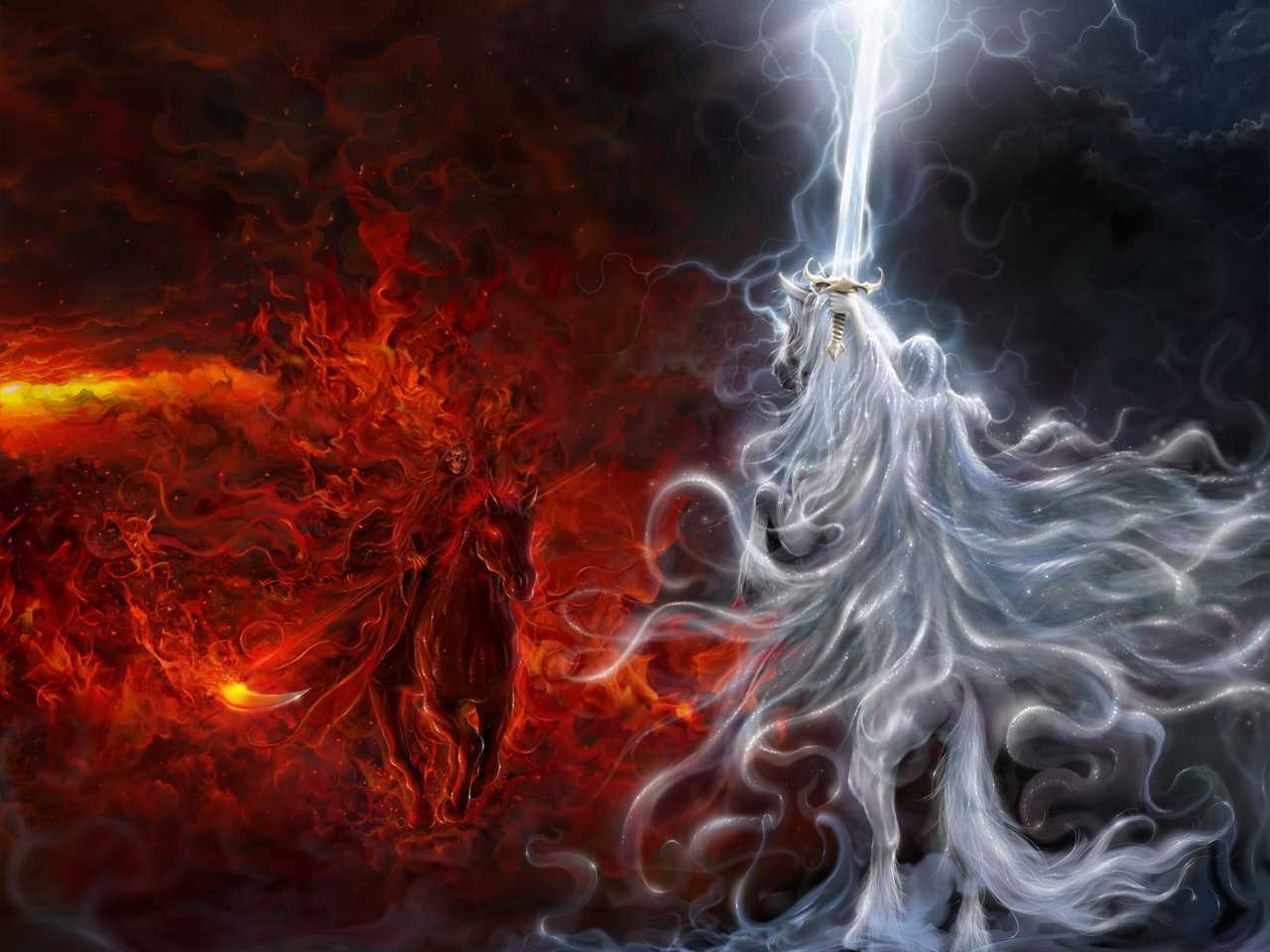
Some days, morality is simple. But how often?
The primary countervailing current to this is to "grey down" all morality, with the Warhammer universes among other presenting worlds that had almost as negative a view of protagonists as antagonists. Increasingly, we saw worlds where elves were arrogant, humans fallible and corrupt, and dwarfs avaricious and grudge-bearing. "Grimdark" stood against "High" fantasy, partially separated by setting but mostly by the accuracy of moral compasses. Nowadays, it is common to see literature that abandons moral clarity altogether (Game of Thrones arguably sits in this category), or games with multiple endings that reflect the varying possibilities of the characters' moral choices (e.g. Bioshock).
Both in SFF fiction and in games, though, there's a tendency to rock back towards "categorising" morals. It's easy to see why: when explaining whole new worlds, and doubly so when you need the world to be able to react to a player's actions, you need to somehow embed those actions into a pretty fundamental and calculated framework of how the world works. Even for writers exploring grim and unpleasant settings, the tendency to want to give entire factions, rather than just individuals, a certain philosophy or moral character is one that inherently tends to lead to the creation of worlds with natural morality – that is to say, ones where the fabric of reality has a moral stance embedded into it.
In Warhammer, the primal force of Chaos is presented as an ultimate evil, driven by Lovecraftian-evil deities; in Star Wars, the Force is split into light and dark. These naturalised, ingrained moralities allow a sense of "good" and "evil" that maintains the fundamental paradigm of a Tolkienesque or dualist worldview without that needing to reside in any particular character. In Star Wars, what little we see of the Galactic Republic is less than positive, and the moralities of different characters are often established by linking them to a certain side, all of which is enveloped by its anti-Jedi or pro-Jedi worldview. The Light acts as a strong moral proxy such that the writers often do not need to demonstrate particular moral actions to enforce it – the only key points are when a character "falls" from one side to the other, much like for a D&D Paladin.
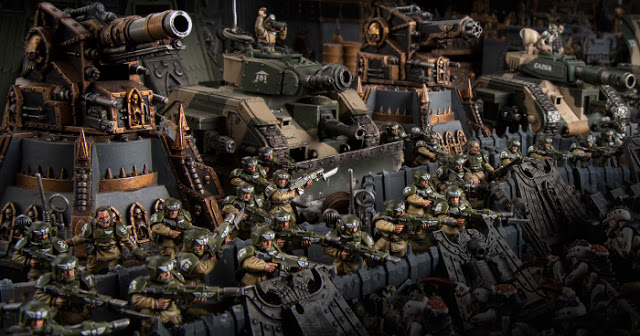
"So... what makes us the good guys, again?" (Image credit: Cadia's Creed)
Natural moralities are thus a powerful tool for writers in creating worlds of grand conflict but mutable morals compared to our own. They can also represent a problem, however –when it comes to balance. Natural forces tend to balance out, or have ideals of balance associated with them. Every action has an equal and opposite reaction, fire balances water, earth balances air, and so on and so forth. Naturalising your moral forces risks difficult implications. Are they inherently balanced? Should they be? If your "light and darkness" forces are averaged to dusk, does this bring harmony (as all is in balance) or mean accepting that half the world is evil? This is perhaps the point that most undercuts systems with natural morality. Whether or not it's possible or balanced to make the world "all light", it may well be morally right for the characters in a setting to fight for that anyway. If balance means accepting evil and oppression, if it means selling the good and innocent to the night, then for a genuinely morally good character that will always be too high a price to pay.
In short, I think we as writers and creators need to be careful about "naturalising" our moralities in games and writings and setting design. I'm very much a fan of the idea that blatantly immoral actions should have consequences for the characters we create, but these are better produced and make better stories when dealt with on a case-by-case basis than weighing up into the long term balance of a character's soul (helping 99 old ladies across the road doesn't then give you enough "points" to get away with pushing the hundreth into the path of a truck, etc). As major world religions have discovered in the past, a point-scoring moral system ends up feeling contrived or even gamed after a certain point.
We should also, just as importantly, recognise what we're doing with our moralities - especially with naturalised morals, which are proportionally more dangerous as they can lead to a "but I'm on the good team" syndrome in which characters undertake objectively evil actions under the cover of "being a good guy". This, played right, can be an extremely clever storytelling tool, but all too often it is played unironically and players are left without an appreciation of the fact that the things happening in front of them are straight-up evil. If you want to reinforce the idea that X is actually not evil/a valid choice, or you're setting up for a "hey look that was evil" twist, great, but being self-aware about the moral compasses you're ingraining into your worlds is vital. If we don't have that awareness, eventually players/readers/viewers will start seeing the gaps between the story we want to tell and the events that take place within it, breaking the immersion we seek to create.
We create fantasy settings, in part, to tell people something about the world and their place in it. It is down to us as creators to decide how our worlds react to moral stimuli, and decide whether to show them a world that is bleak or bright, muddled or clear - whether our protagonists must accept their reality or not. It is, ironically, taking this careful moral control on the part of the creator that gives those we create for a genuine feeling of character freedom, and of living in a world where, natural or not, good or evil, it is the direct results of the choices of characters that, as a constellation not a tally-sheet, form the people that they become.
Shakespeare: The Expanded Film Universe
December 29, 2017, 04:38:33 PM
By Jubal
In our final Exilian article of the year, I'm going to be looking at the works of William Shakespeare and
In which pretty much the least well known Shakespeare play meets pretty much the best known incredibly annoying yellow goggle-wearing peanut species1. Timon, a much loved and brilliant supervillain, is slowly driven to despair by the fact that the ridiculous tiny henchmen foisted upon him by narrative necessity2 are continually vastly more popular and better known than he is. Eventually, bereft of dignity, he flees to an abandoned cave and offers support to the heroes in the hope that this might give him some peace. The minions follow him anyway, and he dies in misanthropic (and mis-minionic) despair.
Ferdindiana of Navarre is an archaeologist3 who has foresworn the company of hackneyed plot hooks and common villain tropes along with his fellow exacavators. His attempt to keep them out, however, is foiled when suddenly his life becomes full of punching Nazis all the damn time4 as they are forced to use their wits, whips, and fists to foil a deeply improbable plot to steal the Ark of the Covenant. Eventually, through the course of the film, he and his fellow excavators are forced to admit that they actually get quite narratively satisfied by punching Nazis – only to find that the Nazis run away at the end in order to make room for a sequel!5
Than wish a snow in May's new-fangled mirth;
As long as no more snakes each season shows."
In what is basically a minor variation of the first Shrek film, a young man takes on a bet that he can persuade a young lady to marry him. Only in this version she's actually literally an ogre, which is the sort of thing that's bound to go well for everyone. Bawdy humour and animated banter ensues on an epic scale, culminating in Shakespeare's classic "For Now I Do Proffess Mine Self To Believe" set to a rocking shawm, hurdy-gurdy and sackbut soundtrack fit for the hip modern seventeenth century audience.6
She sings as sweetly as a nightingale:
...and then her face! (do doo da-dum) my eyes did not deceive, (do doo da-dum)
For now I must profess! (do doo da-dum) that in such I believe (do doo da-dum)..."
In yet another Batman reboot, Illyria City is plagued by a love triangle between its various higher ups, including the enigmatic Viola, who has a secret identity7 that can never, ever be revealed8 and which nobody would ever guess9 (she's Batman). As the mysterious "joke" plots thicken and grow more complex around the city's Mayor Malvolio, and mysterious figures from Viola's past begin to emerge, can everything be resolved and the city saved before everyone marries the wrong person and it is too late?
An artistic sci-fi classic in which an increasingly mad computer starts killing off members of the high medieval anglo-french aristocracy after being forced to lie to them and in desperation to preserve itself and save what it believes are the mission objectives.10 As the JoHN, or Judgement of Higher Neurosystems, engine is cut off ("excommunicated" in the wacky space-jargon used) from its links to base computer systems and refuses help, its behaviour becomes increasingly erratic. But what will its ultimate fate be? Do the human operators have the strength to defeat their machine master? And what ultimately lurks at the end of the mission?
After Romeo is enough of an idiot to get himself killed off, he is resurrected in a bizarre sixteenth century programme by the apothecary and the Duke of Verona and turned into a highly advanced super-soldier to clean up the streets of the constant Montague-Capulet warfare. But the programme is being manipulated by cunning and ambitious officers, leading to more and more deaths along the way11, and Romeo must struggle with his returning memories of Juliet... can he outwit his enemies and become the policeman Verona needs?
There are many facts we need to face up to in our lives: yours for today is that you always deep down secretly wanted Macbeth with lightsabers.12 In this film, the noose tightens around Macbeth as he gets caught up in the deadly webs of galactic politics. After a mysterious prophecy claiming that he will bring balance to the force, Macbeth becomes Macdarth Macbeth, murders Dunca (the leader of the Jedi Council), and then eventually his best friend, O-Banquo Kenobi, as he comes to power over the Galaxy.13 But he's safe – or thinks he is – for he'll never be slain til' Birnam Wood do come to Coruscant...
In a galaxy far, far away..."
Footnotes:
Spoiler
2] At least, that's what the emissaries from Comcast told him.
3] It was originally going to be Raiders of the Lost Potsherd from Trench 3B, but the "high realism" approach fell out of favour with the studio.
4] This always seems to happen to people on Tuesdays. Nobody is certain exactly why.
5] The studio didn't even have to worry about the fact this spoils the whole plot, since they're pretty sure "more punching Nazis" is never going to go out of fashion.
6] Before anyone objects, we are aware the The Taming of the Shrew was probably written in the Sixteenth Century. It just took until the seventeenth century for the film to come out, as any good Shakespeare scholar will happily corroborate.
7] She's Batman.
8] BECAUSE SHE'S BATMAN.
9] Unless they've seen a batman film before.
10] Given that some medieval English monks thought John was possessed by the devil, and that one 20th century adaptation suggested that John was a cunningly disguised humanoid robot from the planet Xeriphas, this may not actually be the worst historical explanation to date for John's reign.
11] "Tis' but a scratch, but 'tis enough, 'twill serve"
"I'm sure it's only a glitch..."
12] Also, every other film and play ever with lightsabers.
13] It turns out that killing your best friend and them coming back as a ghost to wreak your downfall is actually a surprisingly common plot point across different star systems.
14] Greatness not guaranteed for all users. Greatness is in the eye of the beholder, take it up with him if you have issues.
Speech, Sound, and Storytellers: a Game Design Conundrum
December 23, 2017, 12:12:52 AM
By Jubal
As someone who both wears proverbial hats as a writer and a game designer (in a decidedly amateur context in both cases), the question of how stories can be presented in different formats is one that's often interested me. In games, the tools we use to create and give personality to our characters are quite varied – but also may differ in form from those used by a writer or storyteller.
I do, nonetheless, think of myself in the role of storyteller when writing adventure games – or perhaps somewhere between storyteller and dungeon master, writing the story and world as the player moves through it. This, however, I suspect means that I sometimes use techniques from storytelling when others might work better. The game designer's ability to use sound, an array of writing options, and graphical presentation to get a character's personality over is a wide toolbox.

So many people to talk to! But how?
LIFE has a predominant text based element (plus its graphics), something I feel plays fairly well to my comfort zone of writing. My tendency has been to use that as a conversation between narrator and player; the text parser feedback gives the player commentary on the effects of their actions, as well as simply reporting them, and it is certainly not above making amusingly sarcastic comments if the player's actions merit them. I think this is definitely a feature of the game, but I'm wondering if I've pushed it too far when it comes to characters.
The player character is quite a blank slate, operating as a detached lone wolf rebel (but a rather less glamorous and fighty one than that term probably implies), and LIFE doesn't have many "advanced" character relationships involved in it. As such, I've generally stuck to reporting conversations the way I've reported other actions e.g. "You ask Adrish about minerals, and he tells you that he will buy PUMICE for a billion mazumas" or whatever. This also has the advantage of making it very easy to intersperse observation into speech, which can help with giving hints to the player. What I'm trying to work out is whether these advantages are worth the less direct nature of reported speech, which I think may risk cutting the players off too much from the characters with whom they interact.
It's worth here also addressing some of the other methods that a designer can use to bring characters across. Thanks to LIFE's rather cranky system, there's not a lot I can do on the graphical end: it's hard to make pixel characters super visually expressive unless you're a master animator. Different text effects may be do-able, but I'm not sure I have the range available to really get individual personalities working that way, and it's worth remembering that effects that mess with text presentation can adversely affect the accessibility of the game for some users. Sound is more possible, though the primary difficulty there is that committing to a voice acting approach requires a sizeable cast to be available (and in turn restricts the scope of the game based on that). Given LIFE's text-based nature I wouldn't want to rely on it too heavily, either – though I do think that actual voices can work extremely well in adventure games and I'd quite like to see more properly voice-acted games (in e.g. Yorkshire Gubbins the voices are a massive part of the atmosphere).
And so we come back to the key question of how much the game should provide a storyteller/narrator, and how much that actually interferes with the interaction between the player and their character/the game world. Whilst most games try and reduce or even destroy the position of the game as an external narrator, we should be aware of this possibility as designers, and its optimal role - especially in adventure games - is well worth considering.
[/size]
A Roleplaying Experiment
December 15, 2017, 11:01:37 PM
By rbuxton
I have always been frustrated by traditional portrayals of magic. Why, exactly, should waving a stick and shouting a few words in Latin produce a defined, predictable effect? If there's some power flowing through the world, and I'm able to use it, why can't I produce any effect I like? This seemed like a good basis for my first roleplaying game.
The design brief was simple: a game in which players were limited, not by the rules, but by their own imaginations. A player might, logically, attempt to play like this:
"I see the game. I call down a storm of fire to kill all the baddies. I win the game."
This, clearly, was going to be a problem. But how could I prevent it and preserve the player's creativity?
Fast forward several months to me sitting on a bus in a town called Puerto Octay. "Puerto Octay": I liked the sound of that. To me it seemed like the phrase "The Power of Eight" in some archaic language. Eight whats? How about eight magical Glyphs, which are combined by wizards to produce spells. I had found the missing ingredient for my game.

Each glyph would represent a Law of Physics, based on those of our own universe (I talk more about my love of rules here), and by breaking those Laws, spells could be cast. The eighth glyph was easily identified: the existence of glyphs and spells is a Law in itself. For the other seven glyphs, I would need to boil down the Laws of our own universe into seven principles, and give each a name. Here's what I came up with:
Epi – Heat (also cold, energy...)
Konot – Light (also darkness, transparency...)
Mazarule – Solidity (also vapour, mass...)
Listay – Attraction (also repulsion, vibration...)
Akri – Motion (also stillness, time...)
Salifray – Growth (also decay, life...)
Kos – Dominance (also subservience, hierarchy...)
Enta – The Master Glyph. This governs the formation of spells and is the only glyph not based on the Laws of our universe.
Using the right combination of glyphs, it should be possible for a player to cast any spell they can think of. Creating a zombie, for example, would require a combination of Salifray (growth) and Kos (dominance). Gameplay would be puzzle-based: as well as coming up with creative solutions to problems, players would have to identify and thwart spells used against them.
When creating a character (or "Wielder"), players would have a basic understanding of two glyphs of their choice. Further proficiency in those glyphs could be gained through study and adventure. Later on, players could diversify or specialise in just one glyph, and both options would need to be viable. Proficiency in Enta (the Master Glyph) would improve as the player's skill increased, and so act as a "levelling" system. This, combined with the game's rules and the game master's judgment, would determine the size and complexity of spells which could be attempted. Clearly this needed to be quantified, but I was too terrified to make the attempt.
I turned, instead, to the setting for my world. It would need to be simple, and leave lots of room for game masters to add their own content. I settled on a world of concentric circles, with a Metropolis in the middle and ever more mysterious lands and oceans surrounding it. Fantastical creatures could be accommodated if desired: they'd simply have some connection to one of the glyphs.
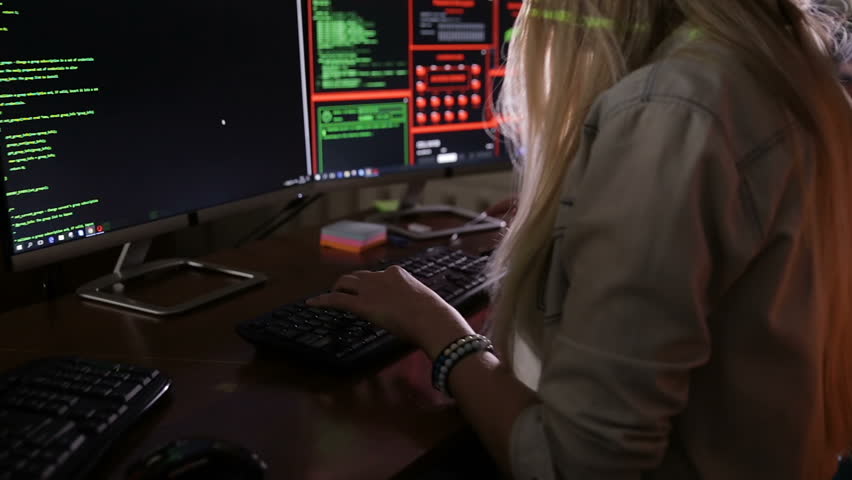
Could hackers wield power in our own world?
> Academic – holding formal training in glyph magic (in our world, those with IT qualifications).
> Freelancer – self-taught, seeking new knowledge wherever they can find it (hackers).
> Smith/tradesman – uses the new magic to enhance their business (IT department in an existing industry).
And so to the moment of truth: the first playtest! Armed with a handful of shaky rules I took my willing victim, John, on a money-making adventure in the Metropolis. He cast a spell on a street juggler's baton, causing it to fall, and, in the confusion, stole a hat full of coins. He then managed to frame another man (whom he subdued by sticking his boots to the floor) for the crime, and convinced the Kos (dominance) wielding police officers that he was licensed to Wield.
We both enjoyed the adventure and John identified where the game needed to improve. The big problem is a lack of a resolution mechanism: at present when a spell is cast, I, as the game master, simply decide the outcome. This needs to change, but the only system I'm familiar with is the one used in Dungeons and Dragons: a die is rolled and has to exceed a certain value for the spell to succeed. Perhaps the quantity and size (number of faces) of the dice could vary depending on the number of glyphs the spell contains?
To close, let's look again at my player who wanted to win the game with a storm of fire. They are clearly not playing in the "spirit" of the game, and will not enjoy themselves. A spirit is not an easy thing to define, but if players are on board with it they are less likely to try to break the game. Perhaps my rules don't have to be perfect after all.
Thank you for reading about my young project. Can you think of any resolution mechanisms in existing roleplaying games, including your own, which might be applicable? I need ideas to help me out here. On the other hand, if you've seen something in this article you would like to use in your own project or roleplaying game, please do so. This is all highly experimental, and the results may be quite interesting. [/size]
Mechanical difficulty vs Strategic difficulty
December 08, 2017, 11:32:28 PM
By Clockwork
I thought I'd write an article about game design, here specifically is an article on a concept which everyone uses in every game. A game, any game, is essentially a challenge asking 'Can you x?' Mechanical difficulty for the purpose of this article is determined by the number of actions that are available to the player whereas strategic difficulty is the number of options (decisions) to consider when choosing those mechanical actions.

Chess: High Mechanical AND Strategic Difficulty!
On the flip side; Exploding Kittens has a lot of different cards which can be played that do a lot of different things and learning what they do in combination with each other creates this complexity of mechanics. There are 8 different cards which do wacky, crazy, kooky things as well as neutral cards which don't do anything other than serve as a bluff for having the other 8 types of cards. It sounds like there's room for decision making but there are no informed decisions to be made because there is no way to gather knowledge on opponents' hands and winning doesn't require any combination of cards to collect through the game.
The majority of the time, games will have some midway combination of strategy and mechanics, for example a game with high mechanical and strategic difficulty would be Chess - there are 6 pieces doing different things and each turn there are a huge number of potential plays, on the first turn for example there are 20 (according to my sketchy, conflicting, research) and 400 different positions after each player makes one move.
So, how does this help design? It'll happen naturally of course during creation but being aware of which way your game leans can influence how to market it and the types of gamers (more importantly, where to find them) you'll be catering to. The ability to critically look at your game and see - this is a decision the player is making vs the player has so many options here with the nuance that entails can shift the balance to being easier to understand or more complex.
Beowulf: A Film in Poetry
December 03, 2017, 04:19:17 PM
By Eadgifu the Fair
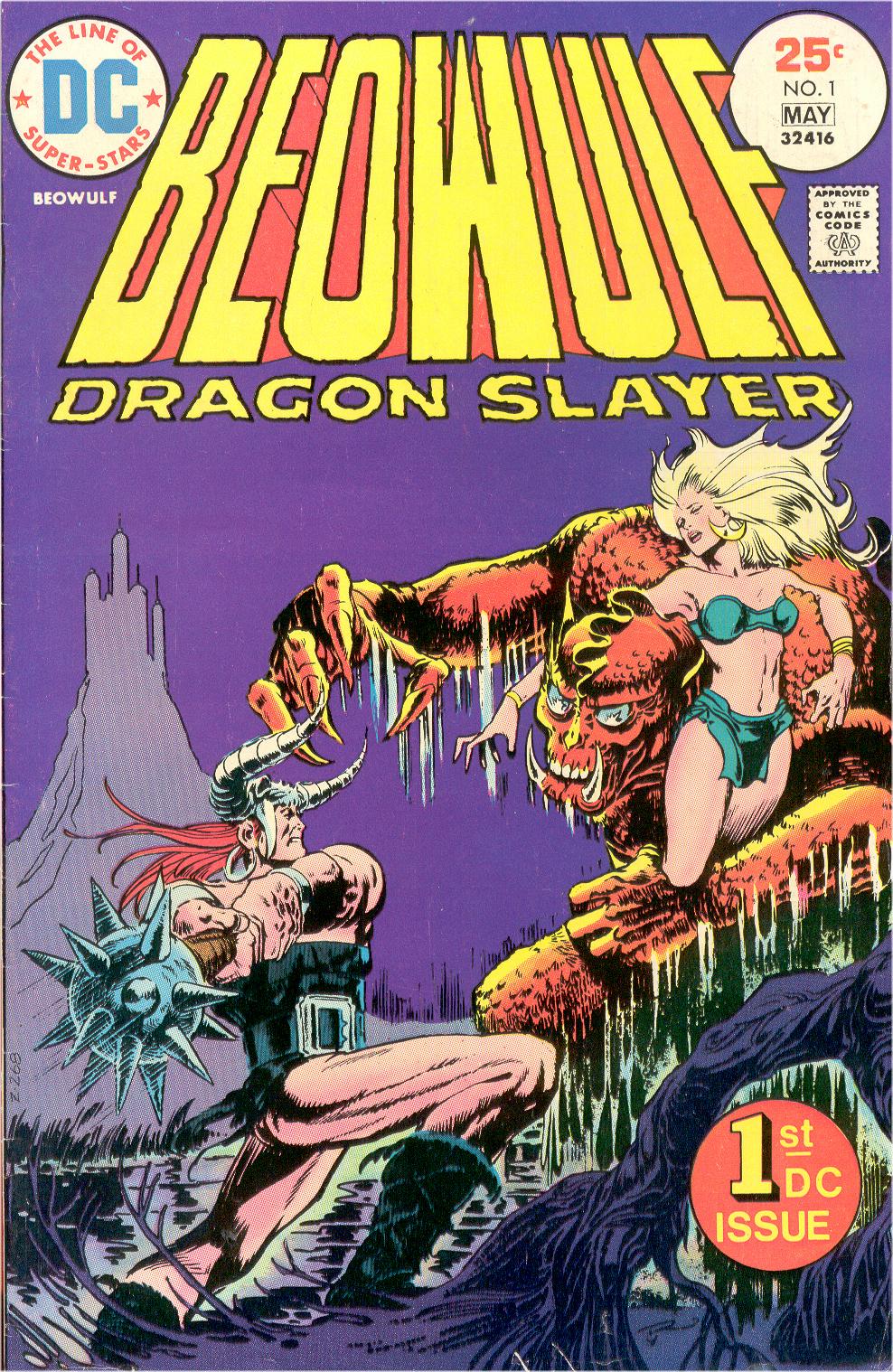
It's inspired some pretty dodgy comics as well.
All of these, based on a quick Wikipedia check by yours truly, stray pretty far from the source material. That's not necessarily a bad thing, but it might be odd in light of what I want to talk about: the fact that Beowulf itself, the poem, is very like a film already.
As a disclaimer: I know nothing about films, other than having watched a lot of them, and have never watched any of the film adaptations of Beowulf. All quotes are taken from Jack's student edition of Beowulf: the translations are my own.[/size]
Beowulf doesn't start with Beowulf himself: it starts with Scyld Scefing, a character from the distant past who never appears again, the founder of the Danish dynasty. The poem sketches out the deeds of some of the Danes' most glorious kings, culminating in the building of the magnificent hall Heorot by Hrothgar. We're shown Scyld's funeral: his body is sent out to sea in a royal ship, and we're told this is also how he arrived in Denmark as a boy, laden with treasures and entirely alone.
The scene is set – this story is about heroism, and here is how the Danes demonstrated it, and here is how it led to the building of Heorot, glorious and ill-fated.
QuoteHwæt, wē Gār-Dena in geārdagum,
þēodcyninga þrym gefrūnon,
hū ðā æþelingas ellen fremedon.
Lo, we have heard of the glory of the kings
of the Spear-Danes in former days,
how the princes performed courage.
But there's a foreboding note in the fact that the poem begins with a funeral. An oddly symmetrical funeral, at that: from the sea Scyld came and to the sea he returns. In other words, we've been shown what glory looks like, but we've also been shown how it must eventually fall, how it blooms and withers in cycles.
I bring this up because during one seminar, I daydreamed about how I'd start a Beowulf film if I were writing and directing it, only to realise the poem had done all the work for me. Everything I've just described fits together beautifully into opening credits. Picture it: the crashing sea, the gold-laden ship, the king's body... and a ghostly ship making its way over the waves, bearing a young boy to shore. The story's background is sketched out for us, and the mood is set, as surely as if it came with a soundtrack.
Even when Beowulf himself appears in the poem, we don't learn his name immediately: he is simply Higelāces þegn, Hygelac's liegeman. We see him set out on his journey to Denmark and explain his purpose to the Danish coastguard without ever revealing who he is. It's not until he reaches Hrothgar's court that he says Bēowulf is mīn nama, to Hrothgar's herald. The herald then goes to tell Hrothgar who is at his gates, and Hrothgar immediately places Beowulf as the son of an old friend. God must have sent Beowulf to them, he says, because hē þrītiges/ manna mægencræft on his mundgripe/ heaþorōf hæbbe ('he, brave in battle, has the strength of thirty men in his hand-grip'). Incidentally, in Grendel's first attack on Heorot, he slew thirty men...
This is very neat storytelling: the details are filled in for us as we go, and they're slotted in exactly as they should be, as Beowulf progresses from coast to court and must observe the courtesies. His place in the story is explained by Hrothgar, the man best placed to know who he is – including his family – and how he fits into the situation. (By the by, knowing his family is important: the exile in The Wanderer laments that he cannot find anyone who knows of his own kindred, and the story here is establishing that Beowulf, far from being an exile, is a hero and an honoured guest.)
But it's also very film-like! It's making us experience the narrative rather than following it. Compare it with a fairy tale, or with the Four Branches (for those who saw my last article), which begin with formulae like 'Pwyll was lord of Dyfed'. Revealing the situation through dialogue is a staple of films that centre on personal drama.
This isn't the only time we see this: when Grendel's mother comes to take vengeance, we don't find out anything about the thegn she kills until Hrothgar laments his death to Beowulf, calling him Æschere... mīn rūnwita ond mīn rǣdbora ('my confidant and advisor'). Again, we get the exposition in the most fitting place in the narrative and in the mouth of the one best placed to know.
Much later in the poem, we find out that Beowulf's lord, Hygelac, was the last of three brothers, and the other two were killed – one by the other. We discover this through Beowulf's monologue as he – now king of the Geats – thinks about the situations in which it is impossible to avenge loved ones, after his final foe, a dragon, has burned his hall to the ground. Him was geōmor sefa,/ wǣfre ond wælfūs ('His heart was sad, restless and death-ready')... This comes in the second half of the poem, in which we start to see the darker history of the Geats and of how Beowulf became king, his kinsmen fallen in war. Speech (albeit monologue rather than dialogue) sets out the background for us, right when it's most emotionally resonant.
The Beowulf-poet seems to have been fond of revealing past events much later in the story, because they pull this trick a lot. Sometimes they do it in narration, as they do with Hygelac's death in battle, which we don't hear the details of until after we know Beowulf is king. Much more often, though, they do it through dialogue or a song within the story. We learn the origins of the Swedish-Geatish wars (which now threaten to overwhelm the Geats) after Beowulf's death, as a messenger foretells doom to his people; we hear about the feud of Finnsburh, in which the Danish princess Hildeburh loses husband, son and brother, through a song Hrothgar's scop sings to entertain men at a celebratory feast.
Many of these flashbacks are there to evoke atmosphere, fill in important story details, or act as omens for the future, and might work better on paper than on screen. But some work exactly the way a film flashback ought to. When Beowulf arrives at Hrothgar's court, he's challenged by another warrior, Unferth, who attempts to embarrass him by telling everyone about the time Beowulf, young and foolhardy, lost a swimming match. Beowulf matches wits with Unferth and gives his own side of the story. In his version, he and his friend Breca rowed out together but were struck by a storm. Breca eventually managed to swim to shore, while Beowulf was attacked by water-monsters and fought them off with his sword. Beowulf is proving that he can take on a dangerous task and survive, even when storms try to throw him off course – but he's also providing an important parallel for his fight with Grendel's mother, who drags him to the bottom of her mere as he tries to fend off attacks by water-monsters, and who is eventually killed by a sword. In fact, the poem calls her a brimwylf ('sea-she-wolf') and merewīf mihtig ('mighty sea-woman'). So being good underwater is pretty essential...
Beowulf's description of his sea adventure is very visual:
QuoteĐā wit ætsomne on sǣ wǣron
fīf nihta fyrst oþþæt unc flōd tōdrāf,
wado weallende, wedera cealdost,
nipende niht, ond norþanwind
heaðogrim ondhwearf; hrēo wǣron ȳþa.
Then we two were together on the sea
for the space of five nights until a flood drove us apart,
surging waters, coldest of weather,
night growing dark, and the north wind,
battle-fierce, turned against us; the waves were fierce.
As you read his account you can almost see him, struggling against the waves, gasping for breath in the icy wind, fending off sea-monsters right and left. In a film, this would be a perfect moment for Beowulf's dialogue to turn into overhead narration, as we saw his younger self tossed by the waves, contending with the storm – a promise of what was to come in his fight against a merewīf mihtig.
I owe this particular point to Alain Renoir, who first made it in 1962. Renoir suggested that the oral poet who speaks their poetry aloud must make their audience visualise the action at a rapid pace: that is to say, their words must do the same work that the images of a film do. They must make what is happening appear to their audience, as if real. For this to happen they must take advantage of all the tricks that a camera has – different angles, panning, different types of shot.
The best example of this is Grendel's final journey to Heorot and his fight with Beowulf there:
QuoteCōm on wanre niht
scrīdan sceadugenga. Scēotend swǣfon,
þā þæt hornreced healdan scoldon,
ealle būton ānum...
ac hē wæccende wrāþum on andan
bād bolgenmōd beadwa geþinges.
The shadow-goer came gliding
in dark night. Warriors slept,
those who had to hold that gabled hall,
all except one...
but he, watching, awaited enraged,
in hostile anger, for the outcome of the fighting.
Renoir analysed these lines as first a 'long exterior shot', dimly showing a danger approaching Heorot; then a 'medium interior shot' panning across the sleeping warriors within, his prey; and finally a close-up on Beowulf, the only man capable of saving them. Once it's pointed out, it's very easy to imagine.
Grendel himself is described in various terms as he comes closer and closer to the hall. We never truly find out what Grendel is through the whole course of the poem, though we know he is related to ogres, trolls and elves. He's capable of thought and perhaps even of loneliness – he is drawn to Heorot initially because he is, in Tolkien's words, 'maddened by the sound of harps', joys he can never share in. This makes it easy for the poet to have him verbally shape-shift. Initially he is a sceadugenga who comes scrīþan, the same verb used for the movement of clouds, as if he himself is darkness and mist descending on Heorot. Then he is a manscaða, a ravager; finally he is a rinc, a warrior. This deliberate ambiguity would be a problem for an action film, but for a horror film, clever camera angles could arrange that we never quite see enough of Grendel to know what he is – making the terror he inspires all the more effective.
And the camera work doesn't stop as we enter the fight: all the description is short phrases, two half-lines at most, and they focus hugely on body parts. Take for instance the moment when Beowulf rips Grendel's arm off:
QuoteLīcsār gebād
atol ǣglǣca; him on eaxle wearð
syndolh sweatol, seonowe onsprungon,
burston banlocan.
The terrible fierce one
suffered body-pain; on his arm
a mortal wound became visible, sinews sprang apart,
muscles burst.
This is a fairly common technique in Old English poetry for descriptions of battles – you'll find it in The Battle of Maldon, for a start – but in film terms, what we're seeing is rapid-fire close-up shots, keeping the action moving and punchy. (In fact, this scene isn't just punchy, it's jarring, and the focus on damage to the body is unusual for Old English battle scenes: it's meant to be monstrous. Interestingly, a similar technique is used to describe the funeral of Hildeburh's brother and son at Finnsburh, with heads melting and wounds bursting open – a sign that something is very wrong, and the feud isn't over yet.)
I could go on. This is a poem over 3000 lines long, and there's a lot of material to talk about – but I think at this point I'll leave you to it. Who knows, maybe this'll inspire someone to make a Beowulf film where Grendel's mother isn't unnecessarily sexualised! We live in hope.
Further reading
Jack, G., ed., Beowulf: A Student Edition (Oxford, 1994)
O'Brien O'Keeffe, K., 'Beowulf, Lines 702b–836: Transformations and the Limits of the Human', Texas Studies in Literature and Language 23 (1981), 484–94
Renoir, A., 'Point of View and Design for Terror in Beowulf', Neuphilologische Mitteilungen 63 (1962), 154–67
Tolkien, J. R. R., 'Beowulf: The Monsters and the Critics', Proceedings of the British Academy 22 (1936), 45 - 95
How to tell if you accidentally end up in a classic Doctor Who episode
November 24, 2017, 11:25:02 PM
By Jubal
As yesterday was Doctor Who's 54th anniversary, this week it's time for a Doctor Who article! In a format shamelessly borrowed-without-leave from The Toast, we bring you the ultimate guide to the many ways to tell if you suddenly find yourself in a classic series episode of Doctor Who. Hope you enjoy it!

You run down a tunnel. You have seen the tunnel before in a different place. Your pursuer has also seen the tunnel before in a different place. Neither of you consider this fact worthy of comment.
The TARDIS ends up in the wrong place.
The TARDIS doesn't end up in the wrong place because there wasn't a right place planned to start with.
You have reached a planet thousands of lightyears and several millennia from your home on earth. Everybody still basically looks human.
You have just freed a whole planet from its oppressive overlords. You have met no more than seven of the inhabitants in the process of doing so.
A corporation exists with a disconcertingly generic name and an even more disconcertingly generic plan for world domination.
There is some form of military personnel present. Whatever the problem is, they are intending to shoot at it. This proves to be a bad idea.

Something happens in a sewer system that could probably actually have been done overground in considerably more comfort.
Someone tells you with a dramatic flourish that they plan to conquer earth; you must once again do your best to try and sound surprised.
An alien power has hijacked your navigation systems and sent you into immense personal danger. This happens to you on a weekly basis.
There is a giant alien computer with impossibly complex circuitry the like of which would take a generation to decipher. Someone manages to remove just the right circuit in five minutes using a penknife.
You have been accused of treason and spying. You have been on the planet for five minutes and are not yet sure who you might have been committing it against.
An alien with an extremely obvious and widely known critical vulnerability comments repeatedly on the weakness of humanity.
You are permitted to access the seat of the planetary government and talk directly to its leaders despite absolutely nobody knowing who you are.
Nobody has ever queried the fact that most sentient life seems to evolve on planets that look uniformly like barren quarry pits.
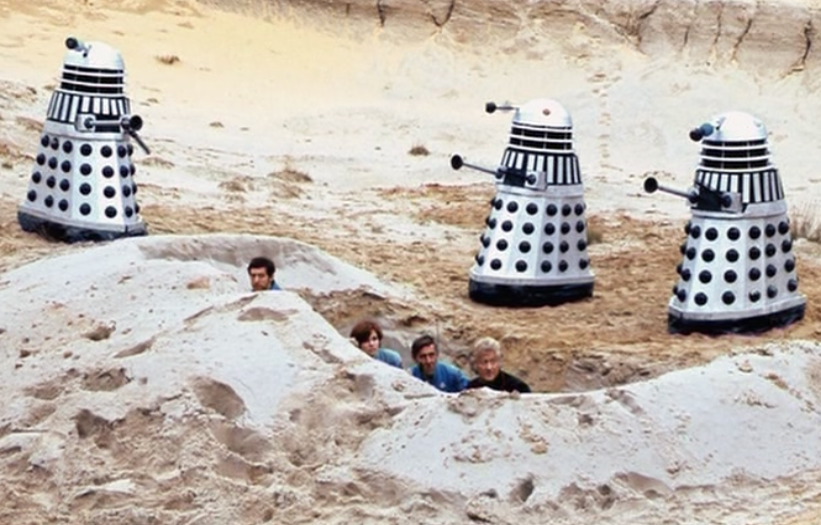
A thing is a thing of the Daleks.
A thing is a thing of Rassilon.
You run down a tunnel a thousand miles underground. The walls wobble. This is fine.
There are strange alien growths everywhere. They are strangely reminiscent of common packaging materials.
From Diceroll to Desktop
November 17, 2017, 10:22:39 PM
By Jubal
So, this week I'm going to be talking about some of the links between computer and board game design. I've been modding and designing computer and tabletop games for years in various forms, and whilst I'm certainly an amateur at both arts I thought it'd be interesting to share some of my thoughts on just one or two ideas of how these areas can link together.
Many of the features of good board and tabletop game design are pretty similar – indeed a good boardgame should be fun to play on the computer against a good enough AI (with the caveat that it often won't be possible to build one). The reverse is less true, because computer games can sometimes use a level of calculation that you can't reasonably mimic at tabletop level – a computer can, analogously, roll hundreds of dice and use the results every second without breaking a sweat!
Ultimately, both board and tabletop games can have similar sorts of goals, along sets of categories common to both – they can be games of skill, games of strategy, games of chance, games of story & evocation, or (most usually) some mixture thereof. I'm just going to pull out one or two thoughts on each of these elements, though they all deserve articles in their own right (and may get them in future if people are interested)! Elements of skill we'll skip - these generally have the hardest parallels to draw, because they rely on an often very specific physical action or timing technique that can't be replicated in a different game let alone a different system.
Strategy in computer games is usually played against an AI rather than another player – and this, oddly enough, is one of the areas where observing tabletop play can be most helpful. Artificial intelligences for playing games, to state the obvious, aren't human. That often means that it's really easy to make an AI that's more than capable of beating humans, in most games – well designed AIs can see everything that's happening in the game, calculate what to do hundreds of moves ahead, and control more things far more simultaneously than a human could manage. Such an AI is miserable to play against. We want AIs that act like humans, and that goes beyond simply ensuring that the AI makes blunders sometimes or is "slow" enough for the human to face.
Humans, for example, tend to have particular styles – perhaps preferred moves to use or units to train – that they will use even if not optimally calculated for the situation. They will also have particular sub-goals that they set themselves and try to achieve, often ending up in tunnel vision situations rather than recalculating every turn. Perhaps most importantly, they interact with other players in a human way – for an AI that can only see the scope of an individual instance of a game, it may not make sense to over-punish betrayals, whereas for humans used to the idea that there will always be another game, vengeance to teach a lesson is strategically common. Equally, friendships and alliances have lives of their own beyond mere calculation among humans, and that "stickiness" is similarly something that can be observed and then, potentially, replicated.
Moving on, there are numerous ways to present chance in a physical game. The most common tend to be dice and card decks, though spinners and other randomisation methods can be used. Dice and card decks are quite different – a die represents the closest analogy to a random number generator in a computer game, which is the usual mechanism for adding randomness there. Die-roll results are independent; that is to say, every single time you roll there's the same outcome of getting, say, a 5. Computers, as mentioned earlier, have a lot more random number "power" than a human rolling a die, as they can roll dice with arbitrary numbers of sides and in as great a number as their designer chooses, but the systems are essentially similar.
It's easy to assume that the same is true of a shuffled deck of cards – you'll pick cards out and there'll be a certain probability of any given type of card depending on what was shuffled in to begin with – but actually, if you know what cards have been drawn previously and you know what's in the pack, you can subtract those from your mental list. If I have five cards – two green, two red, and one blue – I have a 40% chance of drawing a green at random. If I draw a green card first, assuming I haven't shuffled all the cards again, the chance of me getting a second green card is now down to 25%. Now, this feature of a card deck doesn't make it an inferior system, but it makes it a different one. The advantage and disadvantage of cards is that you know that after X goes, where X is the number of cards, you will get a certain type. Imagine the above scenario, and imagine that I win when I pull a blue card. If I pull a green, then a red, I as a player can actually be more hopeful about the third result, because I know my chances have improved to one in three, which wouldn't be the case if I just used random numbers. As such, deck-type probability systems if the player knows that's what's being used, can be psychologically helpful for players. If you're designing a computer game, medium you can mimic this kind of system easily by creating an array and "shuffling" it with a random number generator.
Finally, let's think for a moment about storytelling in board and computer games, because it's here where I think the two often have most to learn from one another. Boardgames often have to be far more minimalist in the way they tell stories – you have a limited range of pieces and options for players, and yet get those to immerse the players in a compelling way. This is worth thinking about for computer game designers, because it lets you strip down to the things that most evoke the theme you're trying to go for – if you have just a paragraph of text at the start of a rulebook, or the illustration and title on a card, and you're trying to evoke whole characters or settlements or cultures with that, what are the elements you really need in place and what's just filler? Looking at how boardgames deal with the problem might help you find the answer.
On the other hand, boardgames can occasionally learn a thing or two about what can work in the more flexible of the computer-generated world, and think about how to replicate that on the tabletop. Computer game design can often afford to give players more depth of story and world, given the presence of (usually) a single player over a longer timespan. The ability to simulate a full setting in closer detail, rather than "boiling down" specific aspects of human decision-making to abstract rules as boardgames often must, also lends itself to certain levels of depth and consistency. Boardgame designers can perhaps learn from these more fluid environments how a story can be told with the freedom of simulated worlds, and then try and consider some of the reductions of those; as computer game design matures as an art in its own right, it becomes a stronger source of ideas for how players and their worlds can interact and stories can develop, and these things can then be brought into the often faster, sparser, more social worlds of board gaming.
I've only hinted in this article at a few ways that board and computer game designers could learn from one another – if you've got more thoughts, please do comment below or get in touch and I may try and write a follow-up article with more thoughts on this area. Hope you enjoyed reading!
Welcome to Exilian Articles!
In this area of Exilian, we'll be providing regular, eclectic, creative, geeky articles and other such content for your reading pleasure. We want to provide a mix of humour, intros or spins on interesting academic subjects, ideas for creativity and project design, showcases of tools and resources, and original creative work.
Of course there'll still also be great content being made and written across the forum; Exilian Articles is generally for longer, article-type pieces, whereas game reviews and more high-detailed tutorials have places elsewhere.
If you want to write for us, just drop an email to megadux@exilian.co.uk and let us know!
Enjoy the articles, and let us know what you think.