
The Bones of Earth 4: Making Maps
March 23, 2018, 11:03:53 PM
By Jubal
Whilst the first three parts of "The Bones of Earth" have dealt with features and how to make them realistic, this will deal with some of the first steps towards actually creating a map for a fictional setting, specifically the overall layouts one could go for.
Single Countries
For some condensed settings, you only need a map of a single country, county, principality, island, or similar. Of course this is very setting-dependent, and it risks restricting your room for maneuver if you're literally not going to plan out more than the absolute minimum land area you need, but there's also something to be said for having a neat, compact setting that's proportionally much easier for your reader/user to get their head around. If it's a pre-modern setting you may need to cover for why national borders are where they are. Rivers, mountains, and coasts are all traditional, though in the case of rivers it's also worth remembering that river valleys often grow fairly culturally similar on both sides: maintaining a really hard border down the middle of a valley may not make a lot of sense for the people living immediately on either side. For a map of this scale, you're more likely to want to work out details of settlement and road positioning carefully - something we'll come back to in future articles.
The East-Facing/West-Facing Generic Continent
The principle here is simple; you have the continent on one side of the map, bounded by mountains or an impassable desert or unknown lands, and on the other it's bounded by sea (usually with further desert/mountains in the south and ice/mountains in the north. Examples of this include Narnia, Middle Earth, Calradia (in Mount & Blade), Memory/Sorrow/Thorn by Tad Williams, Guns, Swords and Steam (my RPG), The Inheritance Cycle, Bletsungia (another world of mine), and the list goes on. Europe, the USA, and China can all pretty much fit this in the real world, which explains its popularity partly. Historically having the sea in the west (Tolkien style) seems to be more traditional, though the east (Narnia) isn't uncommon either. I'm not sure I've ever seen a north/south faced variant on this, though I don't see any particular reason why one shouldn't exist.
The advantage of this generic continent style is that it combines a sizeable land area with effective, natural-looking boundaries that prevent characters from needing or wanting to go far beyond the compact setting. This is somewhat unrealistic, of course, but not entirely so - large barriers like the Sahara have historically been difficult for most people to traverse, though it's worth noting that trade still very much existed and that the presence of large mountains or some tundra certainly doesn't mean that you'll end up with ethnic monocultures on either side.
The Archipelago
This is a pretty good alternative to a continent with a particular facing. Earthsea is the most prominent example, though there are large numbers of others. The major advantage of archipelagos is that they allow for very restricted geographical biomes and areas; this is excellent if lots of small political units are desired, or if large variations in wildlife or plantlife are needed in the setting. Of course, the requirement for transport is also a factor; if you want huge tribes of horsemen sweeping across wide open plains they're going to have trouble on a landmass five miles wide. Conversely, if you want naval journeys and warfare to feature in a setting, an archipelago really lets you go to town and make those a major part of your world in a way that's less plausible in more continental settings.
The Central Sea or the Great Plains
These are another two continental possibilities, both probably under-used. A Great Plains setting, with little water and no obvious sea, runs the risk that such areas rarely had much in the way of settled city-based cultures for much of their history. That said, nomads are pretty damn cool, and a setting that had more of a focus on areas where there weren't the resources for larger settlement could work well. A Central Sea setting, with water surrounded by land, is another interesting idea; essentially most of fantasy writing focuses on inland cultures which happen to eventually reach the sea, but a setting where the sea was in itself the major resource needed would mean that the divide between inland cultures and those on the shore (littoral cultures) would become more prominent.
The Planetary Map
A planetary map is a fairly large undertaking, and in many traditional fantasy settings doesn't necessarily make all that much sense – if there's no reasonable way for your heroic queen with her army to get to the other side of the world, there's no need to focus your reader on a ton of places they don't in any sense need to know about whilst losing detail on the places you really want. Nevertheless, for characters going on Marco Polo-like quests or in sci-fi worlds where air travel is easy it can certainly be useful. Generally the number of continents is up to you; you can end up with a bizarre super-archipelago if there are too many. Remember that if there are too few, you probably will end up with some inland seas etc or at least huge deserts in the centre of your vast landmasses. Thinking in plate tectonics terms is far more important at this scale; mountain ranges will go in long lines, ultimately landmasses will border each other at some sort of plate boundary. Looking at maps of prehistoric earth and the different forms the landmasses took is a really good plan here.
Real World Plus
Something I haven't really talked about in the other articles is the fairly obvious fact that you don't need to change the fundamental geography of the real world at all if you don't want to. This can still lead to a number of possibilities – for example, major climatic change, adding wasteland or megacity areas, moving bits of landscape, simply wiping all the cities off the map and putting new ones in instead, etc etc. Sea level rise is an interesting one which can lead to an eerie "familiar yet different" feel for a map, as is the obliteration of large parts of it in nuclear wars. These ideas are used in a lot of sci-fi (Judge Dredd, for example) and Steampunk (Girl Genius includes Paris and Britain, and is primarily set in what is presumably roughly Germany) stories, and some fantasy too though this is a little rarer compared to a "hole in the world" idea where fantasy stuff invades our world or vice versa.
Star Mapping
Star maps are in some ways easier and in others more difficult than a planetary or terrestrial map. The bad news is that it's harder to know where to start; the good news is that it matters very little! All interstellar distances are so large it makes little real difference as far as the world's inhabitants are concerned. Generally the only advice I can give is to not be too regular or too spread out; have clumps (which will probably be the areas where interstellar civilisations can expand) and also gulfs.
With star maps the other thing to consider is size and depth per planet/location. Authors often spend years if not a lifetime mapping the detail of, say, a continent or even a country, let alone a whole planet. If you're taking on the job of literally constructing a whole galaxy, you're going to need to cut corners. Ways to do this; firstly, have very low population densities (this is surprisingly uncommon but I did it with Cepheida). This means that you only need to deal with a small inhabited area on each planet and many planets won't have inhabitants at all. Good for exploration-based ideas, but less good for giant interplanetary war scenarios where billions die each day blah blah etc. The second solution is to assume that a planet is just one biome. I did that with Cepheida as well, but it's also been done in pretty much all the big sci-fis such as Star Wars (Tatooine is a "desert planet", Coruscant a "city planet", Dagobah a "swamp planet", with little indication of variation, unlike on earth which happily has deserts AND swamps AND cities AND icecaps). It works well as long as you don't question it too much, but if you want something believable it may not always be the best plan. Solution three is just to not ask tricksy questions or, depending on the project, to do the "you can make YOUR OWN world, dear reader/player/etc" option.
So there you have it - a range of basic options and ideas for how to lay out your maps. I'm not sure what the next article in this series will be exactly, so do comment if you have preferences - either one on settlement growth and placement, or the importance of rivers and water systems, might be a good next step I think. As ever, I hope you enjoyed this, and do stay tuned for more!
An Unexpected Bestiary: The Second Parchment
March 18, 2018, 05:37:27 PM
By Jubal
So, I was hoping to get a few more bonus articles than we're going to end up with today, but hopefully this will be a reasonable offering - moving on from An Unexpected Bestiary, my previous article discussing some interesting and lesser known real creatures and thoughts on how they could inspire creativity in game design, creative writing, and beyond, I can now proudly present The Second Parchment, a continuation of that article with seven more bizarre and wonderful creatures. Some of these you may never have heard of: others you'll be familiar with, but hopefully I can show them to you in a different light. Read on to discover more...

The quoll is a marsupial (well, one of six species of marsupial) roughly similar in build and ecological niche to the mustelids of the rest of the world. The name has aboriginal roots – early settler names like "spotted marten" or "marsupial cat" were dropped in favour of the more distinctive word. Solitary hunters and scavengers with a powerful bite, the smaller species eat small mammals and frogs, whereas the larger ones can take on birds and slightly larger mammals like echidnas.
The quoll could have a lot of fictional uses similar to a weasel or stoat – they're a good "exotic mage's familiar" option, and their spotted appearance gives them a very particular and striking look that differentiates them from a marten or polecat. If you're willing to play around with their behaviour, size, or biology, there's a lot more you could do with them – a giant one, or a pack of large ones, could be a pretty interesting threat to a character. Whilst I'm not aware that you can train real quolls very easily, I can imagine they'd also present a fun twist on "sneaky animal sent in with enough smarts to steal keys and pick locks", if you've used monkeys one time too many for that.
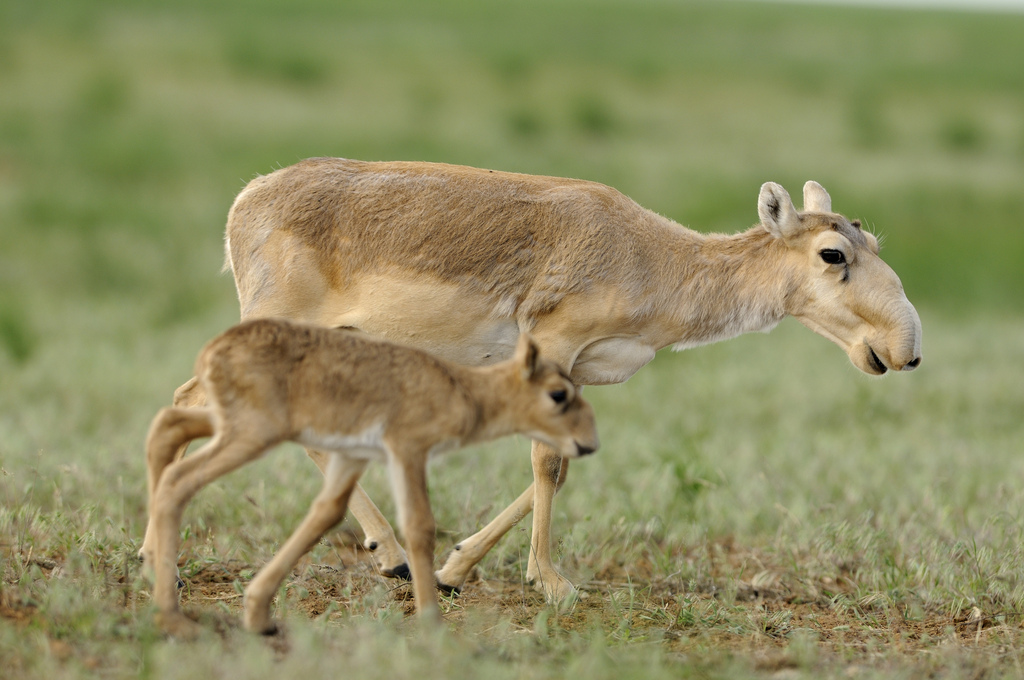
The Saiga is a small, critically endangered species of antelope from the central Asian steppes – only around 50,000 are left after a major population crash in the past few years. They are best known for their bizarrely shaped face, with bloated nostrils that help filter out dust and cool the animals down in the summer months. Males have impressive horns, and the species lives in large, highly mobile herds – their main defence against predators and natural disasters is simply to move on to literal pastures new.
The Saiga have traditionally been hunted – the Chinese population has now been entirely wiped out – both for their meat, and for their horns, which are used in Chinese "traditional medicine" much like rhinoceros horns are and can sell for large sums of money. Steppe antelopes like this are definitely an option for hunted beasts. I think the distinctive look and relatively small size of the Saigas could make them a fun mount for some sort of little folk in a fantasy setting: unlike a lot of antelopes, they look sufficiently different and alien to creatures we know better that it could really mark out riders as otherworldly.

The Mata mata is one of the most bizarre looking vertebrates on the planet. It's a South American freshwater turtle with a huge head triangular and exceptionally long neck, and an extremely knobbly skin. Its feeding method is pretty simple. It sits under the surface of a pool, with its up-pointed nose allowing it to breathe as if through a snorkel; thanks to its less than elegant appearance, it just looks like floating detritus, fooling predator and prey alike. It sits there and waits for a fish to come past – then simply opens its huge mouth and throat and sucks, dragging fish and water alike in and swallowing the lot.
I think the above – and the species' unique appearance – speaks for itself when it comes to using the Mata mata in games or writing. A giant one would make a ready-made "trap-type monster", waiting to just suddenly gulp down an unsuspecting player or even boat, depending on how big you made one. They're also not hard to keep as pets, especially since they don't tend to move around much, so they'd be a good exotic pet for... well, I leave the imagination of the sorts of characters who'd want to keep a Mata mata up to you!

Desmans are essentially aquatic moles, which is a pretty cool starting point for an animal. There are two species of desman: a southwestern European species found in the Pyrenees and northern Spain, and a Russian species found in the Urals. They have extremely sensitive snouts, and their paws are adapted more for swimming than digging: they rootle around for small creatures on the edge of mountain streams.
The desman has some pretty cool features like echolocation, and has been hunted and trapped for furs in the past, which gives it a baseline of relations with humans. I think there are some other interesting ways one could use them in stories, though: I quite like the idea of desmans as message carriers, perhaps with a little waterproofed bag tied to their leg and trained to slip out through a castle or mill's stream to carry messages to a partner in crime or spy in the enemy camp. They'd also of course make endearing children's characters much as water-voles and other semiaquatic creatures seem to in many actual works of childrens' fiction. A story of how the desman learned to swim could be a nice Just So Stories style idea to work on. In general, I think it's nice to have animals for fiction that are alike enough to a well-known creature for people to relate to, but with a twist to make them sufficiently different to be interesting, and so the desman's position as a water-mole is a nice one to play around with.

Few birds have so rich a literary and mythic tradition as the hoopoe, yet so little showtime in modern writing. These little birds have extremely distinctive Mohican-style crests, and orange colouration which makes them very noticeable and distinctive. They're found across much of Europe, Africa, and Asia.
From the earliest times, hoopoes have been noticed and. They eat a number of insect species including agricultural pests, which gives them some positive attributes, and in many middle-Eastern and early cultures they had royal connotations. In ancient Egypt the symbol of the hoopoe was related to legitimacy in birth; in Aristophanes, the hoopoe was the king of the birds, and in the medieval Persian Conference of the Birds, the hoopoe becomes the birds' leader as they attempt to find the Simurgh, their king. In Abrahamic and European folklore they have less positive connotations: they are not kosher in Judaism (though this didn't stop them being named the national animal of Israel in 2008), and they have associations with thievery and death across parts of central and northern Europe. In Scandinavia they were once seen as harbingers of war, and in Estonia their song is said to foretell death; meanwhile in medieval ritual magic, they had further death associations, with the sacrifice of a hoopoe called for in magic books to aid in the summoning of demons.
With so many associations, and their extremely striking appearance, it's very surprising to me that we don't see more hoopoes. Whether you're writing a Middle-eastern ruler, a Minoan trying to claim your birthright, a Viking looking for portents of the future, or a medieval German necromancer, give these little guys some thought – they may be more important than you know.
/cdn.vox-cdn.com/uploads/chorus_image/image/52252929/spider.0.png)
So, these guys, Eriovixia gryffindori, are mostly being included here for the name, but there's some interesting discussion to be had around that. The sorting hat spider was discovered in 2016 in India, and its distinctively shaped cephalothorax (the back half of the body) is thought to have developed in order to make it easier for the spider to mimic leaf litter and hide from predators. Both the common and Latin names were given based on its similarity to the Sorting Hat in JK Rowling's Harry Potter books – originally owned by Godric Gryffindor.
Invertebrates and other animals, especially ones added anew into an existing language, are often named after existing forms, animals, ideas, or cultural phenomena, and when making up fantasy creatures for your worlds and settings that's something to take into account. The idea of having animals that are seen as reflecting the human world in their shape, style, and form is something that's a pretty interesting one to play around with too – in a fictional setting, there actually could be some sort of symbolism in the creation of such animals, or alternatively one could play around with giving animals very different connotations to the ones our own culture has come up with.
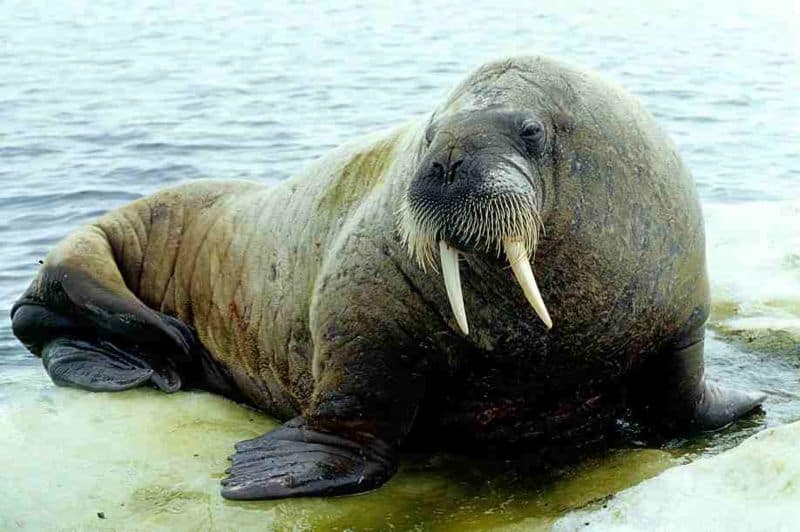
The walrus is certainly a well known animal but, I think, one that gets underplayed in fiction. I think a lot of people have the same issue I do with them, which is that I basically think of them as "those seal things with the tusks", and then mentally assume they can't be that much bigger than a regular seal... whereas in fact a pacific bull walrus can weigh in at two thousand kilos, about equivalent in weight to a white rhinoceros and not far off the bulk of an Asian elephant. These things are biiiig. And pretty dangerous as a result, of course – though the amount of blubber and ivory that can be gained by hunting one made it worthwhile for many throughout human history. Walrus ivory has been a particularly major part of creations across the arctic and subarctic world - the Lewis Chessmen are mostly carved from walrus tusks, and they've been an important basic carving medium for cultures across that part of the world.
I'm admittedly not well read in fantasy generally, but I really can't think of many settings that involve a walrus – but as a serious level opponent, they're as dangerous as a bear or shark. Metre long tusks are a formidable threat, to say the least, and they come in literal herds rather than just being solitary. Their semiaquatic nature can make them a potential target/threat on both land and sea, as well, which adds to their potential versatility. In the wild, only orcas and polar bears ever seriously attempt to hunt them, and even then mostly only older or infirm individuals. If you want a really heavy-duty opponent in a snow-bound adventure, think about the walrus – its size and power alone make it a genuinely formidable beast to include in any sort of writing or game design.
And there you have it, seven more unexpected creatures and some thoughts on their potential roles in your creative works! I defintiely have more than enough animals left for a part three, so let me know if you want that to happen sometime - and I hope you found this a good bonus article to have for Exilian's tenth birthday today!
This article is part of a series: you can also read Part 1, Part 3, Part 4, Part 5, and the Pangolin Special.
The Two Cows (Llamas?) Theory: Exilian Edition
March 18, 2018, 05:37:16 PM
By Jubal
A special 10th anniversary edition of the Two Cows theory! I'm not sure that trying to explain anything about Exilian makes any more sense when done this way, but given none of it made sense to start with... well, why not? As such, I present to you the Two
The Church of Bunneh
You have two llamas. You put them in your signature in an attempt to achieve world domination. The two llamas fall out in a terrifying religious schism.
Cyril & Methodius
You have two llamas. You invent an alphabet perfectly attuned to llama noises and teach them to write.
Exilian Democratic Union
You have two llamas. You attempt to abolish the concept of ownership.
Forums for Internet Freedoms
You have two llamas. You give them the vote.
The House of Generals
You have two cows. They are armed with a disconcerting number of rifles, and at least one thermal pod.
The House of Glaurung
You have two llamas. You sell them and hoard the gold.
The House of the Phoenix
You have two llamas. You're convinced that one of them is a guanaco.
The House of Scholars (Jubal)
You have two llamas. You also have two golden moles, two echidnas, two owlbears, forty-one penguins, and an extremely large number of pangolins. This is as it should be.
Internet Democrats of Exilian
You have two llamas. You pledge to do something different with them in a way that is also exactly the same as all the other systems listed here.
The Krishnabots
You have two llamas. You attempt to preach the word of Krishna to them, and are disappointed when they spit in your face and short out your bot-circuits.
Mixed Mods
You had two llamas, but that was many, many years ago...
The SOTK Clan
You have two llamas and a soup dragon. You clone them. One falls from a high place.
Vance Miller
You have two llamas. You attempt to sell them a badly made second-hand kitchen from China. They are unimpressed.
Wibulnubniblia
You have two llamas. You get them drunk on bootlegged alcohol.
The Beauty of RSS
March 16, 2018, 09:53:25 PM
By Jubal

The RSS logo - look for this to find feeds!
...or at least, that's how it's marketed. There's a lot of downside to the sort of hyper-targeting that goes on nowadays, especially in that it ultimately means you have. Facebook is the most egregious example of this: which posts appear on your news feed is determined far more by what Facebook thinks is popular than what you think you want to see, making it extremely difficult to get updates from people who Facebook doesn't think you want to see news from. Perhaps unsurprisingly, this latter category is especially populated by smaller content creators, businesses, and hobbyists, who can't afford the increasingly exorbitant sums needed to pay to break through Facebook's content algorithms and build a large audience. Twitter operates a similar model, allowing promoted tweets to stay in view as others shoot down the timeline at a rate of knots. Facebook is, despite some signs that its market share may arguably be dropping, still extremely dominant in how people use the internet, both in how they discover content and how they get updates on it. In other words, if your Facebook page gets a new user, that's not necessarily a promise of future engagement: to access all of the users who've "liked" your page, nowadays, you now often actually need to pay to boost your posts in order to do so.
To put it in starker terms, Facebook is actively using the fact it controls the main platform for content finding and social updates to choke off creators who aren't prepared to pay them. Of course, they're a business, and that's their decision - but if you want smaller creators to survive, or if you just want to make sure you're actually seeing the content you want to see, it's time to start thinking harder about how you get updates.
RSS, or Rich Site Summary, is one possible answer. RSS is, essentially, a way for websites to create easy feeds for content in a format that can then be picked up by aggregators. It's essentially a standard XML sheet format that can be updated by the site, published to a known URL, and then picked up by aggregated "feeders" which can then show people the content and notify them when it's updated Created in the late 1990s, it was a major part of internet ecosystems through the mid-2000s until social media really started taking over people's content feeding habits.
So why go back to it? For one thing - no algorithms. RSS will just list the sites you add to it, and tell you when one of them updates, it's as simple as that. No more rolling a d20 to see if you're one of the lucky 10% who gets told what your favourite comic artist has actually published this week. These days, RSS feeders will sit as a little taskbar icon at the top of your web browser - you can then click on it, scroll down your list of feeds, and see what's new. I guess it's possible this could get difficult if you were trying to syndicate a really large amount of content this way, but I tend to find that I can leave off sites I check super regularly anyway and that even the fairly sizeable amount of content I look at doesn't pose a problem. For content from sites where I really need to get those updates, RSS is especially good: I won't run the risk of missing something like I would with a social media follow. It also ensures I can better support and read stuff from smaller creators, most of whom will have RSS running for their blogs or comics as it's easy to set up the feed. Even better, I don't need to give anyone my email address like for a mail newsletter - I just pick up the RSS newsletter via my reader, without risking it disappearing into the dark abyss of my inbox or cluttering things there up at the wrong time.
I mainly use the Firefox add-on Brief as my main feed reader, and I'd really recommend it. I've also got the free version of Feeder running on my chrome browser, which has a few annoying features telling me to upgrade to the non-free version but is otherwise very good. Other options for different browsers or app systems include Feedly, Panda, and Reeder. It's worth having a hunt around to find what's good for you; another advantage of RSS systems is that there's genuine diversity and choice in what's out there, and the standard XML format is open for all sorts of readers and aggregators to parse it. Once you have a reader, all you need to do is go to the URL of a feed, and your browsers/readers will offer you the option to subscribe to it. That's it!
So there you have it - the beauty of RSS. I don't think it's the only solution or part of building a more open internet, but I think it's a very good first step and I'd really encourage people to use it especially to support smaller content creators. If you liked this article, go get a reader and get finding sites to subscribe to (look for the RSS logo like the one above). And of course, make sure you add the Exilian newsfeed to get more like this in future!
The Bones of Earth 3: Worlds In Space
March 02, 2018, 10:54:20 PM
By Jubal
So, having done The Bones of Earth 2 on more unusual fantasy world ideas, here are some thoughts on some sci-fi world building – how we can take into account the conditions in which planets form and their physical characteristics emerge, and some hints on how that might translate into world-building and the basis of different settings. One of the major issues with sci-fi is that we frequently have to work on an inter planetary scale, such that it's often hard to do more for planets than "this one's an ice planet" or "this one has trees", whereas of course planets should have a wide variety of different biomes. Whilst the sheer scale makes it hard to envision entire planets, thinking about how they work physically may be a helpful place to start. So without further ado...


And there you have it! I hope this was useful, and helps you build some worlds where your characters, players, or whoever can develop in a more natural-feeling way based on the properties of the little ball of rock they're clinging to as it passes through space. Sometime in the next few weeks I'll hopefully get to finishing The Bones of Earth IV, so stay tuned for that - in the next article in this series, I'll look at different varieties and styles of maps commonly used in SFF fiction and hopefully help you get closer to drawing your own.
An Unexpected Bestiary
February 23, 2018, 11:57:15 PM
By Jubal
Animals, and our relationship with them, are always an intrinsic element of fiction or game design. We do sometimes, however, naturally tend to stick to what we know. In SFF, hippogriffs are probably more common than, say, armadilloes, partly because hippogriffs are really cool but also because we don't have concepts for what other real species are and how to fit them into a creative archetype. I'm going to do a bit of work to rectify that here, with this unexpected bestiary - behold, seven interesting animals and how you might use them in writing and design!

Let's talk about capybaras. They're often seen as a bit of a joke animal, if they ever come up in popular culture - they're basically giant guinea-pigs, some people might say, and those people would be more or less right. But it's worth thinking about them beyond that - not least in that they're really pretty sizeable. They're a good four feet long, live in herds, are at home on land or in water, and are pretty hefty - a large, barrel-chested capybara could easily weigh more than a smallish human. To my mind, they represent a whole array of interest in terms of being an alternate large land animal to the usual run of pigs, sheep, horses, etc.
Most of the interesting literary uses for the capybara I think involve swapping them (potentially further up-sized) into roles more commonly done by other creatures in human society. That could simply be as a farmed herd animal, but it could certainly also be as a cart-pulling creature or even a mount. I can somehow see dwarfs riding capybaras - their somewhat stoic outlooks upon life would seem to coincide nicely. I can definitely see the idea of capybaras, which are very heavily built, as working animals though, and they'd definitely present an interesting and clear "we're doing something different here" when it's a bunch of cross-looking giant rodents rather than carthorses lugging the folded-up trebuchet toward the enemy castle.

Not many species have taken on a modern human army and fairly clearly won. Emus are on that list. Whilst the Emu War has been covered better than I can here, I think emus are really worth looking at and thinking about from a writing perspective. For one thing, they're simply impressive and somewhat dangerous animals - they've got a hell of a kick, with sharp talons, they're fairly intelligent for birds, and can be over 6 feet tall. In a pre-modern society where people were shorter on average, that's a pretty intimidating creature to say the least, especially in large numbers.
Emus, and flightless birds generally, are sometimes re-envisioned as mounts in modern fiction (hence the chocobo), but I think there might be more interesting uses for them that double down on their independence, intelligence and/or dangerous nature. If you're a GM seeking an early-game quest for your adventuring party, trying to nest-hunt from some emus (and given that emus have huge, beautiful green eggs, one can imagine why you would) is the sort of thing that players may find sounds a good deal until they have a flock of birds half a foot taller than they are scratching into their faces. You could even go the whole hog and really make them properly semi-intelligent, perhaps set as guardians of some sort - there's a certain majesty to a bird that size that would allow for some nice intimidation tactics if a line of them suddenly appeared working in obvious formation to ward your characters/players away from an abandoned temple or stone circle or sacred rock or whatever.

Markhors are basically what happens when you try to imagine the final Pokemon evolution of a goat. They're the national animal of Pakistan, and are mostly found in mountainous regions of central Asia. They're fairly imaginative in what they consider food - they are goats after all - but tend to graze from trees, bushes or ground-plants in the mountains. In the colonial era they were highly prized as animals to shoot, for obvious reasons considering the resulting trophy (and also thanks to their highly alert nature and mountainous homes, which meant they provided a genuine challenge). The name literally means "snake-eater", perhaps from an apocryphal explanation of how they got their giant curling horns - and yes, this makes them even cooler than they look to start with.
I think there are tons of ways you can and should use the markhor in writing and fantasy settings. They are absolutely freaking majestic, for starters, and as a mount they could work nicely for many character types - the noble wilderness leader riding up on his horse is one thing, but it adds a certain amount of punch to have him riding up on a beast that looks like it was invented for the cover of a metal album. There's a myth that markhor spit is good for treating snakebite, which could also easily be woven into a tale somehow. All in all, they're just an animal that is somehow powerful and evocative simply from its looks, and that shouldn't be passed up so much by writers.

The Marbled Polecat is a small ferret-like creature native to the near east. As you can probably see from the picture, it's extremely distinctive, with a dappled golden back and a clearly defined set of black and white facial markings. They dig burrows and live in semi-arid areas where they eat mice, ground squirrels, and other such small mammals; they're fairly solitary creatures, and are more fierce than their size would necessarily suggest was wise, both to one another and to anything threatening them.
I can discuss this one in writing terms quite easily, since I have written about a marbled polecat! In my case, I created a fictional one as a wizard's familiar in the children's book I'm slowly writing, which I think is an excellent use for them in literary terms. They have a certain amount of interest beyond that of a normal polecat (and polecats are inherently at the interesting end of pets/familiars). Using a marbled polecat in this way does, I think, add a certain spark to a character - in my character's case, he's a fairly genteel sort of magician whose ownership of Fessyah the marbled polecat (or arguably her ownership of him) helps hint that there's a lot more to him than meets the eye. I just think these are such visually charming animals that they're very good for stealing the scene, wherever and whenever they turn up.

The Olm, or Proteus, is the weirder and less endearing looking cousin of the axolotl. I think that's why I like them so much - they're a classic look at what happens when evolution stays in a cave for far too long, with the lack of eyes, extreme paleness, and so on. Like many cave creatures, they look fundamentally alien to us, with adaptations for a lifestyle and setting that's very different to anything we can usually imagine. The clincher for the Olm, though, is that it has all that whilst actually also being a vertebrate with four legs and so on - many deep cave creatures are fish or invertebrates, and they look odd but they're still definitely fish, etc. For the Olm, it looks close enough to our body plan for us to read it as if anything more alien.
The number of things you could do with these in writing terms is vast. They're an alien species packed up and ready to go, if you wanted to make big sentient ones. Their strange subterranean existence could also make them sought after - they're on the list of things some arse spellbook writer will somehow make you go and swim in a cave trying to find. Fundamentally, though, I think it's how mysterious they seem that really interests me. I definitely like the idea of them being sapient, and having an agenda - not necessarily in simple terms we can understand, maybe, but with a very different outlook on the universe borne of millions of years of deep cave life.

So, I'm mostly including this because it's called THOR'S HERO SHREW, which is one of the most awesome names for a small mammal in existence. Not only that, but it thoroughly deserves it - hero shrews (there's another species, the armoured hero shrew, too) have exceptionally strong bone structures for their size - an adaptation that may be to help them worm their way into gaps in palm trees to search for grubs, but nobody's entirely sure. One of the results of this is that apocryphally at least they're strong enough that a grown man can stand on one and it can walk away unharmed.
Now, in the real world, "Thor's Hero Shrew" is a modern appellation, but I *really* want to read the story of how Thor ended up adopting a tribe of shrews or possibly somehow granting them their super-ribcages as a result of some unforeseen shenanigans. One could also further the connection in other ways, either by giving more of Thor's attributes to the shrews (can they call the thunder?) or possibly linking them to his other followers (a Viking raiding party arrives in Africa in search of Thor's sacred animal, only to find that they're rather elusive and, in fact, shrews.) Outside that, they're a useful twist on the idea of shrews being little, skittish animals - these little fluffles are very tough customers indeed.

Pheasants are boring, and that's a pity, because they shouldn't be. "Oh, they hunted for pheasants" is often not really seen as much of a big deal in literary terms because nowadays pheasants are common across Europe. This wasn't always the case, though: the very name "pheasant" is derived from "the bird of Phasis" - Phasis is now the port of Poti in Georgia, and was where the ancient Greeks imported pheasant meat from in large quantities as a delicacy. In fantasy terms, it's strange how little characters hunt as a pastime, considering the prevalence of hunting throughout history and folklore, and to have them hunting for anything less than a unicorn is seen as underselling things.
But what if there was a way round this, where one could find a bird with many of the same properties as a pheasant, but with brighter colouration and a cool name your readers are less likely to have heard of? Fortunately, the natural world has you covered - meet the tragopans. Mostly found in eastern Asia, the tragopans are close relatives of pheasants with amazing and striking colouration. Many of the species are now endangered, sadly, but the tragopan could certainly be a route to restore gamebirds to a more used place in fantasy writing.
That's all for this article! Let me know if you liked these and found them interesting, and I might manage some more (potentially even better researched) unexpected bestiary articles in future...!
This article is part of a series: you can also read Part 2, Part 3, Part 4, Part 5, and the Pangolin Special.
Vampires & Music
February 16, 2018, 11:44:26 PM
By Belchion
Vampire the Masquerade is a part of the World of Darkness, a setting for a series of Pen-&-Paper Roleplaying Games published by White Wolf where the player takes on the role of traditional horror monsters like werewolves, changelings or (most prominently) vampires. The setting more or less merged horror stories with esoterics and technophoby, strongly drawing from the cyberpunk asthetics with powerful corporations and dark cities.
In the Pen-&-Paper Roleplaying Game "Vampire: the Masquerade", one takes on the role of vampires. Most vampires belong to highly hierarchical sects called Camarilla and Sabbat. The Camarilla represents an ossifed ruling caste that subsists on favours, backroom deals, and intrigues, whereas the Sabbat represents violent political movements that attempt to overthrow the system and impose their own absolute rule.
Furthermore, all vampires belong to a clan. While players have to agree on a sect the whole group belongs to, members of different clans can and do work together. Those clans are bound by a shared clan curse and clan boon, which creates strong archetypes. By interpreting this archetype one can find ideas how to interpret vampires from this clan.
My friend Teylen recently had the idea to combine vampires and music, showing which songs fit her idea about the Clan Malkavian. I highly recommend checking her ideas, which are completely different from mine.
I decided to follow suit, albeit in a more methodical way as I lack the broad music knowledge that allowed her a more spontaneous approach. First, I defined the archetype Clan Malkav represents in my opinion, and then tried to find songs or music that fitted this theme.
First of all, what archetype do the Malkavians represent? They are insane and they are fools, but theirs is the insanity that breaks through illusions and grants new insight. Accordingly, they are also known as seers and soothsayers. Still, they are monsters, and the Joker from Batman is as much a Malkavian as Cassandra of Troy.
Toccata e Fuga in D minor
The first piece that comes to my mind is always the Toccata e Fuga in D minor from Johann Sebastian Bach. In several beats, it sounds somewhat dissonant, and yet powerful. Furthermore, it was featured prominently in regard to several delusional film villains and, of course, some vampires.
Trout Mask Replica
Second, Trout Mask Replica by Captain Beefheart and his Magic Band. This song is famous among musicians, because the composer was completely uninhibited by any norms and traditions. He combined instruments and song without any regard to each other. And even though the album is also described as the most horrible album ever written, it still inspires musicians to this day and helps them to innovate. Just the same, a Malkavian's erratic behaviour still somehow furthers the plans of the clan as whole.
Jeanny
Falco sings in Jeanny about delusions and the escape into a dream world, from which there is no escape but death. Just like there is no escape from their clan's curse except for true death. The song is ambivalent about who is tortured by whom, just as one cannot be sure who truly controls clan Malkav.
Chain Of Fools
Aretha Franklin sings in Chain Of Fools about being bound to someone who treats her cruelly, just as Malkavians are bound to their insanity and the voices from the Malkavian Madness Network.
Cassandra
As I already mentioned Cassandra as one of the prototypical Malkavians, the song of the same name by Theatre of Tragedy fits well into this theme, given its rather macabre nature and rather depressive, yet energetic tune.
As ephemeral as this article might seem, it still helped me to gain a clearer picture for Clan Malkav and its role in the World of Darkness. And even if it does not have this effect on you, dear reader, I hope it will at least acquaints you with music you would otherwise not have listened to!
Realms of Myth: Somalia
February 09, 2018, 11:40:34 PM
By Jubal
This is the first of what will hopefully be a number of articles on the folklore of different world regions that I'm thinking of doing. In particular, I'd like to explore bits of folklore that haven't made their mark on the modern fantasy and gaming scenes, and showcase some of the reasons why you might want to read and discover more about them. The worlds we know as "fantasy", which have their roots in a mixture mainly of Northern European, Greco-Roman, and western Christian myths and legends, are just based on a small portion of the world's mythical output, and I hope looking at some more in these articles will help spark off ideas for some readers.
For this article, I'm doing – there's a huge amount more to say about Somali myth than I have time to write here, and I hope I'll manage to come back and write more on it at some future point, but here are some of the themes that for me make the myths of Somalia quite so fascinating:

A typical Somali landscape - in places like this, it can pay to stay on the move.
Kinfolk and close kin-groups are also a very large element of Somali myth (and one that finds echoes in some older European myth but is often quite absent from its modern fantasy variants). Part of the corollary of having a society based on small, closely related encampments and clans is that a great deal of narrative tragedy is built up from internal familial jealousies and disagreements. In one myth a character known as the "missing-fingered priest" murders his wife Falaad's brother over jealousy that he is too close to their son, for example; these sorts of close kin-politics issues are the bread and butter of storytelling, and are an intriguing look at story-driving dynamics in these sorts of smaller groupings.
Another thing it's worth thinking about is what different societies value – herds and herd animals are often looked upon in derogatory terms in modern fiction, or are almost completely absent from them – but this idea of the "adventuring" (usually upper and/or urban urban) classes who tend to be the heroes of our modern stories looking down upon the rural world is a very modern creation. Somali myth often takes us into a world where keeping a good herd of camels or other prized animals could be the difference between life and death when times got tough, and where, for exactly this reason, having a really large herd was the sign of real, practical power, writ large in the faces of grumpy livestock. It's an interesting counterpoint to the "jewels and silks" view of power that fantasy worlds often give us.
Whilst male characters often play significant roles in Somali folklore, many of the strongest and most important characters are women, including the two most famous mythical figures in Somalia, Araweelo and Deghdeer.
The most significant central female character is Araweelo, a mythical warrior queen who according to legend created a matriarchal society. In some myths, she castrates all the men of the kingdom in order to try and better control them, a plan that is ultimately flawed when her daughter conceives via an old wise man and raises a son who grows to overthrow her. Whether Araweelo is seen as a mightily strong embodiment of feminine liberty and success or as a corpulent and dictatorial ruler may well vary according to the taste and intentions of a storyteller. Certainly, she is seen as an embodiment of power – a ruler with herds of a thousand camels who could drink as much milk as she ever desired, but whose downfall is in her excessively brutal use of that power, is a compelling centrepiece to a setting in itself.
The monster Deghdeer is another key female antagonist. Mutated into a ghoulish monster by turning to cannibalism and named for one extremely long ear which she uses to listen for her human prey, she is a far more specifically magical and monstrous terror. Like many good folkloric antagonists, she has a variety of specifically numbered, possibly magical, artefacts (a special cooking-pot, for example) that she uses to carry out her evil deeds, and a range of specific strengths and weaknesses. She's extremely strong, for example, and extremely fast, but so heavy she has difficulty turning, such that clever heroes can dodge out of her path. She's also not generally shown as very bright, as in one myth where two children each trick her into thinking they're helping her catch the other and thus escape together – though she's also capable of cunning, often putting up a whole circle of huts wherever she camps so as to make travellers believe there is a village there and tempt them closer.
These powerful female antagonists are treated as the leading characters in their respective cycles of stories (which have many variants – Hanghe for example records a significant number of different possible deaths for Deghedeer). Many of the protagonists are also female, though – one of the Deghedeer variants has a girl called Falaad as a primary character, and another has a group of girls including Deghedeer's own daughters managing to finally kill the beast that she has become.

Hyenas - much more than cackling antagonists...
Hyena-folk are another common part of Somali stories. The aggressive, cackling hyenas that a modern audience was probably mainly introduced to via the Lion King are given a great deal more complexity and interest by the Somalis, especially in their part-human variant as "qori-ismaris" – hyena-men (it is unclear whether they are regularly part-and-part or shape-shifters, and probably variable according to narrative usage). Hyena-folk are generally mistrustful of mankind, but can help and otherwise interact with them too. In one case, one grants a traveller a magic staff that gives him the ability to turn into a hyena himself (as long as he tells no humans), in another, causing problems by successfully winning the hand of a human woman, who then eventually rids herself of the unwanted husband by forcing him to abide by human and civilised customs that he cannot stand. This tension between hyenas as magical and wild and humans as settled is an interesting one to read about.
There are a number of other monsters – the monstrous "five-belly" who eats whole herds and flocks of animals, and one of whose victims results in the birth of the tiny trickster "thumb-size" who outwits bandits by simply being smaller and clever than they are, as two examples. Animal tales are also very common, and often include humans and animals (especially lions or snakes, but also smaller creatures) interacting. Certainly it's worth remembering the presence of animal actors in myth: a manticore or a gryphon of course always have a certain mystique to them, but there's a lot of power and interest vested in perceptions of real animals too, and allowing them to voice their perspective and interact with humans opens up a lot of potential stories.
I'm still very much a novice in the world of Somali myth, and I'm sure there's vastly more to discover than I know, but hopefully the above gives you an idea of some of what there is to look at. Ahmed Artan Hanghe's "Folktales from Somalia" is the source of most of the above stories, and I believe there are one or two other English-language books available (which I'm hoping to get my hands on copies of at some point)! I'd also encourage you to look at Exilian's Somali Mythology Project, which I'm hoping to do some more work on in the coming months to turn it into a useable reference guide to at least the basics of the Somali mythological world (and please do let me know if you'd like to help with that!) Mostly, though, I hope you found this interesting, and I hope you stay tuned for future articles covering some of the world's less widely known cultures and myths!
This article is part of a series: you can also read Part Two, on the myths of Asturias.
Storytelling and Nordic LARP
February 02, 2018, 10:52:05 PM
By Nuhn
Years ago I overheard a Game Master (GM) complain about the players: 'They are ruining my story!'.
This statement have stayed with me ever since as a token of How To Be A Bad GM. You can be a good GM, but to be a great one you have to understand, and accept, that the game is not yours. The players are not there to act your story or bring your script to life. You are there for the players. Your job is to give them the best experience possible, regardless of your own aspirations.
Storytelling has always been a part of most of the things I do - in writing, acting, movie productions and roleplay. I have more than 10 years experience with LARP and several of them as GM and Non-Player Character (NPC). Last year I decided to challenge myself by making a pen and paper campaign based on the D&D rules but the setting from scratch.
My years as a GM in LARP has taught me a great deal about storytelling that is useful in many other aspects.

A warrior can stay in character, even when there's no battle to fight!
Recently I discovered that there is a huge difference in the way we understand, interact with and create LARP throughout the world. So I looked into it and realized the way I do LARP is known as Nordic LARP (I'm from Denmark so that makes sense). The site nordiclarp.org has a good definition of Nordic LARP and especially the bit about collaboration:
QuoteNordic-style larp is about creating an exciting and emotionally affecting story together, not measuring your strength. There is no winning, and many players intentionally let their characters fail in their objectives to create more interesting stories.(From https://nordiclarp.org/wiki/Nordic_Larp)
To me the key to LARP has been storytelling, to make sure the players get the feeling of being a part of a story, preferably like they are the main character whether they're an evil knight, a shady wizard or a greedy farmer. And yes, in my opinion every single player should feel like a main character. This is actually possible when the purpose of the game not is to win, not to be best (strongest, richest, most powerful) but to truly be your character. Not all characters wants the same. One wizard search for an ancient spell while the mercenary wants to sell all his goods because he needs the money.
Note that this is my personal conviction. I still meet players who just wants to fight with weapons and don't care about a story or a character at all.
When I want to create a plotline in LARP I work with non linear storytelling. The first draft might be linear. But then I do the 'what possible choices could the players make?'-exercise. Sometimes I come up with multiples ways or plotlines the players might choose.
E.g. The players are asked to escort a wagon with a precious cargo through the area that is known to house a group of bandits. In the first linear plotline the players do the quest as predicted: They defend the wagon and get a reward for the safe journey. But what if the players are shady and decides to rob the wagon themselves? What is on the wagon? Who sent it and will they send out someone to take revenge? Or maybe the players seek out the bandits because they must have a holdout with a lot of loot. Should we place a bandit camp in the area for the players to ambush? In reality you can keep guessing and adding details but there is only so much you can spend your time on (and hopefully this is not your only plot) so you'll just have to choose a couple of options and keep them ready.
And then be prepared when the players choose to do something completely different than what you could imagine.
Because sometimes (let's face it - most of the time) the players will act in a totally different way than you expected. They will do stupid things, follow wrong leads and not pick up on hooks and hints. But that's your problem, not theirs. Now you have to follow the players and re-create the story around them. Go with the flow.
Maybe the players wont help the princess in distress asking for their help. Maybe they decide to kidnap her and blackmail her father. Then don't force the players into the story you originally imagined. Dismiss the bandits looking for her and send in the knights who will try to rescue her from the players.
My personal opinion is that if you let the players lead instead of forcing them into your story then everything will be better. Let me elaborate.
Of course you might have to help the players along a plotline, giving them a gentle poke in the right direction from time to time. But there is a huge gap from that and to forcing the players down a plotline they didn't choose. There are several reasons why you should let the players lead:

A good adventure needs plenty of strange & exciting props...
The players will feel like they can make an impact on the world. They are not just sheep hustled around. Letting the players have a say in the story and world gives a more dynamic universe.
When the players know their choices have consequences it forces them to consider their actions more carefully. And with a story that is not fixed, the players will not try to figure out 'the correct answer' they know you have prepared, but instead try to figure out the best way to proceed for them and their characters. And that leads to the point of Nordic LARP focusing on 'staying in character'. It is often considered a deadly sin to act on information or knowledge you have that your character wouldn't. As stated earlier, sometimes a player will choose to fail rather than stepping out of character.
E.g. A mercenary wants to show me his goods "just around the corner". I know that his character is an NPC that is up to no good, but my character doesn't. So I go with him even though he might rob me.
Have more fun - Improve your skills
When you let the players lead, the story will go in directions and take turns you couldn't imagine. It's actually fun to see how the story ends. And you will have to be more creative because you have to make things up as you go and make quick decisions (because the players don't prepare you, they just do stuff and you have to react on them instantly). Not only do you have to improvise acting but you have to improvise your storytelling. It's more challenging but it's more fun too.
When you are used to think non linearly, to improvise and to let your ideas go (because the players didn't follow the carefully written plotline you prepared) then you have a huge advantage in every day life.
At work you often have to compromise and to throw away work or ideas. For instance, I've written 7 articles for the local news paper but they only chose to publish one. And I'm okay with that! I also work with online communication and social media, and let me tell you: people never receive or react to a post the way you predicted. But I'm used to work this way and to turn the storytelling around (because yes, storytelling is also how companies communicate online).
The most precious skill, to me, is the ability to improvise. For more than a year I worked as a substitute teacher, often without notice or material. I literally had to improvise almost every day. And I had absolutely no idea what I was doing, but I played the character as 'an authority: a true adult' and the children (and the teachers) believed me. Sometimes when I'm nervous (e.g. at a job interview or an exam) I just play the role of someone with confidence. It actually works.
When you start thinking about your stories in a non linear plotline, you open up the stories to the players. The players will find themselves in a more diverse world where their choices have consequences. You will be challenged more but more skilled too. You will create stories together with the players, and like in most cases when you collaborate with others on creative work, you will create something that's better than what you could do on your own. And sometimes it'll be way more stupid and boring than what you made up, but that doesn't matter. The players are not there to entertain you. You are there for them, to make sure the players are having fun. Because in the end LARP is a game, and games are all about having fun.
The Bones of Earth 2: A Wizard Did It!
January 26, 2018, 11:23:52 PM
By Jubal
This follows on from my previous article, the Bones of Earth, in which I look at the basics of constructing fantasy maps. In this second article in the series, I explore unnatural geographical features or settings and how to fit them into fantasy worlds. We'll only be looking at a small selection of possible ideas – there are many more out there!
Generally cities and settlements come after geography; however, there is a big sci-fi exception to this, the megacity. Essentially, humanity has an effect on the landscape. This can be seen even in low-tech worlds where old barrows (LOTR) or mottes of castles can dot the landscape. The megacity is a step beyond – civilisation built on top of civilisation, layer after layer, so that pretty much all one would find beneath the city is more city. At this stage, and particularly given the large amount of land area a megacity might take up, it is worth marking out areas for such on the map. Remember that historically most of the world's largest cities are coastal and/or based near navigable rivers. Of the world's ten largest city areas today, only three are not on the coast. Of those (Cairo, Delhi, and Mexico City) two are on major rivers and the third is based around a former lake. Generally it is fair to say that a megacity large enough to show up on a map is going to be a coastal area or strip.
Islands that act as ferries or even fly, or mountains that shift to block the path of the heroes on a quest; one of the key things that land does not do (at least not often) is move, so that's precisely what it CAN do in a fantasy setting. You may not necessarily want to include these on your map (for example a flying island is hard to include on a static map) but if there are rules as to where the thing can go it's worth thinking about them. Forests that move can also be an excellent example of this (in a sci-fi world you could even have forests or mountains that are regularly migratory, in which case the migration route should be worked out at the mapping stage).
This is common in sci-fi particularly, though it appears in fantasy too. The magic-blasted or post-nuclear wasteland is an excellent setting; cartographically, it gives a large area which is difficult for armies or characters to cross, and which can be filled with arrays of mutated monsters and other such gribblies. Generally wastelands tend to be inland areas, in line with real desert and tundra areas, although it's worth noting that a real nuclear wasteland would probably be a coastal region since nobody's going to bother dropping billions of pounds/dollars/roubles/yen worth of explosives onto somewhere sparsely populated when the enemy war effort could be obliterated by dropping them on London/New York/Moscow/Shanghai.
Wastelands are likely to end at seas, large rivers, or mountains which can take the blast and prevent fallout from catastrophes spreading. It can look odd to have a wasteland covering a range of large mountains as we would intuitively expect that either the mountains would shield things on the other side from a large explosion. Logic, even in nuclear holocaust planning, is still worth using from time to time.
World to world portals are part of huge numbers of settings. When they are big enough to be used on a large scale, they are most definitely major setting drivers. River crossings and bridges within a world are often fought over a lot as major crossing points, and that's when if you go far enough around there are other options, or you can get boats, etc etc... when there is a trade route or raiding route which is literally the only one of its kind (or one of a very small number), it makes eminent historical sense for it to be a hugely important feature. As such, if it's a natural part of the world (rather than having been created in a city), it's worth considering its position at the mapping stage.
The Edge Chronicles are the shining example of this. The simplified world paradigm is basically the idea that you can build a world setting that does not obey any rules of physics or common sense whatsoever, so long as it's simple enough that nobody bothers asking questions about the geography. The edge is basically a sort of peninsula (jutting off what, nobody knows) which sticks out into the sky. The base of the peninsula is all forest, then there's a mire/wasteland, then a city at the end. That's really literally it. This absurd setting, however, fulfils its function well; it provides a crystal-clear backdrop against which a ton of interesting biology and culture can be thrown. The map is made to give a clear range of settings, but in a stylised way – this makes it easy for characters to move between parts of the setting and encounter different things without too much worry about detail or realism.
Other possible simplified worlds could be based on a certain principle – for example, having a land with four equally sized islands representing the classical elements where water is wet and forested, air has high mountains and tall trees, fire is all volcanic and earth is low-lying vegetation, rocks and mines. Again, this completely ditches any inherent interest in the geography, but it gives an excessively neat and simple backdrop for me to put characters and cultures against which can be useful. Consider different possible ideas you could use in this way – any cultural trope can work (yin and yang, the kingdoms of the four horsemen of the apocalypse, seven deadly sins, alchemical substances, you name it).
This isn't so much a feature as pointing out that, above all, you can do whatever the hell you like. Take The Carpet People – the entire book is a fantasy based on the idea of civilisations rising and falling and desperate battles being fought between the fronds of a carpet. There's references to a giant plateau famous for its mining that is pretty clearly a 1 penny piece, and so on. Equally, you could write a fantasy set amongst gods playing snooker with the planets, or set inside a computer where the characters worship the players as gods and the "map" is just a set of windows explorer directories. There are potential worlds made entirely of food where the world may centre around the problem of eating as compared to living in homes, and so on.
Generally, the suspension of disbelief thing hits in here. The more unusual your paradigm is, the harder you're going to have to work to keep the user of viewer of the setting engaged. Also, the odder the paradigm the more people are going to focus on it – if it's not a simplified paradigm (see above), then an odd one can easily become the gimmick or idea that your whole setting centres around. Think carefully!
The Carpet People (Terry Pratchett) – This is a good example of a very unusual setting which nevertheless works well (it is important to note that part of the reason it works well is as humour though, being essentially a work of satire rather than more serious fantasy)
[Gulliver's Voyage to Laputa (Jonathan Swift) – the original flying island (Gulliver's Travels was first published in 1726 and has been in print ever since), including probably the first ever description of aerial bombardment as a system of warfare. Chapters 17 to around 24, available to read here:
http://www.online-literature.com/swift/gulliver/17/
The rest of the book is also well worth a read, and covers three other important early examples fantasy settings (Lilliput, full of tiny vicious people, Brobdingrag, full of friendly giants, and the land of the Houyhnhnms, a society of intelligent horses totally governed by reason).
The Edge Chronicles (Stewart/Riddell) – Not the most serious or even best written work of fantasy fiction, but a good read and more importantly an excellent example of an unusual setting that works as a basis for serious fantasy rather than parody as referenced in the "simplified world" section.
Welcome to Exilian Articles!
In this area of Exilian, we'll be providing regular, eclectic, creative, geeky articles and other such content for your reading pleasure. We want to provide a mix of humour, intros or spins on interesting academic subjects, ideas for creativity and project design, showcases of tools and resources, and original creative work.
Of course there'll still also be great content being made and written across the forum; Exilian Articles is generally for longer, article-type pieces, whereas game reviews and more high-detailed tutorials have places elsewhere.
If you want to write for us, just drop an email to megadux@exilian.co.uk and let us know!
Enjoy the articles, and let us know what you think.