
Exilian Interviews: Stormwell!
April 17, 2019, 03:56:52 PM
Stormwell (besides being second in Exilian's "most topics started" stats at 189) is a designer and writer of tabletop gaming supplements - in particular Frozen Skies. This dieselpunk setting for the Savage Worlds RPG takes players into the frozen northern land of Aleyska, flown over by planes and huge airships, with great wealth to find but great risk, weird tech, and terrifying monster along the way. We sent Jubal up over the barren cold waste in the Exilicopter, to hunt Stormwell down on his sky pirate vessel and ask him a few questions...

Frozen Skies from Utherwald Press
Stormwell: Well, I'm a born and raised Sci-Fi geek. During my childhood I regularly watched Doctor Who, Star Trek, Red Dwarf, Babylon 5, UFO, Space 1999 and more obscure series such as Space Precinct. Star Wars also got a look in, as did later series like Stargate SG-1, Firefly and countless films. Fantasy for me during this time was lucky to get a look in once a blue moon, being limited to a handful of extracts from The Hobbit and some films. It wasn't until high school that I developed an interest in reading, particularly when I first came across the late, great Terry Pratchett's most wonderful Discworld series. It was at roughly this time that I became aware of tabletop games, chiefly Warhammer 40K when one day I saw a friend looking at some 40K models on the computer. It was a work colleague a couple of years after leaving school who actually got me started with 40K.
(OK, I'm beginning to ramble here, but it is bit of a complex web when it comes to my gaming background, and I hope to be done within another ten paragraphs...)
Right, where was I... ah, yes. What has probably had the biggest impact for my gaming habits is computer games. I'd first cut my gaming teeth on my dad's 1980s Amstrad computer and later went onto the Sega Megadrive and then the first Playstation. Possibly recognising where my interests laid, or just thought I might be interested by it, my parents brought me a magazine mainly focused on card games such as Magic the Gathering. The thing that caught my attention was an ad for a computer game due out the following year called Arcanum; Of Magick and Steamworks Obscura. This game has probably had the biggest impact upon me of any I've played; I still play it from time to time some 18 years after its release. The world of Arcanum is your typical Tolkienesque fantasy thrown headlong into the Industrial Revolution, sitting under the banner of what I would later know as Steampunk. The game saw my first forays into internet based play-by-post roleplaying and developed my initial interest in Steampunk, which probably also owed a bit amount to my earlier passion for trains (which I admit was a factor in me picking up the game as it had a train on the cover). Arcanum also prompted me to start buying PC Gamer magazine on a regular basis after it did a review of the game, which would prove fortunate as the magazine also saw me buy the Crimson Skies and the first two Fallout games after it did articles on those. With my growing interest in Steampunk I also read the works of H.G. Wells and the novel The Difference Engine, developing a desire to write my own book.
I'd been playing 40K for a while when I finally got introduced to tabletop RPGs, there was a group that regularly met where we played wargames and included a couple of people I knew. Curious, I asked about it and then got invited to join a game of the grandfather of RPGs; Dungeons & Dragons. After a handful of games of D&D I wanted to run my own games and had, by that point, been introduced to the Iron Kingdoms/Warmachine setting which I bought the books for and ran. My desire to write a book evolved into a desire to create my own setting, influenced by my interest in Steampunk at the time, which would be the genesis for what became Frozen Skies and the world of Darmonica.
Over time I grew increasingly dissatisfied with the D&D system, prompting me to try out different games and other systems. It was when I was playing a Rogue Trader RPG campaign that Savage Worlds came to my attention, the GM had brought a copy with him and I fell in love with what I saw when I flipped through the book. Frozen Skies had begun to mature as a setting by that point and I had considered publishing it as a system agnostic setting, but saw that Savage Worlds had a licencee programme for other publishers and so decided to adapt Frozen Skies to that system!
Jubal: A few questions on your Darmonica setting and especially your book Frozen Skies. Firstly, what inspired you to go for a snow and ice themed setting specifically for your book, out of all the different options that Darmonica might include?
Stormwell: Ironically, Star Wars.
The Battle of Hoth from The Empire Strikes Back and a couple of maps from the original Battlefront games appealed to me. So did a world from the TV series Firefly. There's just something about an ice-bound frontier that really stands out to me. I suppose the hazards and challenges imposed by an arctic environment helped reinforce my vision of a frontier setting with a true "edge of civilisation and the world" feeling to it.
Jubal: Alongside humans in your world you have at least a couple of other species, the mysterious wyndryders and genchi. What do you think the importance of these other peoples is in an otherwise quite human dominated setting, and what inspired you to include them?
Stormwell: In all honesty I was in two minds about including them, torn between making the setting full dieselpunk or include some fantasy. I think including them helps make Frozen Skies stand out as a setting and enriches its background lore.
People have done some interesting things with the traditional Tolkien races, ranging from the Steampunk Arcanum through to the futuristic Shadowrun. Though I feel theres only so much you can do with dwarves, elves and orcs before you start running out of ways to reinvent the wheel. At least with the genchi and their Windryder cousins I have more wiggle room to explore different concepts regarding them.
Jubal: Your setting is a fantasy, but it's one with a lot of quite modern elements due to the dieselpunk style. Do you think this creates any particular challenges to think about for you that medieval fantasy authors don't have to worry about? Can more modern fantasy settings end up feeling "too close to home" with problems the real world has had?
Stormwell: I think the biggest challenge has been being aware how nations work and how they interact with one another. In a medieval setting people, as a general rule, don't normally travel much further than the next village over and would be vaguely aware of who ruled over them. Frozen Skies is much closer to the 1930s/40s of our world, meaning more integration on the national level, greater mobility of people and better access to things that a medieval peasant could only dream of. Have I managed this? Well, more than one person have commented how 'real' the nations in the setting are.
It all depends on how it's approached. The best example I can think of is Pratchett with the dwarves and trolls in his Discworld setting. He used these two races to tackle both racism and extremism in a way that appealed to people and made them think about it.
Jubal: A lighter one now - what's your favourite character that you've created in the setting, and why?
Stormwell: Hmm, favourite character, eh?
Hands down it has to be an Andrei, a character that has featured in the Frozen Skies campaign I've been running. He's what called a 'keeper of secrets' or information broker, effectively the guy everybody goes to for information - if they've got the money! Certainly has been a character that my players have taken seriously, and he still has plenty of secrets of his own left...
Jubal: Are there any particular books, or authors, or other fictional worlds, that particularly inspired you when creating your Darmonica setting that users of your book could go to for inspiration?
Stormwell: The computer games Arcanum and Crimson Skies spring to mind right away, both have certainly left their mark on Frozen Skies. Others that deserve a mention include Indiana Jones, Sky Captain and the World of Tomorrow, Firefly, the webcomic Alpha Shade and the Brendan Fraser Mummy films.
Jubal: A few questions on technical and rules-driven stuff now. You write for Savage Worlds as a system – what attracts you to that ruleset in particular and why do you feel it works well for the adventures you want to create?
Stormwell: What attracted me to the system was its free-form character creation and advancement, it felt like a refreshing change to the rigid class system of D&D. Having run the system as a GM I really like how it feels so much easier to do things on the fly, come up with new NPCs in an instant compared to the hours that could be spent doing the same thing in D&D. It feels so much more flexible and a better laid-out toolkit for the GM.
Jubal: Recently, Savage Worlds has been releasing its Adventurers' Edition, SWADE – how have you found the rules changes from that? Do you have a favourite improvement or change they've made?
Stormwell: I'll echo what others have said; it's still Savage Worlds under the hood.
SWADE feels like a refinement and upgrade with plenty of new options, some of which I've incorporated into my game current with great success. The changes to character creation and advancement give more options, though at the same you have to think more particularly with assigning skill points.
The new Chase rules are my most favourite thing about SWADE, when I first read 'em I like them over the previous version. Plus I've really grown on me since I've used them a couple of times, just need to find more opportunities to use 'em.
Jubal: What events or scenes do you find the biggest challenge for you to simulate for your players with the base Savage Worlds rules, and how do you cope with this as a GM and/or a setting designer?
Stormwell: Generally most things that I ask Savage Worlds to do it does it well, heck I used the Social Conflict rules for a trial and it worked extremely well. The only thing that I can think of that's challenging is making combat interesting and engaging for the players, though that's more on me as a GM remembering to use the various tools that Savage Worlds gives you for this. If I use stuff for NPCs in combat, usually the players will start using them as well. SWADE gives a few more options, too, especially with the new status states.
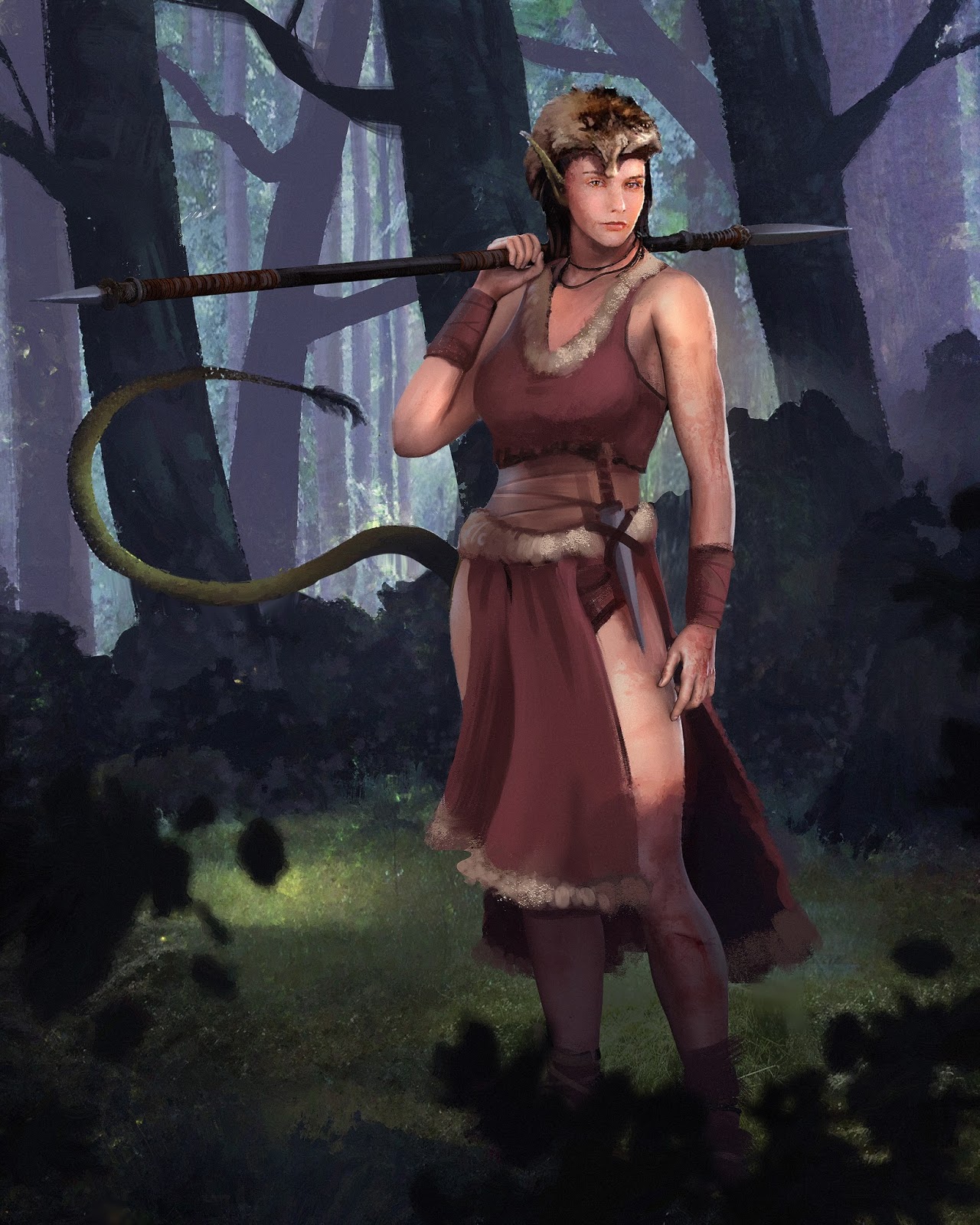
A windryder, one of the stranger inhabitants of the Aleyskan north...
Stormwell: Considering how a fair bit of Frozen Skies was already written before I even considered using Savage Worlds, certainly have to say that story normally comes first. Of course there are exceptions where rules, character abilities or even artwork will prompt story.
Jubal: And, as someone who's now done the whole process, what advice would you give to anyone interested in publishing their own RPG books?
Stormwell: The biggest one which a lot of other people also say: know the system you're writing for.
Tying into that would be to start off small by writing adventures or creating characters, particularly as these will help you understand the system. 'Course there are also programmes like the Savage Worlds Adventurer's Guild (SWAG) and the Dungeon Master's Guild (DMG) where you can create and sell content without going down the licensed publisher route. Those will help with your portfolio and will allow you to see what bits of your work people like.
Jubal: Finally, what's coming up next for you and your work? Any conventions people should catch you at or releases to keep an eye out for?
Stormwell: Unfortunately it's looking to be bit of a quiet year, though there is a few things of note.
Granted, it'll be finished by the time this interview gets published, but a Frozen Skies game was run at SavageCon which is the UK's Savage Worlds convention. I provided some prize support and hope to be able to attend next year. UK Games Expo is another convention that I hope to do, again it'll probably be next year when I go again. On a more positive note, I'm back at Diceni in Norwich, at the Forum on Monday 6th May. This is awesome as, save for the past couple of years, I've usually had a stand since this event started. NorCon is another event in Norwich that I hope to do, but cannot say whether I will. Frozen Skies has also been submitted to this year's ENnie awards, so keep an eye out there.
Releases-wise, it'll probably be the SWADE version of Frozen Skies before I work on a follow-on book called Skies of Crimson that focuses more on the sky pirates of the setting. I also have some other settings in the works, plus I've released an adventure through SWAG called Operation Thule. The adventure is Weird Wars inspired and is set during the 1982 Falklands Conflict, guest-starring a creature out of South American folklore. I'm hoping this will garner interest for a much larger project called Cold War Skirmishes...
Jubal: From cold skies to cold war! Looking forward to seeing the results, and thankyou for talking to us.
Stormwell: Thanks for having me.
You can get Stormwell's Frozen Skies supplement for Savage Worlds here, and do also take a look at regular blogposts on the Utherwald Press website here, as well as Exilian's Utherwald Press Forum.
Got more things to ask Stormwell? Please tell us in the comments below! And let us know what you thought of Jubal's choice of questions.
As ever, please do also check the guidelines and send in any articles you'd like to write for the Exilian Articles section, we'd love to hear from you!
Exilian Interviews: Aure!
February 28, 2019, 03:35:24 PM
Aure, or Aureus, has been a familiar face (OK, avatar) on Exilian for a while now, and his own Moral Anxiety Studio recently managed the successful release of a great slice of life visual novel, Tales from Windy Meadow. We sent Jubal to go and track Aure down to find out more about the game, its setting and development, and what future plans there are for the game world...
Jubal: Hello there! Before we get on to talking about Tales From Windy Meadow, tell us a bit about yourself – how did you get into game development?
Aure: I honestly can't be happy if I don't create things and find new ways to express myself. As a teenager I was writing crappy short stories, while during early college years I was focused on poetry. Finally I spent a couple of years designing and writing tabletop RPGs, though they were all published in Polish, my native language.
I moved into video games to combine a couple of passions at once. I love building my own fantasy world, writing stories, experimenting with dialogues, RPG-ish aesthetics. There are stories that can be told only through video games. I honestly believe that Tales From Windy Meadow couldn't keep its power if it would be a book.
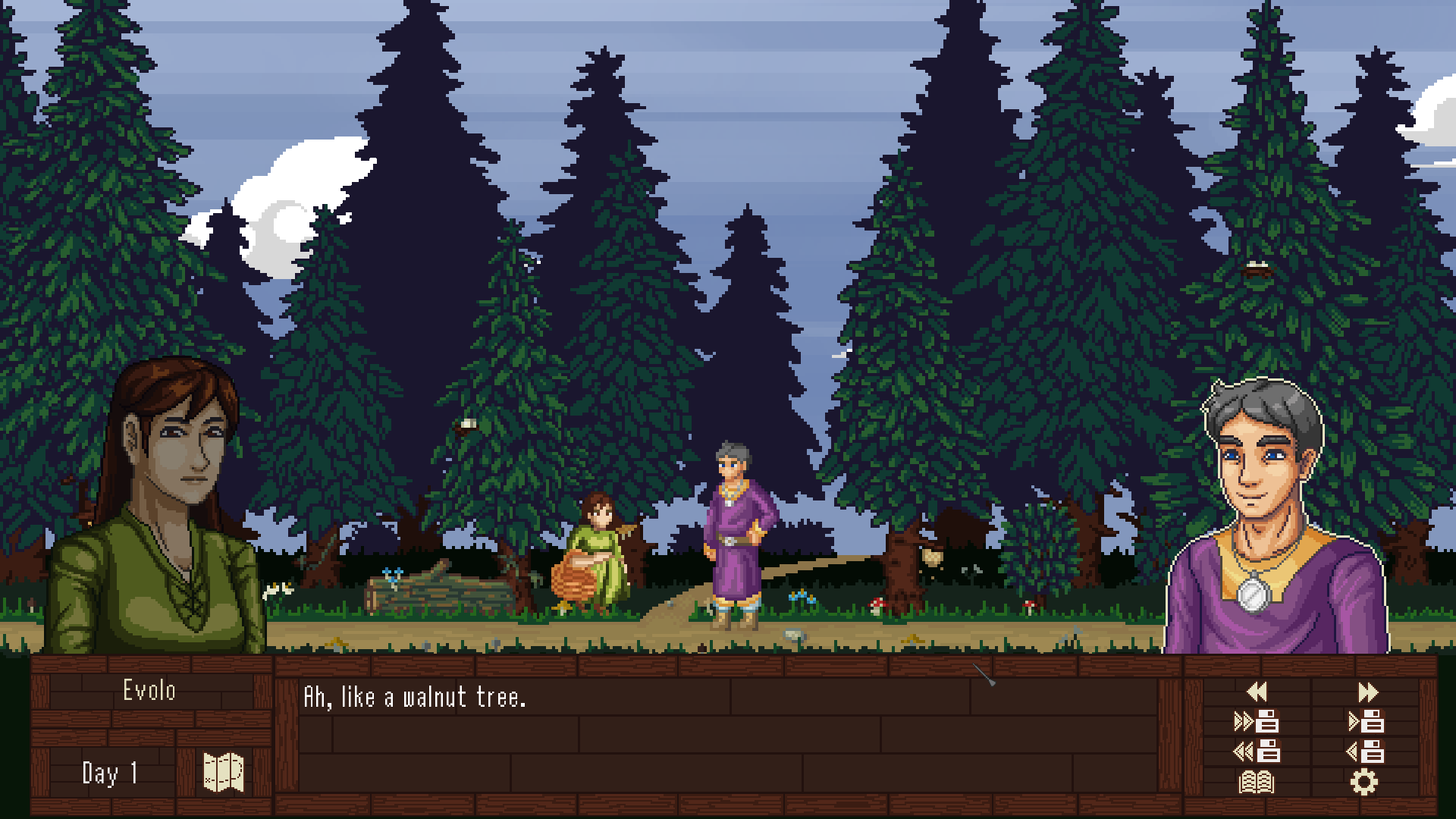
A view into Tales from Windy Meadow
Aure: Thank you! And yeah, I'm unhealthily interested in how people perceive my works. I want to grow, get better, deal with my creative shortcomings, especially since I don't allow myself to stay in my comfort zone.
Nevertheless, Tales From Windy Meadow is extremely niche. A pixel art, fantasy, slice-of-life Visual Novel... I honestly think that there are no people who would buy such a game just because it's on a store shelf and looks kind of nice. People who play it are interested in what it has to offer. All the reviews are either positive or quite enthusiastic, and I think people can sense that the game was made with love and passion.
Jubal: Yes, it's unusual in several ways, bringing together a game genre (slice of life/choose your own adventure), and a setting (medieval fantasy) which are rarely seen side by side. Did you see the game as experimental when you were making it, and did you have any dead ends when working on that format?
Aure: I never give myself a task to write something unique or different, though I'm usually most interested in ideas that challenge me, and catch my interest by showing me something that I can't think of on my own. The original idea for the story wasn't that fascinating. I had to invent a completely new structure for it, but ultimately I was able to invent something that made me feel excited about sharing it with other people.
And as you say, it turned out a bit unusual. I was aware of that. Trying to find an audience for such a game was extremely difficult. I hope that in the future more people will try to merge slice-of-life topics with fantasy settings. The potential of new metaphors and timeless surroundings that can travel across various cultures is great. I'd dare to say that many creators try to add some slice-of-life elements to their books, but there's a lot of pressure to turn all the stories into empowering adventures. I just find repeating the same ideas boring.
As far as the dead ends go, I encountered some, but I mostly blame my own inexperience and wrong decisions that I made. I had to fix my mistakes and learn how to give up on some ideas that I loved, but weren't really that good. Thankfully, everything turned out pretty well. Or so I hope. When I was translating the game from English to Polish, I was actually amazed that I somehow pulled such a weird story off.
Jubal: Iudicia has in more than one review been noted as an example of a character who's heavily implied to be autistic, and Fabel is physically disabled – what research went into creating those characters?
Aure: Fabel's condition was a bit easier for me to grasp, though I would also point out that both of these characters suffered from painful childhood traumas as well. Ever since I was a boy I had contact with people who faced even more advanced physical limitations than Fabel, such as my mother's friend who was born without legs and with only one arm.
I'd say that Fabel is somewhat lucky - he lives in a community that is ready to support him, and offer him help and directions. He wasn't left alone. Even in modern societies there is a lot of people with disadvantages, who are completely capable of achieving great things, but face a lot of rejection from their society. Very often these limitations are rather social, than physical. There are, however, works of fiction that did justice to these topics much better than I ever could, so I decided to not sink into them.
Writing Iudicia with an autism spectrum in mind was extremely difficult for me. I mostly spent time learning about the diagnostic procedures (which are much easier for children than adults) and what people with Asperger syndrome have to say about their adulthood. It's not difficult to write a stereotypical person with Asperger's, but I wanted to avoid silly stereotypes. My plan was to design a character that yes, has an unusual brain, but also much more than that - it's a person, not just a development disorder put inside flesh. I think her relationship with Evolo serves here pretty well.
An additional difficulty was putting this topic into a pre-scientific fantasy realm which doesn't know what "autism" or "developmental disorders" are. Iudicia only knows that other people see her as a weirdo. And she thinks that they are weird as well. I wouldn't be surprised if some players didn't even notice her condition. There was just so many ways to screw this up that I can now only hope that I chose the right approach.
Jubal: The setting design is one of the most iconic features of Tales From Windy Meadow, especially the giant, aggressive nature of the animals and wilderness. What inspired that aspect of the game's world?
Aure: As I mentioned before, designing tabletop RPGs was one of my strongest passions. The setting of Tales from Windy Meadow is called Viaticum, and it's something that I've been working on for about ten years now. Even Windy Meadow doesn't perfectly reflect the current state of this setting - I made some major changes to it since the beginning of the game's development, and some of these changes couldn't be portrayed without delaying the game for another half a year or so.
The core concept of Viaticum is to portray a fantasy world in which nature is more powerful than mankind. So here are some ideas that were meant to complement this concept: the complex social structures known to us from history are not be fully developed, and the human settlements are constantly threatened by the monsters hidden in the wilderness. The monsters are not some intelligent creatures that you can make a pact with. They are a force of nature - heavily inspired by the Earth's prehistoric animals. Dragons are dinosaurs, unicorns - elasmotherium. The goblins, which you can see in the game, are pretty much a hybrid of Australopithecus afarensis and Homo erectus.
There is a ton of material that just didn't make it into the game, but having a complex lore helps me a lot with keeping the mood and the game's world cohesive. I could talk about it for hours, because I absolutely love this setting. I hope to share it one day online.

A conversation in Stabulus' tavern
Aure: For me, all of these questions are fun! But it's a tough one. I identify with the majority of characters presented in the game. All three protagonists are in some minor parts a bit like myself. Many side characters are based on people I know or some old dreams of who I wanted to become.
Nalia, for example, is a character that was the protagonist of my previous, much humbler video game, The Tavern. In Tales from Windy Meadow she's 40 years older and is struggling with the demons of her past, mistakes (or terrible things) that she made. I would like to be like her younger self... But I wouldn't like to take her place in Windy Meadow. She's sort of a sad, troubled person.
If I would have to choose one character, I would take the place of Stabulus. Having a tavern in a fantasy village is like ten times more fun than working in a bar, and who wouldn't like to have their own bar?
Jubal: A few questions on the development side – how big a team contributed to Tales From Windy Meadow in the end, and in what roles?
Aure: It's difficult to give you a specific number. Every person added something special, but for some people it was hundreds of hours of work, while for others it was less than a day of effort.
The most important part of the crew are people from Indonesian artist guild Oray Studios and two other pixel artists - Roberto Luquero and Andrea Zevallos. Oray Studios drew the majority of character animations and almost all of the backgrounds, which I love beyond reason. Andrea stands behind character portraits and core visual designs of their sprites, while Roberto provided general graphics support - he's also the person who drew the map of Windy Meadow.
I also feel that the whole game would be very different without music from Doctor Turtle. His guitar-folk experiments were inspiring me long before the first draft of the story was written. Joanna Falkowska worked on the game's website and helped me pretty much on every level of development, and of course the game was made in Ren'Py engine, which is designed to support Visual Novels and is a priceless (yet free) tool.
Jubal: You mentioned on the development thread that about half a year into the project you had a team member leave, and you yourself had to move from intending to do a lot of pixel art and design work yourself to taking on a lot more of the programming and outsourcing more design. How difficult was that change, and what would you say to any reader who found themselves in a similar position?
Aure: Don't find yourself in this position. Instead, do your best working a day job and saving money on reliable professionals, or have another backup plan.
The game was initially developed on a shared revenue model, which means that other team members were working in their free time, in hope that after the game's release it would return their investment. It also meant that the people who worked on the game were passionate about the general idea and were interested in seeing what can we create together.
There would have been nothing wrong with someone quitting the project, since time and effort are valuable and many things can change in a couple of months, but our programmer kept participating in game jams, spending her time on travels, and working on her own projects, and after a couple of months there were pretty much no results to show. As a result, I had to take this responsibility on myself. I changed the game engine to a simpler one, learned how to use it, and limited my drawing work to the simplest edits.
It was absolutely exhausting and extremely stressful. It did allow me to modify the game many times through the project, though, adapting many scenes to what I felt was feeling the best at any given moment. I learned quite a lot.
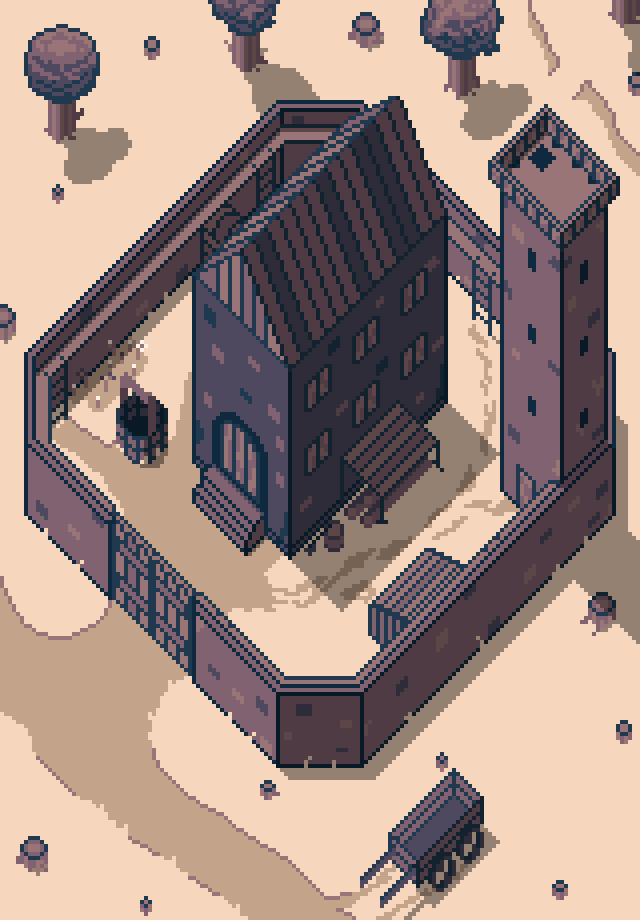
Concept art for the next venture into Viaticum!
Aure: I'm very happy with the final results. Pixel art has an amazing strength to it - it doesn't try to portray every little detail and leaves a lot to the player's imagination. Your brain fills the canvas on its own.
In many low-budget Visual Novels backgrounds are not very important for the story - a bedroom is a bedroom, a street is a street. In Tales From Windy Meadow, however, they are essential to follow the plot, especially since character sprites literally walk around and interact with their surroundings. So the game has a couple of points to pay attention to at once: the text, the character portraits and the backgrounds with their animations. It's easy to miss some details. Pixel art allowed us to provide a lot of contrasting colours and make sure that the backgrounds are easy to comprehend and follow, without providing too much distraction - just like in an old-school adventure game.
It was also important for me to instantly make it clear that the game is not your "regular" Visual Novel with cute manga girls nor nudity, just to make sure that no one would feel cheated! I was strongly inspired by my favorite Visual Novel, VA-11 Hall-A: Cyberpunk Bartender Action. Va-11 Hall-A is using pixel art to draw manga-like portraits. I decided to go a step further.
Jubal: Finally, can we look forward to seeing more of the Viaticum world? What are your next plans?
Aure: My goal for the next couple of months is to work on the prototype of my next game - a non-linear RPG with Visual Novel elements to it. It's going to be set in Viaticum, about 20-25 years before the events from Windy Meadow. Here on the right you can see the first concept art that I drew for this project.
I'll also be working on the next edition of the Viaticum tabletop RPG. The game is pretty much complete, but needs some more testing; it is also spread among various, chaotic files and needs to be re-written from the ground, so I'm not going to work on it right away. It's just a side project.
I have many ideas what to do next, but I assume that even these plans will take all of my creative power for the next two years, so let's stop at that...
Jubal: We're certainly looking forward to seeing it. Thank you very much for talking to us!
Aure: Thanks for having me!
You can get Aure's game, Tales from Windy Meadow, here, and of course also visit the Moral Anxiety Studio website here.
Got further questions for Aure? Please drop them in the comments below! And let us know which of Exilian's many creative folk we should be interviewing next!
If you have an idea for an article yourself, meanwhile, please do check the guidelines and send it in, we'd love to hear from you!
An Unexpected Bestiary: Pangolins!
February 16, 2019, 11:49:18 PM
By Jubal

Long tailed pangolin, Image: US Fish & Wildlife Service, via Wikimedia Commons.
An Intro to Pangolins
To begin with, a recap of what pangolins are is probably in order. They're an unusual order of scaly mammals, the pholidota (from the Greek pholis, for a scale). Whilst sometimes confused with armadillos, pangolins are an old world order living in Africa and southern Asia, and their characteristic scales overlap much like scale armour, whereas armadillo scales form hard bands of nodes around their body. There are eight living species of pangolin, and at least one known extinct species: the smallest tree-living pangolins like the Long Tailed Pangolin of central Africa weigh just a kilogram or two, whereas their southern African cousins, the Giant Pangolins, live in burrows and can be over thirty kilograms – about twenty percent of that weight being in the hard suit of armour.
The English name of the pangolin comes from the Malay pengguling, or "the one who rolls up" – indicating another of their best known abilities, rolling into a ball so that their scales form an impenetrable wall on all sides to protect them from predators. That's not all they can do though; their hefty claws can dig or tear apart pretty solid obstacles (such as termite mounds). They have no teeth, but eat stones to help grind up food in their stomach and have very long tongues to help satisfy their insect-eating diet, so much so that the root of the tongue muscle is planted deep in the animal's body rather than at the back of the mouth. Their strong prehensile tails help balance them for upright walking, allow them to hang from tree branches, or even let them walk up a tree solely on their hind legs, claws gripping the bark and tail providing balance. Finally, in case the scales aren't enough, they can emit a noxious scent in a similar manner to a skunk.
Human interactions with pangolins are the main subject of news on them nowadays, for the simple reason that we're wiping them out, despite their impressive evolutionary defence arsenal. Huge demand for pangolin scales and meat as a miracle cure or aphrodisiac has driven massive levels of hunting, and pangolins often die rapidly in captivity from stress, with techniques for captive populations only starting to evolve in very recent years as conservationists desperately study how to ensure some survive the attentions of poachers. But why are pangolins seen as such a potential asset, and why are people so willing to believe in their magical properties? This fascination has long been apparent; the four Asian pangolin species are in the genus Manis, which Linnaeus in the 1790s named after the Manes, spirits of the dead in Roman mythology. The answer may in part lie in the extent to which the pangolin defies classification: scaly but mammalian, some arboreal and some ground-living, plodding along on two or four feet, it's little wonder that they have frequently been ascribed otherworldly properties.

Pangolins live in various habitats, from jungle to near desert.
In various southern African mythologies, the pangolin seems to have a range of associations with the sky, luck, and fortune. The Sangu of Tanzania traditionally believed that pangolins fall down to earth from the sky, and select a particular human, whose village then performs various rituals which ultimately involve the pangolin being sacrificed. An interesting Sangu story involves a chief who turned into a living tree during the day, but 'separated' into a human and a pangolin at night, until his wife killed the pangolin, keeping the chief in human form. A number of South African tribes likewise believe that pangolins come from the sky but during thunderstorms specifically, and several also believe that pangolins will bring luck to the person they appear to. From further north in Africa, meanwhile, the pangolin is a cunning creature – a recorded Ba-Kwiri story has a pangolin, Kulu, beating an antelope, Kawe, in a running race by posting a hundred of its friends along the route, having each one appearing fresh when the last tired – the gazelle, unable to tell them apart, tired out far sooner and was unable to prove the deception.
Another common thread is the idea of pangolins having hidden characteristics or power; Malay and Sri Lankan folklore apparently holds that pangolins can kill an elephant by biting its feet, then coiling itself around the elephant's trunk to suffocate it. In some Malay myths, this is extended, and some kinds of banyan or "jawi-jawi" tree are apparently avoided by the elephants altogether for fear of the pangolins which leave their stench there (which given their ability to produce noxious sprays may not be a stupid move on the pachyderms' part). Another hidden power link is the obvious association of these burrowing animals with the earth. The central African Mbuti, according to one paper, held that pangolins if angered could drag humans down to the underworld through their burrows, which is a fascinating idea of the pangolin having hidden power. Some Chinese folklore apparently holds that pangolins can travel right round the world with a network of subterranean tunnels that they create, and one Chinese name for the pangolin, "the animal that digs through the mountain", reflects this story.
Finally, it's worth noting that as much as some of us may love pangolins, they aren't universally beneficial in folklore. In some South African cultures they bring bad rather than good luck, and it's often considered taboo to touch or eat them due to their supposed mystical properties. Among cultures that sacrifice pangolins,it is often a ritual done with great care: the Sepedi never kill pangolins during the rainy season for fear of causing a drought. The Tswana, meanwhile, have one of the mouse interestingly gruesome pangolin myths, believing that you must never carry a captured pangolin in a sack over your shoulder, or it will use its long tongue to suck your brain out through the ears. Otherworldly mystery, to say the least, isn't always friendly.
Pangolins as inspiration
We've just scratched the surface of the world's pangolin folklore, but gives a great starting point for thinking about the pangolin if you'd like to use them in settings, writing, games, and so on. Some good hooks; firstly, pangolins have value in magic and belief, and less scrupulous characters are likely to want to make use of that whether or not you actually impart the pangolins of your setting with power. There's a good chance either way that pangolin-related potions may (sadly) be existent in your setting – possibly even pangolin-scale armour, too, though to me either of those feels rather like unicorn blood in that there's something unsettling and taboo about killing such a creature.
If you have regular pangolins as we have in our world in your setting, they're no particular threat to humanoid characters, though you could certainly over-emphasise some of their physical characteristics to make them more of an issue in that regard rather than them just being a helpless (to humans) hunting target. Even if not as a threat, just emphasising the pangolin scales and their defensive powers could be interesting. On the other hand, if you wanted to make a really large and more potentially aggressive pangolin, then a metre or two long pangolin could be pretty scary with a mix of horrifically noxious sprays and hefty claws as well as the razor-sharp edges of its scales. The toughness of pangolin claws would be a fun thing to emphasise with regular size pangolins too - having one break out of a supposedly secure box or enclosure just by tunnelling out through some concrete would be a fun move to pull.
A tricky question when it comes to the Kawe and Kulu story and things like it is how much sapience you want to give pangolins in fantastical settings. My recommendation is "not too much" - it's easy to end up writing pangolin-people instead of pangolins, which are also fine but are quite a different thing to be working on. I think in some ways it may ruin the enigma as well if you go down that route. An important part of the pangolin feeling magical is the mystical nature of it as a creature, so even if you want pangolins to have meaningful interactions and understand humans to an extent then I wouldn't go as far as making them just another speaking 'civilised' race for the most part (though I suspect one could work out some good exceptions to that!)
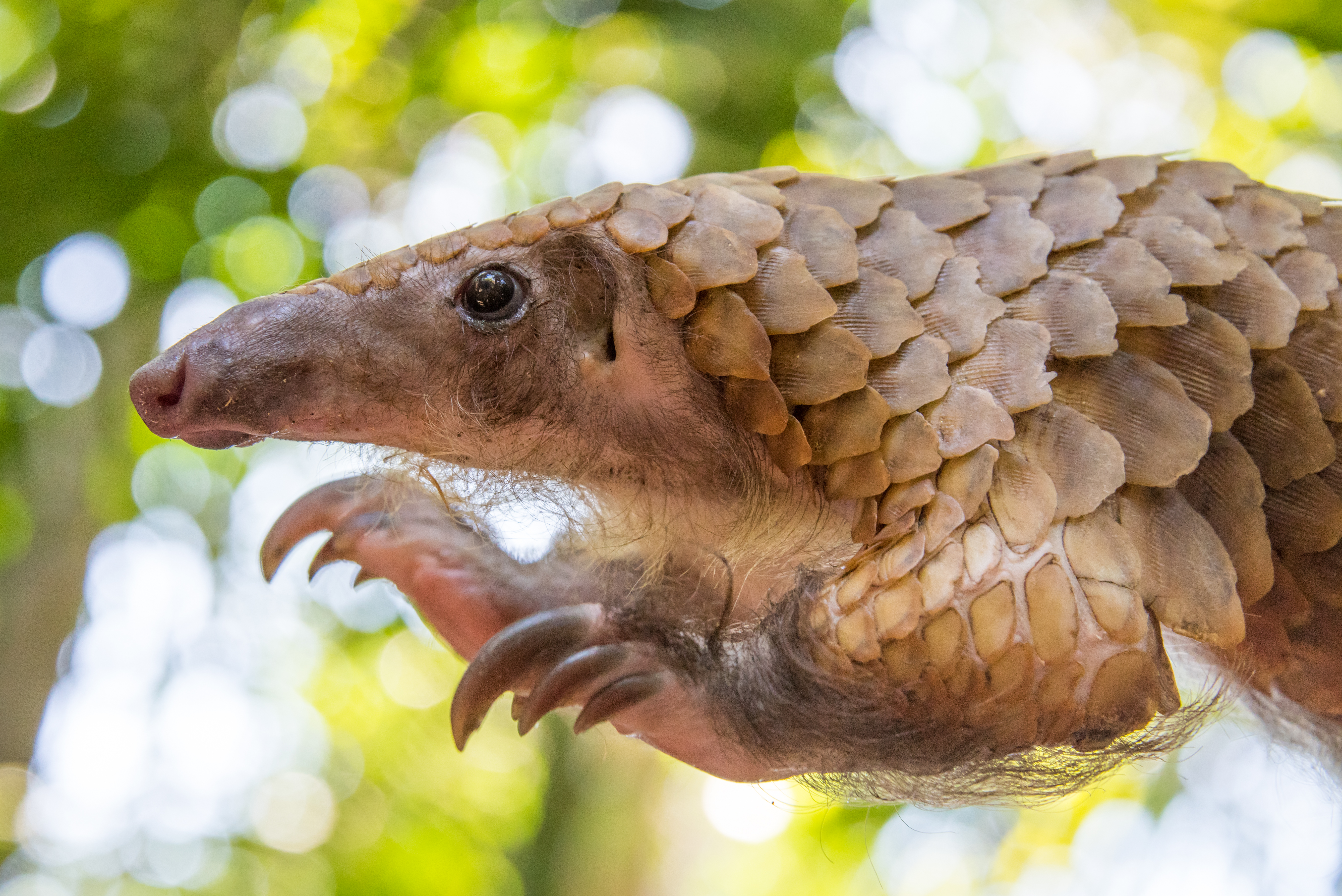
Sky-shaker, or down underground? Photo: USFWS
Conclusion
There's so much more to be written about pangolins in folklore and their storytelling potential: most of what I've read has been scattered studies from across Africa, so Asian pangolin folklore has been dealt with pretty lightly here and if I find more good resources on it then I may have to do some more writing in future. The pangolin is an animal I've found captivating for many years now, and I hope from this brief little introduction you can start to see why. Happy World Pangolin Day, and let's hope our scaled friends are with us to inspire us for many, many more to come. Thank you so much for reading!
You can read part one of the regular An Unexpected Bestiary series, here, part two here, part three here, part four here and part five here.
If you enjoyed this article, please donate a bit to the IUCN pangolin specialist group whose work is vital to keeping Pangolins around.
The Problem of Focus
February 10, 2019, 09:07:39 PM
What is focus?

A functional world, or are things in the lap of the gods?
Let's look at a few examples to see what I mean. Firstly, there's how 'realistic' a world is, with low fantasy tending to have less, and less obvious, magical elements. There's also how 'pathetic' or 'heroic' the aesthetic is - a pathetic-aesthetic protagonist could be a scoundrel who ends up fighting giant rats in a sewer, while a heroic protagonist actually stands against whatever in their world counts as fearsome odds with a brave heart. Another factor is the 'grit level' – that is, grimmer and darker settings that involve painful human failings and unpleasantness are often considered 'lower' fantasy as a result. And there's the issue of how clear and functional the events and fantastical elements are – do they just fit in as additional technology or species that can be used predictably by characters and other agents, or do they signal a world where the rules are decidedly more like guidelines, to be discarded when the plot demands?
It's this last idea I want to look at today: how much focus does your world have? This is an idea that can bridge high and low fantasy; whilst a crisper focus may tend towards low fantasy, there's no hard and fast rule. In science fiction, the equivalent concept is a much more key divider. "Hard" sci-fi which exists within the bounds of physics is very much in-focus and functional, whilst "soft"sci-fi of space opera and space fantasy kinds is very low-focus, preferring to wave away the technical elements with a few science sounding words at most. This concept is very useful when applied to fantasy too, though. A setting with more mythical elements, that's happy to say "it just is" or "it was called into being by power beyond ken", is a low focus setting; a high focus one, conversely, stipulates that things operate in predictable ways under the same circumstances, and that whilst the rules and boundaries of this world may be different to the ones we're used to, they exist nonetheless. When just applied to magic this is sometimes referred to as the difference between a functional magic system (where magic has reliable set ways to invoke it, with set effects and set rules) and a mystic one (which is less tightly defined and more mysterious). The idea of high and low focus can apply to the rest of the setting too though. Is the setting's history built in known tomes or shrouded in confused oral tradition? Are mythical beasts just another species that mates and has babies and so on, or are they singular miraculous creations from the very earth or gods themselves?
Some examples might help at this point. The world of Harry Potter is very high focus; there are some clear bounding rules on what magic can do, spells have a predictable, reliable (if you fulfil the requirements correctly) effect, and so on. D&D settings are generally high focus – you shout "fireball", cast a fireball, and a fireball probably happens. Even for clerics, divine intervention comes in the form of clearly defined slots into which you can prepare defined abilities. Tolkien and Lewis on the other hand both write low-focus works. Gandalf's powers are never explained, bounded, or made consistent, and it's important for the book that they aren't; they are revelatory and miraculous, not a tool in the hands of just another character. In Lewis, the religious elements of his work import the low focus of religion with them. Aslan's rebirth on the Stone Table is a miracle, and its miraculous nature and the numinous sense that invokes, the realisation of Aslan's divinity, are what's important, not the unanswerable question of "so how did he do that".
The Use of Focus

Are your heroes problem solvers or virtue paragons?
Low focus is the opposite, and low focus worlds can delight readers precisely because ultimately their mysteries cannot be solved; there are things that the reader, or their perspective character, and perhaps even the author, do not or cannot know. This sense of miracle is common, indeed the norm, in the folkloric, mythological and religious texts from which most modern fantasy ultimately derives a lot of its creatures and heroic narratives; it has a tendency to disappear in the hands of many more modern writers who want to drive a compelling plot where the readers will feel they fully understand the resolution. This is in some ways a pity, because the effects of low focus can be spectacular; by declaring an exception to the laws of nature as we know them, a writer declares that there are things more powerful than those laws.
Rather than the intellectual thrill of seeing a plot point resolved, then, the reader of a low focus fantasy can be given a more gut-punching emotional thrill; that of seeing in your fantasy something fundamentally and incomprehensibly larger than oneself, whether that's a deity, a concept, or whether it's left barely named. This is used in myth so much because mythic heroes often embody virtues; we're not meant to consider how we could've copied or improved upon the hero's exact actions, we're rather meant to appreciate and emulate the virtues that in turn allowed them to make those calls on the underlying powers of their world. In the Odyssey, Hermes giving Odysseus the antidote to Circe's magic isn't a sign that Odysseus can't solve the puzzle himself; it's a signal that Odysseus is a great enough hero that the deities who represent the fundamental forces of human society and nature are willing to make a direct exception for him. In Tolkien, the continued enigma around the powers of the various magical beings is important in providing a sense of great depth to the whole setting.
Problems of focus
As a final part of this article (or at least this part – I had a whole discussion geared up on high and low focus in game contexts which is going to have to wait), let's look at some of the pitfalls with how writers use high and low focus. One of the most common is breaking a high focus setting for a single emotional low-focus burst – when love, or a deity, or the power of friendship, suddenly save the day in a way that the reader wasn't expecting. If you've generally made it the case that the reader could expect a cause and effect relationship for things throughout the work, this easily comes across as lazy deus ex machina writing. A lot of this comes in how you set your protagonists up - it feels right when a druid can call on mysterious powers of nature they never knew at a critical moment to save the world, but very very wrong if, say, a MacGyver type engineer character at a critical moment suddenly stops thrilling us with clever tools and tricks in order to suddenly be saved because love has granted him immortality.
If you want to use low focus, you ideally need to establish a consistent sense of mystery and knowledge beyond what is accessible to your characters. Low focus, conversely, can't be used to fire constant deus ex machinas. Simply because there isn't a functional logic to how your fantastical elements work doesn't mean that they should come out of the blue; it needs to feel right to the reader on an emotional or numinous level for them to be able to maintain the sense of wonder involved. Low focus, in other words, requires drama and theatre in its workings in a way that high focus fantasy doesn't; it requires not just a general suspension of disbelief for the whole secondary world, but a specific, case-by-case suspension of disbelief for every particular magical instantiation.
So, what have we learned? High and low focus can both be good ways to write fantasy, and give very different feels to a setting, though ones that don't always mix well. A world dominated by high focus is good for puzzles and plots, where you're pulling the reader along with the intellectual intrigue of what characters will do. A low focus world is one where you can't always puzzle things out and there are bigger and more mysterious things out there, enabling a sense of mystery and miracle that focuses far more on what characters can experience or feel. I hope you found this article useful – let me know (or start a discussion on) where your worlds fit into this in the comments below, and do let me know if this was useful to you as well. Thanks for reading!
An Unexpected Bestiary: The Third Parchment
December 29, 2018, 03:31:39 PM
By Jubal
It's been a while coming, but here's the third part of my Unexpected Bestiary series, in each of which I look at seven lesser known or lesser thought about animals and give you some information on their lives, names, and culture, and perhaps an idea or two for how you might use them in your creative projects. As ever, please do let me know what you found useful in this and I'll try and ensure more of the things people are after get into the next article! You can read part one of An Unexpected Bestiary, here, part two here, part four here, part five here, and the Pangolin special here. This time we've got hyraxes, oilbirds, sea sheep, and more besides, so do read on and find some stuff out...

These squat, furry mammals, mainly found in Africa, despite being superficially like a pika or marmot are curiously more closely related to the manatee and the elephant. Rotund and short-tailed, they live up cliffs in caves and small burrows, and are good climbers, mostly eating vegetation of various sorts. One curious quirk is their tendency to huddle – they actually have very bad internal temperature regulation compared to most mammals and will sun-bask or sit in huddles in order to compensate for the fact.
The hyrax is a bit mysterious in its way, being in a role we more usually associate with rodents or lagomorphs but not akin to them, and it is maybe in that role that it's best fitted into stories and settings. They're mentioned in the bible, and they make a suitable substitute for rabbits that mark out a warmer and more rocky setting, but they may have uses beyond that. In one rather obscure novel, Omar, a hyrax character claims their species was the origin of Lewis Carroll's "frumious Bandersnatch", and one can imagine these heavy-browed, almost lorax-like creatures taking up some sort of talking-animal or similar role.

The oilbird, or guácharo, is certainly not a well known animal, and nor is it initially a very dramatic seeming one – it's a medium sized brown bird that mainly eats fruit. There are a few things about the oilbird that make it rather more intriguing though; for one thing, the name "oilbird" comes down from the fact that people used to literally boil down oilbird chicks to get the oils out. Given this rather gruesome fate, it seems little wonder that the oilbirds have a famously harrowing cry – on Trinidad they were sometimes referred to as "little devils". The oilbird has one other sneaky and rare trick up its sleeve too; it's one of the only birds that can use echolocation, clicking its beak and listening for the echo to work out where it's going at night. We are used to the high-pitch echolocation used by bats, which in any case we can barely sense, but there's something decidedly unnerving about a flock of birds (and oilbirds live in cave-dwelling colonies) flying out into the pitch black, clicking their beaks as they find their way through the night.
The hunting of oilbirds was vividly recorded in the nineteenth century, when travellers to a Venezuelan monastery recorded the massacre of huge numbers of oilbird chicks around midsummer. Local people would apparently move their dwellings up to the mouth of the birds' caves and process the chicks on the spot after knocking them down with long poles, with the terrible cries of the adults in the darkness above their heads. As well as oil, they would cut open the crops of the birds and take out hard "guácharo seeds" for use as a fever cure. The oil harvest produced the whole year's cooking and lighting fat for the monastery - but as the fever cure story shows, the caves were nonetheless a place of superstition. This may be no surprise, either, with the birds literally able to fly far deeper into complete darkness than the humans could, with increasing numbers of increasingly piercing cries if one went further into the cave. The association with hell was very direct - death was known as joining the guácharos to the local people, and the exorcism of spirits (including a chief evil called Ivorokiamo) was noted as one of the activities happening at the cave mouth. They're evocative birds, I think, with real inspiration potential.

The far from humble caracal has to be one of the most under-appreciated members of the cat family. Its name is Turkic, from kara kulak, literally "black ear", and their impressive ear tufts along with their orange coat and sleek build make these visually very impressive animals. Whilst not as big as a leopard or lion, they are fast, agile, and capable of taking down prey far larger than themselves. Their powerful back legs give them a particularly notable jumping ability, which they can use to take down avian prey as it tries to fly away from them.
The caracal is stuffed with potential for stories, and has a long history of interaction with humans, mainly in that they can be trained as hunting animals (Iranian legend had the mythical Shah Tahmūraṯ select them as one of the first and best hunting animals to be trained, along with the cheetah). For any nobility who consider dogs just a bit too normal they can be used in much the same way, especially for running down small and nimble prey like hares or birds. Chinese Emperors used to give them as gifts, and it was common in parts of India to test trained caracals against one another by using them in competitive pigeon hunts (almost certainly thereby originating the phrase "put the cat amongst the pigeons"). A pet caracal definitely marks out either a setting or a character as either connected or existing outside a European-themed milleu, and bestows on them the feeling of seriously cool elegance that cats always have. There's also definitely something more impressive about hunting with cats because we don't expect it – humans regularly hunt with dogs and we tend to think of them as controllable, whereas we have a very different idea of cats and being able to command them feels inherently more impressive and very classy indeed as a result.

The sea sheep is actually a sort of sea slug – a bizarrely diverse group of creatures with a multiplicity of forms – with a pale body and a mass of green fronds attached to its back. So why look at this particular blobby invertebrate? Firstly, it has a bizarrely cute face that looks very much like a cartoon farm animal, hence its name. Second, it has an absolutely incredible biological trick that's well worth its inclusion here. Like most sea slugs, it eats algae. Unlike most sea slugs, it steals the chloroplasts out of the algae and reincorporates them into its own cells. Those green fronds aren't just for show; they're actually photosynthesising, letting the sea sheep produce energy direct from sun power.
The suggestion of photosynthesising animals has often been made in sci-fi (not least in some theories around 40K Orks) but it's very cool to see a species that does it for real. We think of plants and animals - and different categories within either - as being fundamentally separate groups that we can distinguish by means of identifying characteristics. Creatures that by their nature play with and distort those boundaries always add significant interest, both in challenging the reader's ideas about the world and in making that particular animal stand out. The nuidbranch sea slugs of which the Sea Sheep is one are all pretty strange and have an almost science fiction feel to them to start with - to come up with strange things in space, starting here on earth is often a surprisingly fruitful point of departure.

Image Credit: Alex Pyron
There are two types of slender loris – the endangered Red, native now only to parts of Sri Lanka and with few left in the wild, and the commoner Grey which also lives in wide areas of southern India. They are primates with huge eyes, usually solitary and nocturnal and thus rarely seen, mainly feeding on insects deep in the forests of their home. Like all primates they are excellent climbers, and their huge brown eyes give them a strange sense of wisdom. They used to be considered quite ugly due to their thin, lanky appearance, and the Tamil word for loris, thavangu, could also be applied to ill and emaciated humans according to 19th century records. One old proverb recorded in the early 20th century was that they say that the loris's offspring is to it as beautiful as a gem - in other words, that parents will love their children even if they are ugly or misshapen.
For the lorises, humans and habitat loss are a major threat, but with some difficulty greys have been kept as pets. Slow-moving, and with strangely human-like hands and big front-facing eyes, they have reportedly been used by fortune tellers to select tarot cards, and that sort of mysticism suits their strange nature right down to the ground. Their association with magic and the mysterious extends to their use in potion-making traditions, from eye medicine to supposed leprosy cures. In setting design writing they would no doubt make an excellent companion to a mystic or magician for exactly this reason – there's definitely something of the ethereal about these beautiful little creatures.
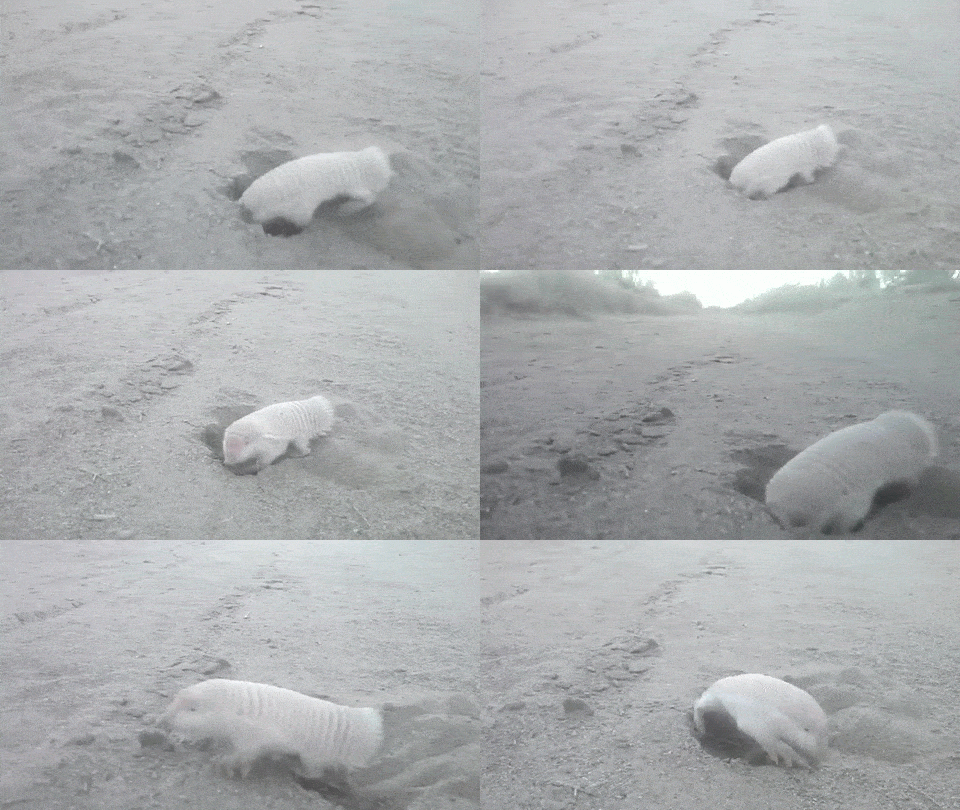
The Pink Fairy Armadillo's name alone is more than enough to merit inclusion in the Unexpected Bestiary, but they're also just all round lovely little creatures. They're mainly burrowing animals, and small enough to fit quite comfortably in someone's hand. Their slightly odd shape, with a very flat back end, is an adaptation to ensure they're armoured from behind as they dig away at their tunnels: like all armadillos they of course have armour plating, too, though it's not enough to fully protect them from feral dogs which are one of their major predators.
I think to include the fairy armadillo in setting design you have to double down on how weird it is. As a burrowing animal they don't make good pets, so their use to humans is always going to be very restricted: their use to fairies, pixies, and sprites on the other hand could be great fun to read about, either for hole-digging or perhaps as beasts of burden. I don't know if the pampas has many traditional little folk myths, but it would be great to see these combined with some such creatures for a story.

Wilson's Phalarope. Image credit: USFWS
Heading out to the coasts, the phalarope is a bird of shorelines and salt lakes that has some surprising and interesting characteristics. There are three existing species: the grey, red-necked, and Wilson's phalaropes. The most characteristic sign of these birds is their tendency to swim in apparently mad small circles – a behaviour that is actually a core part of how they feed. Their circular swimming creates a vortex in the water that pulls mud, small crustaceans and insects up from the bottom of a pool; the phalarope can then simply dip its long beak in and grab morsels to eat. It's an interesting feeding strategy and it might be a fun idea to apply to mythic creatures too - it's certainly a good alternative idea for where a whirlpool comes from! In phalarope society, it is also the female that rules the roost, with females being large, brightly coloured, and each engaging in competitions to win over a number of smaller, drab males with whom they mate and who they then get to look after and hatch the clutches of eggs they lay. Once the breeding season is over the birds will migrate every year to stay with the best feeding grounds.
The name 'phalarope' means 'coot-foot', referring to the coot, a commoner bird with which it shares a foot shape, and beyond its inclusion in the title of a 1953 novel by South African anti-apartheid activist Alan Paton there's little more to be said there – its other names give some rather more exciting ideas, though. To sailors, it was once known as the whalebird, or mackerel goose; the names Wassertreter (German) or the beautiful veetallaja (Estonian) meanwhile indicate its water-treading habits as it swims in whirlpool-building circles. Given these birds' distinctive circle-swimming and profoundly matriarchal society there's a surprising dearth of folklore I've been able to find on them; perhaps that's an opportunity as much as a drawback for a canny writer, though...
I hope you enjoyed this run through a few more obscure and interesting animals - there's plenty of fish left in the sea (we didn't even do any fish this time), not to mention birds in the air, etc, so I hope we'll get one or two more of these articles out in 2019. Please let me know if you enjoyed it - comments, and sharing the link to this article so others can find it too, are always hugely appreciated. And of course thanks for reading!
A Forgotten Realm: Tartessos
November 18, 2018, 10:56:16 PM
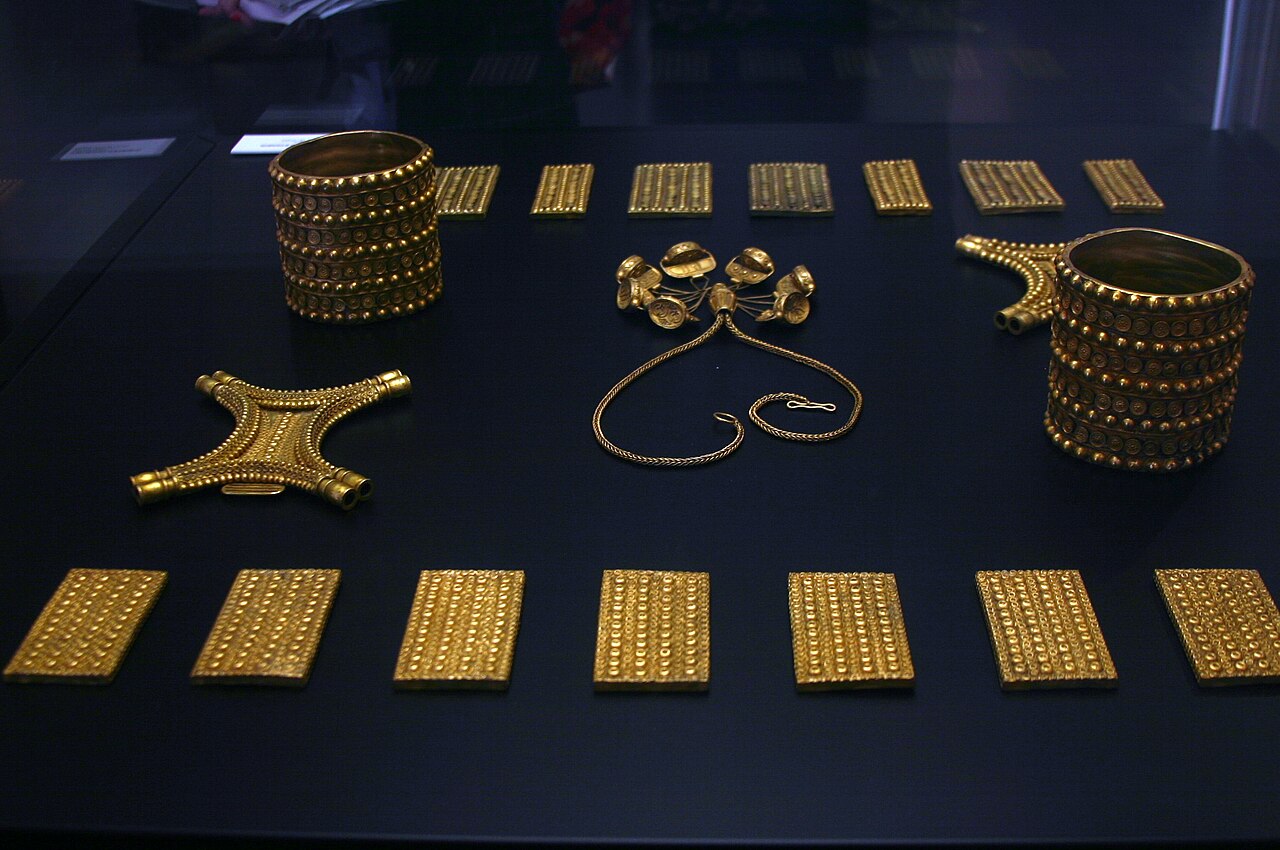
Tartessian gold artefacts. © José Luiz Bernardes Ribeiro, CC-By-SA license.
Tartessos is a Greek word, and it is to the Greeks that we must mostly look for writing on the people who lived there. Herodotus, in the fifth century BC, paints a picture of a fully functional monarchy capable of negotiating with Greek merchants who arrived on Tartessian shores. He gives us just one name for a king, Arganthonios, though whether this is really a name, a title, or an epithet is impossible to tell. Either way, it is likely linked to modern words like argent, meaning silver – the metal that southern Iberia was known for and which could well have given the Tartessians great wealth. Herodotus shows them having friendly relations with Greek seafarers, with their trade making an accidental lifetime's wealth for Kolaios of Samos, apparently the first Greek to sail so far west and only then due to being driven there by storms. These friendly relations may have had a darker overtone though, too, in mutual fear at the rise of what would ultimately become the dominant pre-Roman power of southern Iberia, Carthage. Scattered references exist elsewhere – Stesichorus gives Tartessos as the home of the giant Geryon whose cattled Heracles stole, and one later reference suggests that the Tartessians' own sailors reached as far as Brittany – but for the most part the history of Tartessos as a country remains mysterious.
This vague picture of a rich and welcoming culture is only the starting point, however, for what we now know about the Tartessians – archaeology in recent decades has provided a considerable amount of additional interest. Huelva, a modern city that is another strong candidate for having once been the Tartessian capital, boasts huge pre-Roman deposits of silver-bearing slag material. With gold and tin also present in southwestern Iberia, the fabled wealth of Arganthonios seems thoroughly historically plausible, and mining (done without even the aid of iron tools) seems to have been a common activity even before Greek and Punic influence on the area began in around the eighth century BC.
The arrival of foreign trade is likely to have supercharged the mineral-rich economy of the region, with trade posts springing up on the coast and imported pottery starting to appear in Tartessian graves, flowing in as heaps of rough-chipped hacksilver flowed out to be traded by weight at markets across the Mediterranean. Along with their pottery, other new objects brought by traders started appearing in Tartessian life – incense burners, bronze jugs and braziers. Decoration styles, as in the Greek world, moved from geometric designs to more detailed imagery, with jug handles made as hands grabbing the bowl, and lotus flowers, gryphons, ram's heads, and other such motifs found more and more on common items. Trade may have even touched the Tartessians' gods, with statues of recognisably eastern and Punic-style deities providing some of the more spectacular archaeological finds in the region.
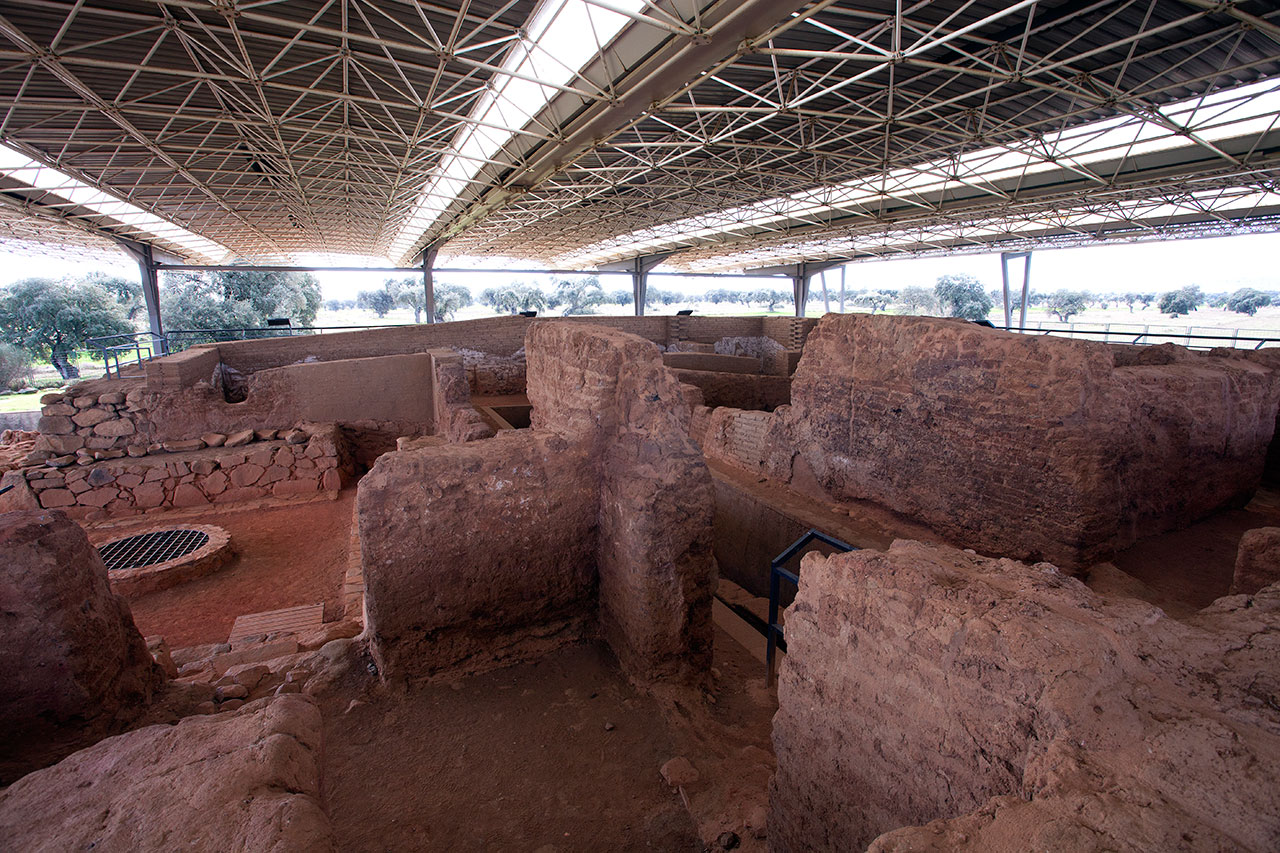
It this period that defined Herodotus' Tartessos, where a creative, if perhaps difficult, fusion of native culture, a thriving raw materials trade, and increasing economic and political influence from outside shaped a culture and, perhaps, the state that Arganthonios ruled. Tartessos moved from being a land where villages were formed of scattered circular huts to one where settlements had planned, stone-built houses. This land was not simply being absorbed into a new culture, though – it was adapting to it. The introduction of writing allowed the Tartessians to express in a Punic-style alphabet their own, possibly Celtic-related, language in inscriptions on their tombs, calling on deities with names that seem to link to the Irish god Lugh or the Celtic horse-Goddess Epona rather than to Punic Baal or Astarte. Spears and carp-tongue swords, in which a broad blade narrows in its final third to a stabbing point, seem to have been the favoured weapons of the Tartessians.
We have no records of how Tartessos fell, though Carthaginian expansionism is perhaps one of the more likely culprits. If there was a city of Tartessos based in the Guadalqivir delta, the shifting waterways at the mouth of the river may have also contributed to the loss of the city's power, as they have done with so many other port cities around the Mediterranean world. Either way, by not long after 500 BC Carthaginian dominance had been far more firmly established in the region, and Tartessian culture and literary references alike drop out of the historical record.
The rosy picture Herodotus handed down of Tartessos has proven captivating to some more modern imaginations. In these scattered references, some scholars saw in Tartessos a link to the fabled wealth of the biblical city of Tarshish, which spurred on archaeological searches for a central Tartessian city. Others aimed still higher, seeing in it, shining in silver beyond the Pillars of Hercules before ultimately being lost to floods, a possibility of discovering Atlantis itself. Even in recent weeks, a new film suggesting the 'discovery of Atlantis' involves aerial mapping teams claiming to have major new archaeological discoveries in the Guadalqivir delta. If they are to any degree correct – and given they have rushed to film-makers rather than academic journals, one should be cautious – it may well be Tartessians, not Atlanteans, who they have to thank.
Perhaps, though, Tartessos is as intriguing as Atlantis anyway. Being the only attested Iberian state to have been recognised across the Mediterranean before the Romans, they occupy a unique position in history. Caught between the Punic and the Atlantic, theirs was a land built on a metal-rush, full of new ideas and foreign images, all the while using them to express a culture they made their own. The silver wealth of Arganthonius may have long since been scattered, but the gods and people of his realm still have the power to intrigue.
Bosch, Breugel, Beelzebub and Baphomet
October 27, 2018, 10:37:44 PM
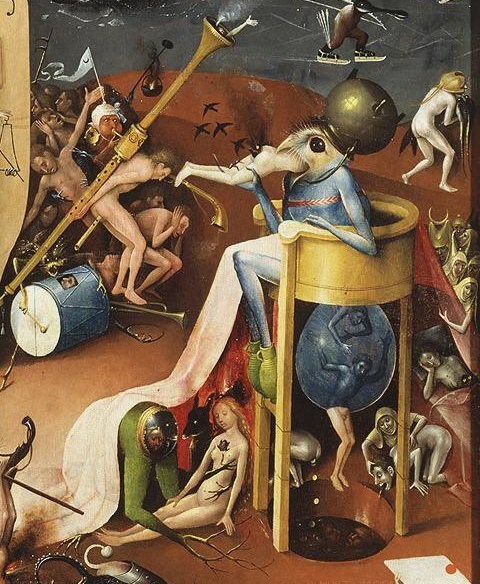
The Prince of Hell, from Bosch's Garden of Earthly Delights
Given their already notable impact on the genre, can these eccentric painters of the sixteenth century teach creators of fantasy anything today or add anything new to how we treat hellscape-style subjects? I think they can, especially when it comes to our depictions of demonic creatures. The dazzling variety of beasts in the works of the two men is one of their crowning achievements. Their demons are not regimented or regular, even when they appear in armies - they are the unique horrors of unique contraventions of the moral order of the universe.
Despite this, depictions of the demonic in fantasy media have settled to some degree. Horror demons have a lot of variation, but primarily down the lines of body horror and lovecraftian tentacles: meanwhile fantasy imps, devils and demons have in many cases settled into the goat-horned, satyr-like devil depiction, or at least some other form of humanoid. Tabletop gaming perhaps further builds on this perception, by presenting regular ranks of, to take two Warhammer examples, "bloodletters" or "plaguebearers", all of whom are essentially similar in style and function. If I say "demon" to you, you probably expect a pointed tail, red skin, perhaps a prodding weapon like a trident. Whilst it's great to have such an evocative image available, it feels like there's more that could be done to play around with those ideas.
Reintroducing a much wider conception of flat out weird demons and what they look like has a bunch of advantages for any creative work that touches on the subject. As such, here's three key ideas for how to use Bosch-style demon ideas in your creative work.
Firstly, ditch the humanoid body plans. Some of Bosch's stuff may be more body horror than you want in a fantasy campaign, but there's plenty that isn't, especially among the smaller demons he depicts. There are a few broad categories here it's worth thinking about: firstly, chimera-type demons, with animal heads, bodies, or both; secondly, blemmye types, where the order and number of humanoid body parts is edited, but in a way that is grotesque rather than horrific; thirdly, combination types, where a demon is heavily associated with a non-animal item, such as a walking helmet or a creature with knives for feet; and finally, a particular specialism in the bosch oeuvre, cavity types, where a creature's body is hollow and actually contains something else, be that a smaller demon or a useful/important item or similar.
Many of these are also great from a storytelling perspective compared to a "standard" demon. Chimera-types create an interesting mix of absurdity alongside malice, especially those with animal bodies and human heads. Their animal parts might be meant to exaggerate the extent to which they're a reversal of the norms - a fish or a chicken attacking a human, for example - or they might give clues as to a demon's character or goals (a conniving fish-demon or a cowardly chicken-headed demon might be fun for example). These things are done best when they're done with the most every-day things possible. There's something much more unsettling about a demon with spoons for feet and forks for hands than one with giant iron maxes for feet and swords for hands, because the former demon takes things we associate with normality and safety and puts a twist on them, rather than things we associate with danger already. Different body forms can also make a big difference to what you want players to think about a creature: a small creature, such as you might get from having a walking head with feet and a tail, is going to feel inherently less dangerous to the extent that it might almost be cute. Enlarging human anatomical items for example, like making the mouth of part of hell the literal mouth of a monster, is gross and definitely fully into the demonic idea. Finally, the demons-with-cavities idea that Bosch and Breugel both used is well worth considering: if a demon visibly is, say, carrying a vital artefact inside their body space, then the characters can get a visible reminder of what they're doing without encumbering the demon with having to waste a hand carrying it.

Demons need something to do - this sad guy from Breugel's Dulle Griet at least has a hobby!
Third, link demons to what they're doing in form. This is an area where the D&D alignment system has done more harm than good, by promoting a subdivision of demonic creatures where the primary differentiating feature is their attitude to the law/chaos axis of the graph. This then encourages demonic beings to be presented first within that framework and then given other attributes secondarily, whereas ideas like the classic deadly sins, or the circles of hell, might be significantly better organising principles. Beside the iconic idea of the succubus, there are surprisingly few demonic creatures that spring to mind that are really designed as a direct representation of other sins, despite the fact that these by definition lend themselves to interesting plot-hooks and visuals: imagine an avarice demon with a cavity body into which it pours money, an envy demon that takes on the visual form of the strongest enemy present, or a gluttony demon with two extra arms devoted to stuffing its face full of meat.

Breugel's sin of pride - note the bizarre buildings that form the background.
Finally, give demons a suitable environment. The thing that really hammers Bosch's hell into place isn't the demons so much as the fact that they're living in such a rich environment that has all the same upended madness that they themselves embody. We're perhaps too used to just thinking of hell/underworld locations as grim and firey and full of things that kill you. In fact, hell doesn't need lots of things in it that kill people, for the simple reason that most people who get there are decidedly past the point where that would be a significant concern to them. Rather, hell is about messing with their immortal souls - a place of buildings jumbled together in utterly wrong ways, clocks running backwards and forwards alternately every time you look at them, people living in bottles and the open mouths of giants and ships on land and castles in the sea. The overall theming of a hellscape is often done well, but the richness and maddening detail of these fifteenth and sixteenth century depictions is something that could be very usefully brought into more fantasy writing and settings as well.
So there you have it. I hope that this has given you some good ideas for demons - let me know if you liked it, or if you know any good recent examples of Bosch-style demons in fantasy settings, by commenting below!
The Divine and the Feline - An Exilian Chain-Writing Story
October 13, 2018, 10:39:27 PM
By Jubal, Sam Cook (Tar-Palantir), HanSolo, Holly S-E, La Ciguapa, Suzi (Spritelady), Andrew Conway, and Eadgifu the Fair
Mediterranean cats are an institution. Not for them the soft furnishings and barrel-guts of the lap-cat: they are slender, clever, proud. They do not so much live beside as strut above the humans – poor, blundering humans – who catch their fish, build the buildings that shelter them, give them the respect they deserve. They are daughters of the sphinx, living in state as their forebears did ever since mankind settled those jagged shores, and the buildings and the villages grew, and curled up just like cats in every inlet and every bay.
It was a warm afternoon; the cat was curled up on a low wall, waiting for the fishing boats to arrive, moving for no-one. Apollo stroked her fur with sunbeams, Poseidon yielded her dinner from the deeps, and the daughters of Prometheus stumbled past as they did every day, as they had done since people had first brought those gods to this shore. The cat stretched and yawned.
A group of travellers stopped by the little empty house. They had no bags. Three were shown into it by a suited official – a man with creased brow, a broad-shouldered son, and a girl who skipped out, squeezing her face up in the sun.
The cat opened half an eye as she grew near. Her eyes were slate, her hair a dark tangle, her skin sun-beaten. The cat opened its other eye, sleepily, and looked into hers. Mediterranean cats move for no-one.
The cat stood, and walked over to the girl.
'Miaow'. The cat sat looking at her. 'Miaow?' it added again, for good measure.
The girl completely ignored it, absorbed in looking around her new surroundings.
'MIAOOWWWW??!' tried the cat a third time. It was quite fed up now. The human was ignoring it. What did it think it was, some kind of superior being, despite all the evidence to the contrary? Though, in this case, the girl might have a point, conceded the cat in what it thought was a gracious manner. It wouldn't have abandoned its O-so-comfortable perch for any normal human.
This time, the strident yowling did the trick. The boy looked round and saw the cat gazing at the girl. In the manner of brothers everywhere, he promptly nudged his sister, saying 'Look round deafy, I think you've got an admirer!', before contorting his face into a leer to make the point. 'Maybe if you kiss it, it'll turn into a prince who can dig us out of this hole.' he continued, before making an obscene pout.
At this point, his sister punched him. 'Shut up, Niko!' at which point, Niko did indeed shut up.
The girl turned round to face the cat. 'Well, what do you want? I've not got any food.'
The cat, satisfied that it now had the girl's attention, responded by coming over and sitting on her now-stationary foot in an entirely unhelpful manner, whilst purring contentedly. She needed to be observed for a while to make sure its instincts were correct.
The not-so-normal human did what a not-so-normal human would do: she sat down without moving her feet, her bare knees pointing to the sky and the cat undisturbed on her foot. Then she stared at the cat.
"You're strange."
"So are you!" Her brother muttered, not quite quietly enough for their uncle not to hear. His creased brow creased some more but he did and said nothing.
An old local woman started creaking down the narrow street, paused when she saw the girl, made the evil eye at her, then hurried back the way she'd come.
From the other end of the street, Hera appeared and marched toward the group.
The cat spotted the goddess over the girl's shoulder and scarpered back to her wall, ears down and tail up. Satiating curiosity was one thing, but she didn't want to be anywhere near Zeus' latest offspring when Hera was around!
The girl was too busy watching the disappearing cat to spot her danger so the clipboard-carrying official was the first human to spot the wrathful matriarch of Olympus. The centuries had been kind to her and of course she'd kept up with the latest Greek fashions. Her peacock-blue maxi-dress swished side-to-side through the street dust while her silver bangles jangled angrily as her arms swung back and forward. The official had never seen such a beautiful yet terrifying sight. He saw a lot less when she turned him into a weasel with a brief flick of her bejewelled index finger.
This was a feud between men and gods, or so the cat thought. The cat brushed its fur against stone walls as its paws avoided the muck of gutters; the muck of men and gods. The cat peered into the drains, disgusted by the fishless sea beneath that bred rats. The cat had no interest in rats or men or gods, but the cat was hungry.
The cat climbed to find itself on the very roof of the travellers' new house. The straw roof scratched its stomach as it spied through a hole. The weasel was no longer with them but Hera was.
"This is to be your home," Hera's voice roared like a lion's. The cat could respect a lion.
"Please, we have nothing--" The uncle began, his brow turned upwards as if to beg. The cat thought the uncle was like a dog.
"I am not speaking to you," Hera looked up to the hole in the roof, into the cat's green eyes. The cat's back arched and its fur shot out like blades. It shrieked and jumped off the roof, landing on all fours before the door of the small stone house.
The girl ran to open the door.
"Zoe!" The girl's brother called after her. Hera stood unmoved. Her eyes glared at the back of the girl's head painted with soft yellow curls. The girl once again paid no mind to the men and the god towering behind her. She saw only the cat.
"Miaow!!!"
Hera examined the girl curiously as she stroked and played with the cat. Zoe's innocent laughter bounced through the air as its tail tickled her legs. Hera had endured countless bastards over the centuries. This child was just another example of her licentious husband's brazen infidelity. And yet, there was something different about this one.
She watched as the cat weaved in and out of Zoe's delicate legs before settling on her feet just as before. The cat looked up and met eyes with the towering goddess.
"This child is now under your protection," Hera declared. "Should any harm come to her you will suffer Zeus' mighty wrath... and mine."
Zoe's uncle fell to his knees and grovelled before Hera, thanking her for her mercy and generosity. She stoically raised her right hand and left the family in their hovel.
Zoe lifted her new companion up into her arms and brought her to a small chair in their new home. "I will call you Sapphira." She whispered, nuzzling her face into the cat's neck.
"Chirrrp" So this is to be my fate? Guardian to a demi-god and her family of simple mortals. So be it.
"A cat?" Niko shouted, "We're starving and all she gives us is a stupid cat!"
"Be quiet! Do you want to bring her wrath down upon us even now?"
Zoe's uncle spoke wisely; Hera was known to be ruthless to any she considered disrespectful of her. And of course, Zeus' philandering was the greatest disrespect of all. The cat had no doubt that Hera's apparent mercy in giving Zoe and her family the hovel and entrusting their protection to the cat was more than it seemed. Somehow it was linked to Zoe's father.
For now, however, the cat would begin its duty of protection by leading the family to the docks, where they would be able to find some food.
"Miaow." The cat leapt from the chair it had been placed on, briefly winding itself round Zoe's legs, before heading towards the door. There, it stopped, disappointed in the lack of attention the family had paid to its attempts to lead them outside. Instead of following it, they had begun discussing what they might do about dinner.
"MIAOW!" The cat tried again, louder this time. This caught their attention and so the cat began to scratch at the door insistently. When none of them moved to exit the room, the cat returned to Zoe's legs and began attempting to headbutt her towards the door, with little success.
The cat gave up on trying to communicate with the humans. They were just too stupid to understand. She would just have to bring food to them. It was too far to bring a fish back from the docks. There were too many small children in between with stones to throw at a cat burdened with a purloined mullet. But there had been something nearby that would do for prey. She knew humans ate fish, but would they eat weasel?
She jumped to the windowsill, and looked around. The distinctive aroma of mustelidae still lingered. Was there any motion? Yes, under that rosemary bush. The cat dropped to the ground within pouncing range. The weasel sensed danger, arched it's back, and hissed. "I am a lion among weasels," the hiss said, "Meddle with me and I will rip your face off."
The cat was not impressed. It crouched, nothing moving but the tip of its tail. The weasel stared at the cat. The cat stared at the weasel.
The weasel broke first. It turned to scuttle deeper into the bush. The cat leaped. The weasel turned to meet the attack. There was a flurry of claws and teeth, and the then cat had the weasel by the neck and was shaking it. There was a rumble of thunder in the cloudless sky, and then where the weasel had been stood the god Zeus, still wearing the ill-fitting suit of the rental agent, with rosemary in his hair and the cat hanging desperately from his tie.
The cat retracted her claws - carefully - and dropped to the ground, landing on all four paws, as was proper.
Forgive me, Your Divinity, she said, in that cat's way of speaking with two meanings, so that she was also saying: A weasel? Really?
Zeus could read between the lines. "I didn't choose this form," he said, rather resentfully. "You would do well to be more careful of your prey, cat."
The cat nodded her head. Yes, Your Divinity. I was trying to find food for your daughter. Between the lines, she said: Since that didn't seem to occur to you.
"My daughter deserves better food than a weasel," Zeus retorted, though he seemed less displeased. "And I will hear no reproaches from you, feline. Not by my choice did I hide my true face, and it is not by my choice that I cannot be near her."
The cat did not deign to respond to the weasel comment. Some deities simply didn't understand the refinement of the feline palate.
But Zeus' words struck her. She was a knowledgeable cat, when it came to the gods and their histories: all Mediterranean cats are. They soak up history the way they soak up the sun, from cobblestones. Zeus usually did what he could to save his paramours from Hera's wrath, but he had never showed any interest in being present in the lives of his offspring.
She is different, the cat said to Zeus, tail flicking in the air. I knew it as soon as I met her. Why? What was her mother?
Zeus' gaze grew distant, for a moment, and he suddenly looked less like a rental agent and a little more like a king among gods.
"She has none," he said. "I created her, and I bore her myself. She shares no blood with her human family."
At the cat's silence, he added: "Well, if Hera could do it with Hephaistos...!"
So that was it. He had been jealous of his wife's feat, and tried it himself - and now, being the child's only parent, felt responsible for her as he had never felt before. Perhaps that was why Hera had spared this child, too: she had sensed that no infidelity lay behind this.
The cat thought for a moment. Hera had charged her to protect the child, but she had given the cat no help, and certainly no food. Zeus, however... if Zeus was entertaining parental feelings, he might be more forthcoming.
Then she is unique, she said, playing to his vanity. A treasure. She deserves to be well protected.
Zeus' gaze turned sharp: he knew when someone was opening a negotiation. "Are you offering? Have you not been charged with her care already?"
Yes, the cat purred, but how I am to keep her fed and protected, by myself, I really do not know, Your Divinity. Humans are very slow creatures: they cannot even be taught to hunt.
Zeus' eyes narrowed. The cat stared steadily back, confident of her victory if a staring contest ensued.
"Very well," Zeus said. "I will ensure you have an unending supply of fish. More – I will make you queen of the dockland cats, if you will lead them in her defence."
The cat began to wind herself around his legs in approval. Your Divinity, I believe we have a deal.
(The cat accompanied Zoe on all her future exploits, some of which were outlandish and very heroic. But that is another story entirely.)
This is one of three stories written as part of our summer 2018 chain writing project. You can read the other two here and here, and find the project wrap-up announcement here.
Editor's Note: As the starting writer on this chain I was interested to see how it would end up - the answer was much more pleasant and indeed cat-heavy than I'd expected, and although this was logistically the chain that had all the difficulties and ended up delaying the project several weeks I'm happy with the result. I'd initially only meant the mentions of Greek deities in the early section as metaphorical, and was amused to see them taken literally in what turned out to be a very nice and gently funny piece of chain writing.
The Editor Is Now Concerned About: The damage done to the local ecosystem by Zeus' unending supply of fish. And what Poseidon has to say about the matter!
Of Storms and Silence - An Exilian Chain-Writing Story
October 13, 2018, 10:39:16 PM
By Rory HJ, rbuxton, Phoenixguard, Jake, Suzi, Caradilis, Jubal, and Lizard
Atop Three Kings' Crag, the North Wind raged. It was a storm to uproot oak trees, to topple houses, to send all creatures scurrying to shelter. It cut through all the layers of fur, leather and wool I was wearing, chilling me to the bone. I scarce dared to stand for fear of being plucked from the rock and carried to ancestors know where. But I had business to be about that night, business that at its completion would uproot royal trees, topple noble houses and send oppressors scurrying for shelter. At least this high above the clouds, there was no rain to make the mountaintop yet more miserable.
Crouched low against the mighty gusts and roped together for safety, my companions and I inched our way across the bare rock. Ahead of us, Kelgar's Rest – the smallest of the three barrows – seemed to glow faintly from within, a promise of warmth in the darkness. In fair weather, the journey from the top of the path to the barrow entrance was barely a minute's stroll. That night, it was an eternity of biting cold.
At long, long, last, we reached the door. Pressing tight against it to seek respite from the wind, I beat against it with the haft of my axe-turned-walking pole.
"Who goes there?" asked a voice, muffled by stone.
"Can't we do the interrogation inside? It's freezing out here," I replied, more concerned for comfort than security at this point.
"Spoken like a true spy. Who knocks?"
"I am Ren," I said, "With me are Monok, Turin and Pey: three men with only one tongue between them."
The door opened and I ducked inside to find a young Southern woman, weathered beyond her years, staring at the two mutes behind me. She rushed to greet them in their traditional way – foreheads touching – and, though her words were alien to me, her relief at seeing her kinsmen was palpable. Turin and Pey could only murmur in reply. I turned away to find two small children, a boy and a girl, at my feet.
"Isil vai," I stammered, and they responded in kind.
Discomforted by the children's stares, I looked about the room: a chimney hole had been made in the barrow's stones; there were furs aplenty, but little else. Turin and Pey came inside to greet the children, and Monok heaved himself in after them.
"I apologise," said the woman, "I am Surimay. You are welcome to shelter with us tonight, but you'll find no food here."
"We have plenty for us all", I replied, as I sought comfort against the stones.
"How can you bear," growled Monok, "To shelter in this tomb?"
"It will be our tomb before Midwinter," was the curt response, "We have nowhere else to go."
The children, ignorant of their mother's words, looked at us in confusion. Seeing our expressions, Surimay continued:
"I'd rather we die before they take our tongues."
I awoke with a start.
Around me, the other inhabitants of the barrow continued to slumber in their bedrolls, oblivious to my current panicked state.
I heard a snuffling on the other side of the door. Something was out there.
A slow scratching sound emanated from out in the cold, like a gigantic clawed hand dragging down the hard stone door.
My teeth chattered, not from the cold this time, but from fear. I'd never seen a Silencer, and everyone I had met were not able to tell me of them, but I knew that one was outside the door at that moment. Whether it had managed to follow my own trail, or if it were able to track the scent of its former prey, did not matter.
It was there, looking for a way in.
Slowly, quietly, I gathered my things, searching desperately for another way out.
The barrow was too well built for escape. Though furs hid the sharp edges of the smooth metal, silencer's metal, there was no yielding. No exit.
I was fortunate among our broken people, not only had I so far avoided silencers I possessed a modicum of knowledge picked up from those few who had learnt before silencers rooted out our last settlements and we were truly scattered. The vague probing behind the door, as the natural sounds faded a low metallic whine began to fill the air rising in pitch and intensity before an earth-shattering crash sounded, again. And again. The door began to shudder and falter before the onslaught. There was no time.
From my pack I drew a glistening metal rod which seemed to hum in its natural surroundings. The tongueless drew back in fright; the woman spoke over the ear-piercing whine "What are you? That thing is of the silencers".
I could not reply, entranced by the radiance. The soft glow of white behind the furs had been replaced by a dancing brilliance that assaulted my sense. The rod - the Baton - danced in conjunction as I wove it in the first form. New shrieks broke the night. The silencer seemed to grow more frantic, desperately whining. As the door buckled and I caught my first glimpse of the twisted metal and flesh which made the monstrous silencer.
It advanced in triumph.
Behind me, awakened from its slumber, a silencer emerged.
I realised that, in my fear, I had stopped moving. The Baton was still humming, held in the first form by my previous movements, but it no longer seemed to affect the two silencers as it had been. I knew from my research that the first form would only aggravate them, but was a necessary precursor to the end form that would allow a temporary reprieve. Quickly, I resumed my movements, weaving the Baton once again into the second form.
Sensing the change in the Baton, the two silencers once again began to move. However now they seemed dazed and I knew this was the work of the Baton. They shuffled sluggishly, as though half awake, towards me- they were pulled by the workings of the Baton. I began to weave the third form and finally dared myself to hope that I could pull this off. As long as nothing broke the trance that the Baton was creating, I could get myself and these people out alive.
Fate, it seemed, had other ideas.
As I began to weave the fourth and final form with the Baton, one of the barrow inhabitants finally decided that he should run. The noise he created broke the trance and I stared in horror as the two beasts advanced on me.
Okay, so subtly sneaking away wasn't going to work this time. Fine. Violence it is then. "Run!" I shouted at the others, charging right at the two beasts, Baton still in hand. Hungry? Choke on this! I jammed the Baton right between their razor-sharp metallic teeth as I slid through the small space between them. This gave me just the second I needed to pull Songweaver from my belt. The albinium blade gleamed bright blue, humming contently and vibrating in my hand, thirsty to bite into the Starforge Titanium skin of the Silencers.
I had only done this once before. I had sworn to never do it again. Songweaver was one of only seven albinium blades, the only swords that could cut through Starforge Titanium, but there were consequences. Destroy a Silencer and the Lords of History – I did not name them, take it up with them if you have issues – would know immediately where you were. They would find me, but for now, that didn't matter. The others still had a chance to escape.
The growling beasts were done chewing down on my Starforge Baton and turned to face me once again. The others had all made it outside. I had to believe that they would make it far enough away before the death of the Silencers would home in the airstrike. I lifted Songweaver and braced myself for impact. "These are my words. This is where I stand." I thought, as I made my blade sing.
It sang of the Lords of History, the Takers of Tongues. It sang hope beyond death, joy beyond fury, and freedom beyond chains.
The blade tasted the shapeless, metal-jawed silencers, slicing the flesh-knots and the cacophony of jarring, jutting metal, singing lost harmony past the titanium skin and into the dark knots of energy that kept the silencers... alive, if they could be truly said to be living. Fighting is usually a grim, physical, sweaty business, but the blade of songs made it almost serene.
The two silencers slumped where they fell. And now they knew.
I looked down at myself. Beneath the heavy furs and gloves, I quivered. I took a glove off for a moment and just stared at my hand – earth-dark with a pale palm, as my family's always were – and wondered what that hand might do with its fingers round such a hilt. I had sworn never to take that risk out of fear. That night, caught between the song of a sword and the cry of the thunder, I found the courage to become the oathbreaker I was destined to be.
Stepping up to the door, I passed out of the barrow. None of the Southerners could be seen. The dark, close curls of my hair tossed in the breeze, and lighting ripped across the sky. I held my sword aloft, and the sky seemed to roll around me. I screamed my name – my real name – and in the distance, shapes loomed through the clouds.
The maelstrom of storm-clouds, flickering with forked lightening, swirled, parted, and closed again around the man who held his sword high, challenging the night. He was manic, frenzied, broken by time and fear and held no qualms with his final stand being here, fighting off the ships which loomed on the horizon and were ready to purge.
Malcette watched, as if seated behind her pilot's shoulder, but remained within the safety of the Lords of History's court. She was fascinated. This provincial man, haggard by years of hard work and fear, so small when all things were considered... He should stand in the darkness, as if his albinium blade stood any chance of taking out three strike ships cruising at a thousand feet? It was absurd, comical, really. She sat forwards, over the communications array, and called off the strike.
"Lady Malcette?" The squadron leader's voice crackled, the signal only just penetrating the storm.
"I said 'disengage'." The lightening stopped, the thunder gave one last clap, and the clouds began to lessen. The last she saw of the man, before the strike ships turned, was a look on his face somewhere between disbelief and triumph.
If he should fancy himself an Oathbreaker, she thought, then he would have to learn. They were dead, extinct, and it would do everyone good to relive the pain and remember.
She did not look forwards to the task ahead of her, breaking the people, destroying this man. But it had to be done. Before things could get any worse.
This is one of three stories written as part of our summer 2018 chain writing project. You can read the other two here and here, and find the project wrap-up announcement here.
Editor's Note: This was the one of the three chains that was designated from the outset as "definitely SFF" though the other chains managed to fit that bill equally well. Storms and Silence ended up being a fairly consistent narrative throughout, and was probably in some ways the smoothest of the three resulting stories. The cliffhanger ending does rather beg for more, though...
The Editor Is Now Concerned About: Silencers. Silencers are scary.
Last of a Kind - An Exilian Chain-Writing Story
October 13, 2018, 10:39:08 PM
By Loren, Andreas, ArtDodge, Tusky, Samuel Cook (aka Tar-Palantir), HenriNatalie, Caradilis, and Andrew Conway
If she could wipe out her own race, she would. But it is not time yet.
She allows the idiosyncrasies to snowball and explode in one large sitting, like a black holocaustic balloon of smoke. Anything less would be an insult to her years of precise planning.
She is at best a troll and at worst a misanthrope. The neurosis of her own kind creeps under her skin and annoys the crap out of her. The best part is she understands completely this neurosis, a pattern that has dominated her for the first 18 years of her life. She has been a nervous wreck. She refuses to spawn, even with elite specimens declared the best of her kind, to bring more little maniac Booyians into this already hysteric world.
She is obsessive with staging a reform – one that could turn back the clock and restore life proper on New Earth, and perhaps bring back the long-forgotten prestigious race. One that has tickled her fancy, one that she has for so long yearning to be part of, one that she could turn her back on her ascendants for, one that could undisputedly be the rightful ruling species, one that could be her downfall.
She cannot knock before it is time. Instead, she waits. Btobo is waiting as well, she knows. He is sat upright behind his desk, waiting for her to be done waiting.
'He will see you at 0900 hours.'
This is the statement Btobo's secretary made. It is a reality which has not yet come to pass, but a reality nonetheless.
She looks at her watch, an old thing from an old world, from a dead people, a bit of guidance to cling to amid the uncertainty. She thinks about the reality that is her plan and a shade of purple creeps into her skin tone. A balled up tentacle trembles as her thoughts drift. They had it all figured out, time and words and order, all of it was once theirs to understand, to command, and they are no more.
She will knock in thirteen seconds and Btobo will see no purple. She will speak and her words will not be reality.
At one second to 0900 hours, she raises her arm and it coils around the plain knocker. Thrice, she lifts the iron ring and thrice, at equidistant intervals, metal slams into wood.
The door swings open, their eyes meet, and Btobo nods his approval.
The forgotten race used greetings of varying formality, sometimes pleasantries and even physical contact, but the Booyians only incline their heads, confirming, 'Yes, you are who I expected. You are who I have business with.'
'So, tell me what happened?' Btobo asks.
'I had it again' I answered. 'Another attack. Suddenly, I could not breathe, I started shaking and everything turned dark around me. I got lost, forgot where and who I was and what I was going. I kept my focus on my breathing. I do not know for how long. I closed my eyes. And I got lost in this darkness. I felt cold and empty. As if I was about to die; as if this darkness was my path. But I was not afraid. I was just empty... inside'.
'Do you take your medication?' Btobo looked disinterested.
'Yes, I do' I answered. 'But it is not enough. I need something stronger. It is not working.'
'I cannot give anything else now - it should be enough. You must keep on taking it and it will work. Now please, you have to leave'
'But I cannot go back to work, I need to have a break. I am afraid I will make a fatal mistake '
'Just be more concentrated and take your medication. Your condition will improve. Now go. Your time is over'
'Yes, but what if it doesn't?
'In that case, we will find another solution, but you may not like it.'
She found it frustrating that so much of their discourse had to be hidden in code and double meaning. It was a necessary evil, however. The ministry was monitored too heavily and Btobo worked so deep within it that if they ever spoke frankly it would undoubtedly mean a swift end to both them, and the others involved in the plan.
'So you'd like me to leave... now' She asked with a laboured pause.
He nodded.
She had her answer. He'd got to the limits of what he could provide her. It meant the reform was coming, and much sooner than she had expected, or hoped. It was welcome news. Very soon perhaps she could be freed from these afflictions and affectations of a civilization she had no desire to be a part of.
With a slight nod in reply she stood and left. She felt a strange mixture of heady elation and a sense of deep foreboding of what must come next.
She made her way out of the building to the street. Despicable, chittering pen pushers in suits rushed here and there, oblivious to how futile their manic endeavours were. Endless rush hour traffic crawled past. She could see Eress waiting for her in the massive truck across the road. She ran over, dodging a few cars which honked in protest, and jumped in the passenger seat.
'Ok, there's no more' She said.
Eress smiled. She started the thunderous engine, and they pulled away.
Eress asked 'So, it is time to leave, then?'
She replied 'Yes. Now. We must leave.'
The rest of the journey passed in silence. Both occupants of the truck were too unsure of what lay ahead and whether the plan would work to engage in any unnecessary and probably pointless chitchat. In all likelihood, they would both be dead soon. Only the occasional pulsating patch of red on their skins belied the anxiety they both felt.
The truck pulled up at the deserted hangar, far away from prying eyes. This was the last consignment of materials and supplies. They loaded them quickly into the vessel, getting ever more nervous as the minutes passed. Surely they'd be discovered? Surely someone would shout 'STOP!' any second?
But nothing happened and soon the loading was complete. They both entered the vessel and began the pre-flight checks. Still no sound of sirens or signs of alarm. They couldn't quite believe that everything was working so far.
It was finally time to leave. Leave this accursed civilisation and, in doing so, destroy it. The viral vials were secure – once they were in orbit, they'd rain death on the unsuspecting Booyians, her own race. They deserved it. And then, with the second set of vials, they could seed the cleansed biosphere and bring back the rightful rulers. The galaxy, if it cared, would thank them for it.
They initiated the launch sequence.
5,
4,
3,
2,
1.
With the buzzing sound of the engine and raising dust the spacecraft took off. All had gone according to plan. Now was the critical moment, the whole plan hinged on. Btobo promised to distract the authorities that heavily guarded the airspace. But would it work? They could not be sure. All they could do was follow the plan.
As they had reached the perfect distance to New Earth, Jurou hesitated for a moment, looked at her beloved planet for the last time - how small and insignificant it seemed now - and pushed the button that released the vials into space. She watched them sail onto earth on their tiny parachutes and saw how New Earth was shrouded by a reddish-grey cloud. A deep feeling of woe swept over her and the tentacles on her head wound up on top of it. The first part of the plan was herewith realised.
Tense, Jurou now looked at her watch. Its arms still moved, albeit according to another time. She had learnt to interpret it correctly, so that she knew when to release the second set of vials. Jurou fathomed that after doing so she will have ushered in a new era. An era of peace and respect. The so-called Prestigious Race would once again not know war nor conflict. Wherever its seed fell on New Earth the Prestigious Race would settle and adapt to their surroundings perfectly. Each population would develop friendly relations with others and together they would prosper anew.
It was time. She turned her chair to the other side of the control panel and her hand reached for the red and black lever that would release the second set of vials. This was the moment all her efforts had been working towards. Her Prestigious Race. They would be so grateful to her for bringing them back. She would be revered, finally. She pulled the lever and a second patch of vials sailed down towards the planet below. Jurou smiled. She had prevailed. New Earth was cleansed and soon the Prestigious Race would be ruling it again, in peace and prosperity, and Jurou, she would be there every step of their way.
But there was not to be peace. There was not to be prosperity. There was not to be a Prestigious Race. It had all been a lie. The Booyians had glorified this mysterious species who had built so many wonders on New Earth. They had named the planet and built the cities. The Booyians never built anything. They never had to. The elaborate structures of stone and steel had been good enough, and they reminded them of what the Booyians had seen as a more glorious time, a time of prosperity and mystical inventions, when great cities were built and when there were still heroes. But the people who lived in those cities first were no heroes. They were monsters, who knew no peace, only greed. And their inventions, they were not meant for mysterious things, as the Booyians had thought. They were meant for war.
Sarah pushed her chair away from the monitor and shook her head in disgust. "I guess we can kill this emulation." She made a gesture in the control space, and New Earth was nothing but a collection of log files.
Sergei looked up from the novel he was reading. "Not again? I thought we had it this time."
"Yep, total species extinction in 18.3 gigaseconds. Terrorist attack using bioweapons."
"But they were doing so well. Strong central government, scientific research, a space program... Let's try again with more deference to authority. Perhaps some sheep genes as well as the octopus, turtle, and magpie?"
"I think it's time to give up on the air breathing octopuses. We've run twenty nine emulations now, and the best one only lasted less than 40 gigaseconds. We need to go back and look at the bears again."
Sergei shook his head in frustration. "Environmental collapse every time with the bears. Twenty runs, and they all ended the same way. Overfishing, overeating. You can't build a decent civilization with a species that hibernates. It has to be octopuses. They are intelligent, they have fine motor skills and mainpulative ability. Just get them out of the water so they can learn metallurgy. Let's try one more time."
Sarah shrugged. "OK, one more octopus run, and then we do the bears again. I think there's a hummingbird sequence we can add to prevent hibernation, and some sloth to slow down the metabolism."
Sergei nodded, and began to set up another emulation run. Beneath the orbiting DNA bank, an empty planet turned, and the last two surviving humans tried to work out how to repopulate it.
This is one of three stories written as part of our summer 2018 chain writing project. You can read the other two here and here, and find the project wrap-up announcement here.
Editor's Note: This was the one that I'd mentally pegged as "maybe this won't end up as Sci Fi". You... can see how well that ended up. It's a twisty narrative, but I think wrapped up very neatly in a way that actually drew pretty well on the strange octopoid life story that emerged in the early parts of it. This chain was the first to be completed, and holds an impressive record for fastest turnaround time on a section - part 4 of this was emailed back to me twenty-one minutes after I'd sent it to Sam Cook, which is certainly a record marker for future chain writers to have a crack at beating!
The Editor Is Now Concerned About: Whether octopuses and bears are really the best two options here. Axolotls may be underestimated as a possibility?
Welcome to Exilian Articles!
In this area of Exilian, we'll be providing regular, eclectic, creative, geeky articles and other such content for your reading pleasure. We want to provide a mix of humour, intros or spins on interesting academic subjects, ideas for creativity and project design, showcases of tools and resources, and original creative work.
Of course there'll still also be great content being made and written across the forum; Exilian Articles is generally for longer, article-type pieces, whereas game reviews and more high-detailed tutorials have places elsewhere.
If you want to write for us, just drop an email to megadux@exilian.co.uk and let us know!
Enjoy the articles, and let us know what you think.