
Chain 3 – A Chance of Tentacles Past - An Exilian Chain-Writing Story 2020
July 24, 2020, 01:16:47 PM
By justatoady, Waddleflap, SLiV, Muxley, Leo, KingSingh, Nakyo, and Jubal
The centaur sees no stars when she looks up at the night sky. Bright, blue-white lamps illuminate the clean streets and the furtive population, and the sound of her hooves on the concrete is absorbed into the city's melody. The centaur's legs have a memory of their own. She lets herself be swept along by the ponderous mass, her mind preoccupied with waking from its trance. She yawns and stretches and is mildly surprised when she comes to a halt in front of her destination. Before entering, she brushes dust from her hooves and undoes the top button of her blouse. At this time of night, she can take her pick of the tables, but she chooses to stand at the bar. She lays her laptop in its large, black bag on the counter, then takes off her glasses and puts them next to the bag.
'I thought you weren't coming,' the Pudding King tells her. He kisses her on both cheeks. 'How late do you work now?' he asks.
'Not as late as you,' she tells him. 'You have my reward?'
The Pudding King produces a heavy crystal chalice and offers it up to the centaur.
'Sticky Toffee Love,' he names his creation.
It smells like a freshly baked cake. She lifts a silver spoon to her lips and loses herself in the warmth and the sweetness.
The Pudding King grants the centaur this single moment of bliss. 'Vanessa is here,' he admits.
The tiniest hesitation as the centaur takes her next mouthful, which has already lost some of its sweetness out of the door the Pudding King's words have cracked ajar in her mind. Studiously unreactive, she continues eating.
The silence threatens to swell into and overflow the gaps of their conversation as the centaur teeters on the edge of memory, the Pudding King unsure of how he might help. Slowly, almost mechanically, the spoon continues on its circular journey between chalice and mouth. She knows she can't just stay silent; the emptiness of the chalice forces her hand as she looks up to meet the Pudding King's eye, one eyebrow arched sardonically.
'Sticky Toffee Love?'
He blinks, mouth slightly agape.
'I...yes. It just seemed fitting somehow.'
'Because she's here?'
'I suppose.'
She snorts. Ever clichéd, always just that one step wide of the mark, the Pudding King's obliviousness to all but the most obvious of facts would be laughable at any other moment. She knows from long experience that there is no point starting an argument over it.
'Did she say anything?'
'Anything?'
'Well, unless she's somehow managed to refrain from speaking, she must have said something. Expecting an answer as to where on earth she's been for the last three years may be a bit much, but you never know.'
The Pudding King tries to make decisions quicker than his mind can actually handle to answer the question. Before he can even open his mouth fully, though, the door behind him opens.
A familiar sense of comfort floods the room. The centaur fights it, determined not to let go of her anger. She looks down and starts playing with the spoon in front of her, hoping to appear too distracted to notice the golden-haired girl stepping through the doorway. Instead she becomes mesmerized by the crystal's cruel reflections, slowly adjusting the angle of the spoon as the inverted figure approaches her.
'I see you still have a sweet tooth,' Vanessa says with a grin.
The centaur glares at her, but says nothing.
It takes a gentle tap on his shoulder to disrupt the Pudding King from hopeful anticipation. 'I'll leave you two to it, then,' he says, before turning around and making his way to the kitchen.
'I know I hurt you,' Vanessa begins when he's gone, more serious this time, but still with an airiness that somehow doesn't feel as inappropriate as it should. 'What we had... I was foolish to think it could work.'
'You knew exactly what you were doing. It's who you are. I don't blame you for that. In your eyes I was just another nymph-head looking for a fix, and you were happy to oblige.'
'That's not true. You were special to me.'
The centaur had felt special, at the time. But then wasn't that the point? Even now, part of her wants to believe Vanessa, to forgive, to forget. She shakes it off.
'That's not what you told the police.'
Vanessa paused, taken aback the bluntness of the centaur's statement.
'I was scared.' She said, averting her eyes and sweeping her fringe out of her face. 'I didn't want anyone thinking we had planned it together... it was all your idea, anyway.'
The centaur felt rage surge through her as she stared down her former lover. 'All my idea? Was it my idea to bribe the munchkin council to get the logging rights for the gumdrop forest? Was it my idea to secretly fund teddy bear insurgents to scare the natives away? WAS IT MY BLOODY IDEA TO...!?'
The centaur stopped, peering around at the audience she had been gathering before returning to look at the quivering mass that was once the woman she loved.
'Y-you were the o-one who started emb-bezzling from the pension f-fund' Vanessa stammered, again adjusting the fringe of her blonde wig.
Even with all that had happened, seeing Vanessa so terrified still sent a twinge through the centaur's hearts. She unclenched her hooves as she looked into Vanessa's eyes, all six of them spread randomly over her grey, slimy body.
The centaur raised a hand to brush the Shoggoth's fringe behind one of her many, many tentacles, 'remember when I said I would love you forever?'
Vanessa lifted her gaze, giving a nervous smile through one of her churning maws of nightmare. 'You said nothing could ever tear us apart.'
The centaur gave her a smile right back. 'I lied.'
She couldn't bear to tell Vanessa what she's now been reduced to. She couldn't imagine why an ethereal beauty like her could still have her eyes set on a disgraced centaur. After having done time for five centuries at the Booyardar Penitentiary, the centaur tried to put the failed heist behind her and went on to earn an honest living as a resurrectionist.
For the past three painful years, she had been trying to locate her former lover, but to no avail. With every cadaver she collected, she had wished that she could at least be reunited with the mass of her beloved. If not for the Pudding King, she would still have been kept in the dark. But what was three years compared to five hundred, they both meant an eternity to her.
The centaur tried to hide her bitterness, but her tender affection for the Shoggoth could not mask her true feelings. Nonetheless, she still tried.
'So you lied? All these while?" Vanessa stammered softly, refusing to believe all her eight ears.
'You know you asked for it,' the centaur whispered stoically, with her eyes falling on the shimmering corner of her laptop exposed from her bag at the counter, where the Pudding King was eyeing the duo intently.
Vanessa followed her gaze towards the laptop. 'You're still carrying that old thing round?' she said after a long silence. 'I thought you would have covered up all the evidence.'
'You'd think wouldn't you,' replied the centaur, still staring at the laptop. 'But I thought I'd hold onto it just in case you wanted another crack at the job.'
Vanessa's eyes darted towards the centaur, all twelve of her fang filled mouths twisted in shock, 'Surely you're joking?' she whispered harshly, 'They'd be expecting us, especially after how badly we biffed it last time, and don't forget how you murdered the whole crew as soon as we got past the first gate because one of them looked at you funny!'
The centaur snorted.
"Really. You think after 503 years they're still on high alert waiting for illegal loggers with botched permits?" The centaur said, pointedly ignoring the accusation. Vanessa shifted, her tentacles writhing around her. The centaur could read Vanessa well enough to know that meant her proposal had been rejected.
"I'll take that as a no then." The centaur said, starting to shove the laptop into the bag. 503 years she'd been dragging around that laptop, following any lead on Vanessa she could find. She hadn't realised how much she'd invested in the idea of pulling one last job with Vanessa when she finally found her.
Only to find that the Shoggoth had lost her nerve.
"Shame." The centaur flicked her mane out of her face. This time she didn't even try to hide her bitter tone. "Why are you here then?"
Vanessa shifted again, before she finally said,
"I heard you've become a resurrectionist." Three of Vanessa's eyes were watching the centaur warily, while the other three darted around the room. They rested briefly on the Pudding King, before coming to rest on the centaur again. Confident no one important was listening, she opened just one of her mouths. "I want you to resurrect me."
The centaur blinked, her tail starting to twitch behind her. So, Vanessa already knew about her embarrassing new profession. Shame burned through her, her tail starting to flick more violently in response.
"Well, I hate to state the obvious, but you're not dead."
"Not yet," said Vanessa. "Soon."
"What do you mean? You're nigh invincible..." the centaur looked at the Shoggoth closely. There was something a little different, those eyes still the colour of fresh toffee, the tentacles still delicate, but somehow... oh. Oh, no...
"You think I lost my taste for adventure for nothing?" asked Vanessa. "I cut and ran because I had to, because I knew what was at stake, because..."
"...because you never needed to finish the job," completed her erstwhile colleague, eyes closed and five hundred years of realisation crashing in. "Because you'd already found what you needed. Because it wasn't about gumdrops, and it wasn't about money, it..."
"Yes." Vanessa's voice was quiet. "It was about freedom."
"You didn't trust me." The centaur's voice was flat.
"I am trusting you now. Please."
"And doing this... will kill you. Is killing you."
"Yes, I ate the helix. And if I die," said Vanessa, "what will become of them? Where will they turn?"
"I'm an ex-con with a murder record," snorted the centaur, suddenly laughing despite herself, "and a former lover who you ditched for half a millennium, and I'm somehow the person you have in mind to help you save your entire species?"
"You wanted one last job," smiled Vanessa with half of her mouths. "How about the biggest jailbreak in all creation?"
The centaur grinned. "I'm in."
It is morning, and the Pudding King walks out onto the terrace and plucks a sugar-flower, smelling sweetness and lavender between his fingers. Somewhere below the earth, ten thousand shoggoths are writhing free of aeon-old prisons, called to life again by sacrifice and desperation. Their ends will be their own. He hopes they will forgive the sins of his ancient forefathers against them, he hopes that they will find a peace for themselves in this strange new world. But that will be up to them.
He hopes they will enjoy his chocolate implosion cake. Everyone deserves to enjoy chocolate.
The morning is cold, and wisps of his breath solidify into candyfloss in air that feels, somehow, just a little lighter today.
This is one of three stories written as part of our summer 2020 chain writing project. You can read the other two here and here, and find the project wrap-up announcement here.
Editor's Note: At first you think it is a food story, maybe even a cooking battle of some kind that the centaur has come to rule on. Maybe there are a set of contestants? But you would be wrong. A tale of betrayal, nearly lost love and imprisonment. Vanessa once helped imprison the centaur but now needs the centaurs help to eventually help herself and free her people. Though their time away from one another has been great, the memory and assurances are still fresh as ever. Time the centaur spent captive has not been forgotten, as though it happened only yesterday. A story of lost love and being conflicted with many choices.
The Editor Is Now Concerned About: What you all thought of the story of course!
Chain 2 - The Sin of the Cross - An Exilian Chain-Writing Story 2020
July 24, 2020, 01:14:03 PM
By Tar-Palantir, Eleonora, Pitys, BlackZebra, Caradìlis, Spritelady, Tusky von Tuskington III, and H. E. Strachan
'Philip, I have a very special mission for you. As my personal physician, I know you will carry it out faithfully'
'Your Holiness is too kind. How may I be of service to you and the Church?'
'As you know, the pagan Saracens threaten the Holy Land. I intend to resolve this. You have heard of the great Christian Eastern king, Prester John?'
'I and all of Christendom. Did he not write recently to the Greek Emperor?'
'Indeed he did, proving that he exists and is most eager to assist the Church in our efforts to save Jerusalem for the true faith. I intend to reply to secure a great Christian alliance of East and West against the Saracens. And you must deliver it.'
'I am not worthy to be the instrument of Your Holiness in this great undertaking, but I will do my best.'
'I know you will, my son.'
'Before I depart, may I ask one question, Your Holiness?'
'Of course, Philip.'
'Whither should I go in the search for Prester John?'
'I know not rightly where he lives, but seek for the land of the Armenians; we know them to be Christians of a kind and they may have surer knowledge. Godspeed!'
And so I found myself leaving Rome for God knew where. All I had to do was somehow circumvent the Saracen kingdoms of Asia and possibly fight dog-headed men and Blemmyes to reach the Armenian lands. And beyond that, who knew what I would find?
Arranging the departure took me months. The sunset surprised me often as I sat in my library way after Vespers, with the sole company of the feeble light of a dying candle. The cool evening breeze was slowly invading the halls of the palace while I was still sitting at my desk, making my way through old charters. None of those obscure geographers indicated an accessible way to enter the land of the Armenians. The maps were seemingly unclear. Studying them, I came across traces of ancient cities, settlements whose names had been erased and became illegible. And was that an oasis there, possibly an old merchant base in the shade of the Anatolian mountains?
Although my aim was to secure an ally, I knew that I should have been extremely careful in venturing into Byzantium and moving forward to the East, up to the Great Wall that Alexander the Great built to stop the giants Gog and Magog.
One evening, shortly before my departure, my apprentice Mercutius came looking for me. He was not alone: Cardinal de Grimoard was sending an embassy. His layman lieutenant, Jaufrè Malebranche, was there to escort me, as His Highness requested to have a private conversation.
"And you, Doctor of Medicine, might use the help of someone well-versed in tracking down who's very good at hiding, don't you?" so sneered at me Malebranche, with a snarling laugh that proved me that he sensed how appalled I was by his presence. Indeed, he was right.
The sky was growing light but it was still before dawn when I first caught sight of our destination on the horizon. The finally calm sea and early morning quiet was soothing to my nerves. There had been little chance for sleep last night and even less inclination. I had long chased tales and rumours of a pious, Christian King of the Indians, was this finally my chance to find him? My revelry was rudely interrupted, Malebranche had emerged from below deck and was coarsely addressing the captain much to his displeasure.
What had I got myself into by bringing him here? What was in it for him, or for the cardinal? The woman was probably little more than a wild goose chase. A royal princess, even a widowed princess past her breeding years, would surely not have been risked with such a desperate mission. And yet... I thought about the small, dark skinned woman who accompanied us. Her clothes did something to diminish the exoticism of her appearance; plain, and her hair covered not unlike any good sister who might be found in Rome. But she did not hold herself in the same subservient way. And how could I ignore the significance of the token she bore? The three magi, the gifts they bore had been replaced with three small emeralds. My hands had shook when the cardinal had triumphantly revealed it to me that night in his quarters. I could not simply dismiss it.
Finally, our ship arrived in the magnificent city of Constantinople. While sailing through Sea of Marmara my gaze fell upon the magnificent Theodosian Walls protecting the city for centuries. I wondered if these Greeks, despite their declining power, would be a better bet against the Saracens instead of this mythical king in the east. As we anchored at the pier and left the merchant vessel, which brought us over the Mediterranean, to our surprise a group of soldiers and a man in ceremonial clothing awaited us. Beside him a small figure emerged clothed in the simple robes of a monk. He addressed me in pristine Latin:
'My lord sends you greetings and wishes to inquire about your journey. What brings the personal physician of the Pope to these lands?'
Surprised about the man knowing my identity, thoughts about possible betrayal crossed my mind. Was there an intrigue by the cardinal? Who was this man in ceremonial robes? It seemed as if the monk had read my mind.
'You seem to be puzzled. May I introduce Katastaseos Arkadios. He is the ceremonial master of his majesty the Basileus. I am his humble servant and translator Konstantinos. Cardinal de Grimoard informed us about your impending arrival. Nevertheless, my lord wishes to hear himself what the purpose of you journey is.'
'His holiness the Pope sent me on this journey in a secret mission. I cannot tell your lord.'
After translating and receiving an order from Arkadios, Konstantinos replied:
'You must be tired from the long journey so please enjoy the hospitality of his majesty.'
I nodded and conveyed my thanks. Arkadios waved a hand and a young man appeared by my side almost instantly, beckoning me to follow. And so, I let myself be led away through several corridors and a small courtyard.
We walked quickly and in silence, only stopping, when my guide halted at a small wooden door. He opened it and gestured for me to enter. Behind the door was a small, but comfortable room. Light entered only sparely through small windows near the ceiling. There was a simple bed at the far side, a washbasin and a wooden chest next to it and near the door, a small table with a single chair and a candlestick holder with a nearly burnt down candle stuck within. My guide remained silent, as I looked around the room, but it was made quite obvious even through his silence, that these would be my quarters for the duration of my stay. It would do. Having done his job of leading me here, my guide turned and disappeared.
I sighed, sat down on the chair. This place, I was beginning to get a bad feeling about it. Hopefully, I would be able to complete my mission here soon and return home. I had an inkling that I was not wanted here.
The following day, I was summoned to the private chambers of Katastaseos. I had not informed Malebranch of this invitation; I was keen not to spend any more time with the man than absolutely necessary.
'My lord would like to ask you to reconsider the secrecy of your mission. He and His Majesty are keen to aid the Pope in whatever way they can, especially if your mission concerns securing the Holy Land.' As Konstantinos spoke, his hands twitched slightly, in anxiety perhaps?
'I can only say that my mission is in the best interests of His Holiness and his goal to secure Jerusalem. I am forbidden to speak further and must decline your offer. We are prepared to proceed with our journey. But we thank you for your hospitality.'
Konstantinos appeared to pale at my response, and I couldn't help but wonder why this was so important. Was he set to receive some punishment if I declined to reveal the information his lord sought? Or perhaps was it something more, an issue concerning Master Arkadios' own standing with his Majesty? Whatever the answer, Konstantinos delivered my response and the reply came swiftly.
'We would be grateful if you would stay another night and consider this request. Your ship has not yet been fully resupplied for the continuation of your journey. In fact, it may be some time before this can be completed'. Arkadios' message was clear to me. He would not permit us to leave until we had revealed the nature of our mission.
The next day I enquired as to the readiness of the vessel, but I was told there was an issue with the ship's rudder. My suspicions were confirmed. I was furious. My path was guided by God and I would not have it imperilled here.
With this in mind I decided to venture out into the city. Whilst I was free to move around as I pleased, some figure always followed me, probably hired by Arkadios. So, this time I headed out in the company of Malebranche. Whilst I did not like the man, I had thought of a use for him.
As we passed through a bustling market I had him start an argument with a vendor over something trivial. It was a ruse. The ensuing commotion distracted our tail, and I was able to slip away. Seizing the opportunity, I quickly made some enquiries about moving east. As luck would have it, I happened across a merchant from Ani, a city in the Bagratid Armenian kingdom. He told me his caravan would be heading there by land the next day, so in exchange for gold he agreed to escort us.
The merchant had given me a map, detailing the route we would be taking through the western Anatolian mountains, so I spent the afternoon familiarising myself with it.
I was reluctant to move on in this clandestine way. The Basileus himself might get wind of it and brand us fugitives, but what other choice did I have?
The next day I rose at Lauds for prayer, asking forgiveness for my coming deception and the certain missing of my more usual Prime prayers. In the pre-dawn, I, the despicable Malebranche, and our mysterious female companion, escaped our separate lodgings and hurried to the merchant's caravan. God was with us: the man had not left and, facing the rising sun, we escaped Constantinople.
Or so I thought. Barely a mile from the ancient city's wall, the camels and donkeys halted, my own included. Malebranche dismounted and approached the caravan's leader, a wrinkled fellow different to the man I had paid. He turned his head so it was in profile and I almost fell off my mule: it was the face of Byzantine's coins, the Basileus!
Malebranche, addressed the ruler boldly, "Cardinal de Grimoard sends his greetings."
The Basileus made no answer. My merchant, a servant or a spy I now realised, acted as a translator to the Basileus and the grey man nodded once in response.
I thought of the map I had been given to study: was it fake or genuine? could I ride without a guide? did I have enough supplies on my mule? My indecision denied any of these questions being answered. The other men in the caravan, openly armed, took my donkey's reins from me and hope left my breast.
We did not return by the same route. The dark woman who had courted my curiosity so long rode beside the Basileus, silent as ever. Malebranche on the other hand delighted in goading me with the details of his cleverness and double-dealing on behalf of his patron. He made jest of the tortures lined up for me in the eternal imprisonment which was my due.
"Why is it my due? I am innocent! You have betrayed the Holy Pope, the agent of the Almighty God. Hell awaits thee Malebranche!"
"Not if I'm serving the next Pope who will absolve me it won't," Malebranche countered. My jaw dropped at the audaciousness of Cardinal de Grimoard. Then my consciousness was taken from me and I knew no more.
This is one of three stories written as part of our summer 2020 chain writing project. You can read the other two here and here, and find the project wrap-up announcement here.
Editor's Note: A rich story with a winding subversion. Philip is sent on a dedicated mission, accompanied by someone who he would have preferred was not there at all, but what could Philip rightfully do? Even so, Philip continued on and complied with the requests of the royals, with a whiff that something just was not right. To get so far in his escape plan from the palace, only to be brought right back to where he was, how really very unornate.
The Editor Is Now Concerned About: Why Philip did not try to flee the moment he suspected his company of plotting and preparing to outmanoeuvre him, it's a shame.
Chain 1 - The Brigs of Boredom - An Exilian Chain-Writing Story 2020
July 24, 2020, 01:10:31 PM
By Spritelady, Andrew Conway, Beebug_Nic, Bigosaur, Arthcymro, Dan Shaw, rbuxton, Irina Rempt, and Phoenixguard
When Lucia had made her deal, this had not been the outcome she expected. 100 years of servitude on Davy Jones' ship in exchange for her life had sounded like it could be a lot of things–frightening, thrilling, shocking, enlightening–all these had crossed her mind. But, as she'd briefly debated whether or not to accept the offer, the possibility of boredom had been far from her mind. And yet, sitting atop the mast, bored was exactly how she felt.
As she watched the crew scurry about their usual, strenuous activity, she couldn't help but sigh. It wasn't as though she was anxious to toil for the sake of a ship and a crew that, for the most part, wanted nothing to do with her, but being left alone day after day was torturous.
When Davy Jones had taken her on, half of the crew had clearly been outraged. There had been more than a few outcries of 'cursed' and 'bad luck' in response to taking a woman in. These were the crew members that ignored her presence so completely she may as well have been invisible. The other half of the crew had been obviously elated to have a lady among them. So much so, that they insisted she did none of her share of the work and left her to wander the ship, lonely and bored.
She hadn't seen Davy Jones since she had come aboard the ship ten days ago.
She looked from her perch on the mizzen mast to the main t'gallant top, where the lookout, Blind Jenkins, glared blankly at the horizon. In the distance a kraken waved a friendly tentacle. There was nothing else to see, not even a mermaid frolicking in the wake. Though the mermaids' chatter was mostly of hair conditioner and scale polish they were at least more talkative than the crew.
Perhaps she could borrow the cook's Bible. She swung onto the futtock shrouds, and descended to the ratlines. It had been two years before she had ventured into the rigging, but now she was as agile as any jack-before-the-mast.
There were only three books on board: a King James Bible, complete except for Leviticus, which had been burned by the cook who disagreed with its edict on ferrets; The Young Sea Officer's Sheet Anchor, used as a pillow by Marlowe, the junior midshipman, in the hope that soporific proximity would educate where earnest study had failed; and Old Possum's Book of Practical Cats, which she had cordially hated even before it was set to music.
In the galley, the cook was pounding an amorphous blob of meat with his ceremonial peg leg.
"It's a mistranslation," she said for the thousandth time. "Leviticus 11:30. Where it says you can't eat ferrets. It's supposed to be lizards."
"No, young Missy. God changed His mind. It used to be lizards, now it's ferrets. But He's wrong, He is. They're delicious. My dad had the biggest ferret ranch in north Lincolnshire, till he was struck by lightning."
The ship's rat, a well dressed and grizzled creature spat in disgust at this statement.
"It's disgusting that you eat flesh like that – just because the ferrets can't talk. I remember the Cat Wars when you lot first found out about the black liquid on our islands. Scared the bejesus out of you lot, finding creatures that could talk and fight. You two leggers with your mechanical cats invading us. But we fought you back well enough."
She sighed – conversations often went this way. Out of all the crew the ship's rat seemed the most intelligent even if a torrent of racism about a war a hundred years ago would spew forth out of his mouth after a glass of cognac.
It was only a matter of time (and another glass) before he would start rambling about how his father had led the counter attack on Cornwall, heroically avoiding gunfire and delivering his load of pestilence filled fleas to an orphanage.
She sighed and got up, leaving the rat to his disjointed and incoherent rant. The ship shook softly as she left the galley. She could feel the ennui building up inside her as she went to her sparsely decorated cabin. Her duties on board were pretty light, so she spent a lot of time here in the dark. Contemplating what she now thought of as her "past life" and knowing that this was going to be the routine for a horribly long number of years.
She decided it was time to do something about this. Maybe she couldn't change the way the things are currently, but there were those who could. At least, she thought that Davy Jones could cancel the contract if he wanted. She wasn't sure of this, but it was her only hope. So she convinced herself that it has to be. But how to make him do that? And more importantly, how to have fun while doing it?
They won't let her do anything? Well then, idle hands do devil's work. Her first thought was to become so obnoxious, so irritating, so annoying that all the crew gets upset and complain to the captain. It would go on for weeks if needed, until he gets fed up with it and lets her go. He can't really kill her, can he? She wasn't sure of that either, but it didn't sound possible.
Without any duties, she was free to roam around the ship. In the following days, she watched the crew carefully. Who liked what, where would everyone go during the day. Things that would annoy someone, items that someone was attached to.
Soon she realized that every path leads to the food. Everyone has a favourite meal, everyone dislikes something. If she really wanted to mess with them, she had to get access to kitchen. She needed to be able to mess with the ingredients. And the ferrets. Oh, the ideas were overwhelming.
The time had come to cook the cook.
--
The Captain continued to stare down at the maps. He'd been studying them for almost four hours and was getting nowhere. Usually, the Gods guided him to his next assignments, meaning his navigational skills were never really put to use. Now, with the Gods 'occupied', he was forced to put these waning skills to the test. Frustrated, he tossed the yellowing papers into the air and lent back in his chair, removing his hat to rub his temples. What he wouldn't give for some ale. And not the vile, slush they had on board. Proper, mortal ale.
Someone knocked. "Cap'n?" He ignored it. "Cap'n Jones, it's me." "For Gods' sake, McCladding, what is it!" The minotaur, entered the study, bowing slightly as he approached. "We've found our trickster sir." "Let me guess. Lucia" asked the captain, rubbing his eyes. "'Ow did yo—yes, sir. We found her put'n somethin' in the pie" replied McCladding, a little deflated.
"What was she going to use?" McCladding withdrew a weathered, corked bottle from his sash and placed it into the captain's open hand. Davy, examined the bottle lazily. "How unoriginal" he signed before throwing the bottle on to the table. "What have you done with her?" "She's in the lazarette. We 'ad to chain her up 'cause she was causin' such a fuss" Davy, groaning, got up from his seat and pulled on his coat. He then snapped his gloved fingers and the maps instantly tidied themselves away. "Take me to her."
--
The shackles hurt her wrists, but that wasn't the worst part, nor was the stench of salt and half rotten food. It was the boredom! Lucia's recent hijinks had worked in stirring up the crew but she hadn't figured they would just chain her up in the bowels of the ship and forget about her.
Footsteps, McCladding's unmistakable hooves and a second softer set behind them, the door creaked and two figures stepped inside. Lucia pulled against the cahin strining her neck to see her visitors, it was McCladding followed by Davy himself. She'd done it! She had his attention. The pair came to stand in front of her with Davy taking no time in starting his tirade, his voice bellowed as he listed off her deeds and insulting her for being a child.
Finally he said "McCladding, leave us!" The minotaur waited a moment then bowed, leaving them alone. Lucia waited until the door was closed, now was her chance "I suppose you won't be-"
"I'm sorry" he cut her off "It was for the good of the crew, you understand. I have to been seen to be disciplining you." What? "But playing up, won't get you kicked off my ship. Lucia, there has never been a woman on my ship. Do you think I changed this on a whim? Do you think I have risked the possibility of a mutiny for nothing?" It hadn't occurred to her until now that the pirate may have had ulterior motives. He was looking her up and down, nodding to himself.
"Lucia," he began, "The newest member of our crew. Nice to have a fresh pair of eyes on board. Tell me, have you any feedback on your experience so far?"
"Well, umm..."
"Your cabin is satisfactory?"
"Yes"
"Your duties, manageable?" She nodded. "So can you explain the mischief?"
Lucia felt herself slumping lower against the wall. "Bored."
"Pardon?"
"I'm bored."
"Yes," Davy nodded again, "You had to see it for yourself." Without warning he flung himself against the bars of her cell. "Bored? You? After a few weeks? Try eight hundred years! I don't understand, the crew, they were all so talented, fun, there's actors, gamers – take Rat!"
"Rat?"
"A celebrated comedian in his own country, renowned. Yet one deal, one soul bartered, and it's all gone. Honestly, what passes for fun on this ship! If I hear one more rendition of Heave, Ho I'm taking us straight to Hell where we belong! No Lucia, we need you, it had to be you. You're our new Social Secretary."
The silence which followed was broken only by Davy's heavy breathing. He was asking a lot of her, but she could think only of her comfortable perch up on the mizzen mast.
"Lucia," he said, in response to her blank gaze, "I need your help. What should we do?"
Lucia smiled. Time for some fun after all. "Captain," she said, "Set course for the Isles!"
"The Rat Islands?" The captain's face radiated incomprehension.
"No, the Hidden Isles of Adventure! Bring me a map! Oh, and while you're at it, please get me out of this dungeon."
"It's not a dungeon, there are no dungeons on a ship. Not even on this ship. It's called the brig."
"Brig, dungeon, lockup, jail, clink, it's all the same to me. I can't think properly in here, let alone do magic on maps."
The captain's face became even more puzzled. "Magic?"
"Of course. How else can I show you the Hidden Isles?"
Davy wielded the heavy key to unlock the barred door, and a smaller key to free her from the chains. He didn't so much bring her a map as bring her to the map: the one hanging on the wall in his own quarters, which showed all the known seas in the world. Clusters of pins adorned it, some shiny new, some old and with a ring of rust around the business end.
"Show me your isles," he said.
Lucia could have done it with much less fuss, but people wouldn't believe magic if it didn't look spectacular. She recited the spells aloud, ponderously, in Latin, and let light stream from her hands to the map and reveal faint outlines that became more definite by the second. Brown and green patches appeared.
Davy Jones stood gaping at the sight. "We sailed there countless times. I never saw any islands!"
"Well, they're hidden," Lucia said smugly.
"Hidden in what way?" Captain Jones asked, his brow furrowed in concentration.
"Have you ever been out at sea, weeks away from the nearest spit of land and seen what looks like a coastline or island where you know there can be nothing? And as you approach it, the land disappears behind some waves or swell, and you do not see it again?"
Davy Jones nodded, his thoughts drifting back to past instances of the phenomenon Lucia had described.
"Look at the map more closely, Cap'n, and tell me what you see."
The captain leaned in closer to the vast map upon the cabin wall and was amazed to see the small brown and green patches he had taken for islands were actually slowly moving, drifting upon the surface of the map. Lucia's slender finger reached across in front of his gaze and traced a loose circle around a small group of 'islands', drifting slowly across the oceans.
"This is a family of island turtles, the fabled Hidden Islands of Adventure. All up, five turtles, a breeding pair and their three offspring, wandering the southern seas. Who can say what we might find upon their shells?"
And thus did the Flying Dutchman, the dreaded ship of the mighty pirate captain, Davy Jones, set sail for the south, and then for the west a little, following in the wake of the Hidden Isles of Adventure. Within a month of setting course for the islands' general location, five great rocky outcrops in the distance were espied from the crow's nest. The festivities which occurred once the ships finally caught up to the island turtles proper is worthy of record, but sadly, the telling of that tale must wait for another time.
This is one of three stories written as part of our summer 2020 chain writing project. You can read the other two here and here, and find the project wrap-up announcement here.
Editor's Note: A tale of mischief and uncertainty! What a great ending though, the ship may have been mundane and the daily schedule monotonous, but Lucia took a big risk. Boredom was her sole driver, with an idea to stir up mischief and get kicked off the ship, all to free her from her life with Davy Jones. Her plan did backfire, but in doing so Lucia had no idea that it would become an adventure. Now they are preparing to visit places previously visited, to make new discoveries that Davy Jones had not seen or known about before.
Of course, this could have ended in a completely different way. Fortunately, Davy Jones saw past the obvious mischief and wanted to help make Lucia%u2019s time better
The Editor Is Now Concerned About: What sorts of things can get everyone around the world escaping their fleeting brigs of boredom? Any ideas?
An Unexpected Bestiary: The Fourth Parchment
May 27, 2020, 10:21:48 AM
Here's the overdue part four of my series "An Unexpected Bestiary", in which I look at the natural history and narrative potential of seven more animals you might well never have heard of before. From the less humble than expected Dunnock to the tiny Honey possum and the bizarrely beautiful Sea swallow, there's hopefully plenty of interest here! You can also read other parts in this series: parchments one, two, and three, five, and the Pangolin special.
Seriema
You may have seen a video circulating around the internet a while back of a bird apparently bouncing discarded balls on the hard surfaces around a golf course. The captions often suggested it was playing, or having fun – but there's a bit more to the story. The bird was a Red-legged Seriema, a bipedal hunting bird from South America. Their strategy for hunting isn't based on having especially strong legs or talons, or being able to fly especially well – rather, they have very powerful beaks and necks, and throw their prey down on the ground hard or shake it about to break it, eating a mix of smaller mammals, eggs, lizards and snakes. In other words, that bird was probably trying to break the golf balls in the hope that they were eggs it could eat, and was getting baffled by the weird devil eggs that just bounced instead of breaking!

Fast runners at up to fifteen miles an hour – quicker than a human – the Seriemas only fly when there's a particular need to escape predators. They will nest a metre or two up, and can be both in conflict with and trained by farmers, who will keep them at times as guard animals to warn predators off chicken flocks and other small farm animals.
Seriemas are fantastic possibilities for a certain aesthetic of fantasy fiction. They're bright enough to learn, so the idea of a fantasy South American ruler or noble heading out to hunt with a pack of Seriemas to keep the snakes away and run out to finish off smaller prey is definitely a workable image. The red-legged Seriema's distinctive crest positioned at the top of its beak particularly helps the aesthetic. Simply reflecting their actual usage works well too, however, with them being one of the less well known species to have a trained relationship with humans.
Noble Pen Shells
Pinna nobilis, the Noble Pen Shell, is a large and increasingly rare bivalve mollusc living in the Mediterranean Sea. They have attractive, large shells with beautifully iridescent mother-of-pearl inside, and require clean, warm waters to live in, and – a fatal combination, as overfishing for the tourist shell market combined with pollution and habitat destruction has led to the population crashing to a critically endangered fraction of its former glory. This isn't just a tale of a pretty but otherwise unprepossessing big shellfish and the loss of its habitat though – Noble Pen Shells have a fascinating property that's made them the heart of an ancient craft industry dating back millennia.
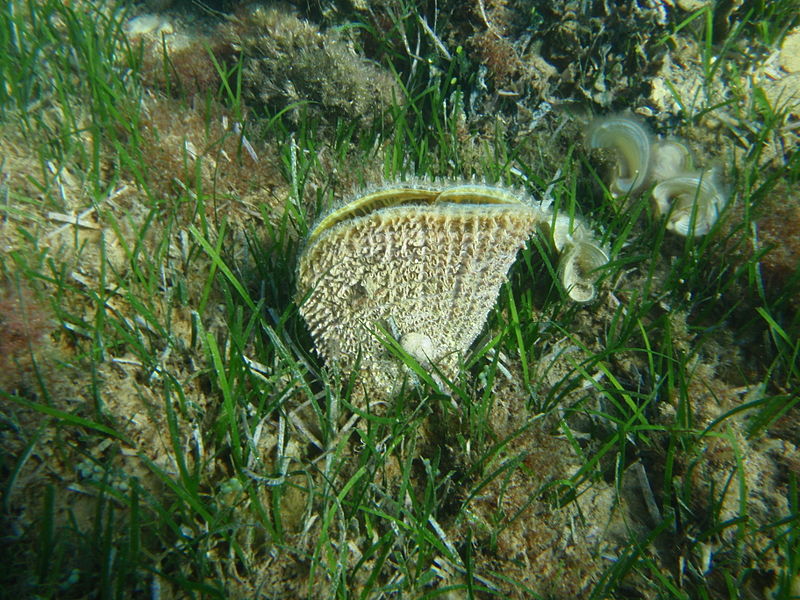
Bivalves have little threads, the Byssus, that anchor them to rocks on the sea floor to stop them floating away. On most of them, the threads are far too small to be of any interest to humans – but the mighty size of Pinna Nobilis, up to a metre in size, can have Byssus filaments up to six centimetres in length – just enough, in fact, that if collected in sufficient numbers they can be woven into cloth.
Sea silk, as the resulting fabric is today known, is a miraculous material, highly sought after since the ancient world. The Byssus threads are exceptionally fine and can be woven more finely than silk can, creating an exceptionally light and warm fabric. The tendency for it to be a favoured target of clothes moths, rarely being passed down for generations, has probably only added to its rarity and value over time. Procopius records a set of sea silk cloaks being an exceptionally fine gift from the Emperor to the highest nobility of Armenia, while a ninth century Persian writer recorded over a thousand gold pieces as the price of a robe (only affordable by society's greatest elites: a slave could probably be purchased for under forty gold pieces at the time). Middle Eastern writers recorded stories of strange sheep-like animals that emerged from the sea, no doubt influenced by the practice of calling Byssus cloth "sea wool". More recently, the uniforms of Jules Verne's Nautilus crew had to come from somewhere, and what better place than the sea floor?
Sea industries that aren't fishing are perhaps particularly interesting narratively because there are relatively few of them. If you want to get some sea-shore interest into your campaign, threats that keep weavers away from harvesting their immensely valuable, time consuming crop might well be worth a protagonist's time to go and investigate, with the shallow sea diving involved allowing for narrative interest without the need to shoehorn scuba gear or underwater breathing herbs into your tale. And there's something about the end product, sea silk, which is immediately captivating: we dream of kingdoms under the sea, lost arts and treasures of the deeps, and this gives sea silk a mystique that even regular silk, which might once have attracted the same feelings, now lacks due to our general familiarity with it.
The art of sea silk weaving is now in the process of being lost forever: Pinna nobilis is now so endangered that its last practitioners in Sicily and Sardinia, most of them very elderly, are unable in any case to obtain the raw materials for their craft. I write this, almost undoubtedly, in the age of the last generation of sea silk craftspeople. We sometimes find it odd when narrative worlds fixate on the crafts that ancient versions of a culture were once able to do, and the idea of lost secrets – but, without many people even remembering that the secret was there to be lost, some of our own are disappearing beneath now-empty seas.
Dunnocks
Small, common birds tend to be pretty overlooked in most literature, and it's not that hard to see why. They can't be trained for many useful purposes, they're too small to make a good meal, so it's not obvious that the characters have a good way to interact with them. The occasional princess might find herself surrounded by generic songbirds, some mage might send small birds with messages, but in neither case do the differences between types of small bird tend to matter a great deal. I think that's a pity, however. Past people's understandings of the world almost certainly included a lot more detail on small birds than ours do, simply because in the wild they're a completely everyday occurrence – although people's past understandings of those animals of course often also had gaps.

Dunnocks, a small brown bird that visually looks a bit similar to a Sparrow, are a good example of both.
"Be thou like the dunnock – the male and female impeccably faithful to each other", proclaimed the naturalist Reverend Frederick Morris to his parishioners in the 1850s. These small, drab birds seemed like the perfect emulation of an idealised humble, protestant ethic. Morris couldn't have been more wrong: Dunnocks have an exceptionally loose and fluid sexual structure, with multiple males around a single female often sharing the work in raising a brood that mixes young from all of them (and some of those males may be visiting and helping with other females and nests too). Capable of copulating in a tenth of a second, and doing so over a hundred times a day, the assumptions people made about these birds traditionally were rather different from the reality.
Dunnocks were historically often simply known as hedge-sparrows, Chaucer's heyesugge (indeed one mid twentieth century folklorist bemoaned the popularisation of "dunnock", previously a more localised dialect word, by ornithologists). In Irish they are Bráthair an Dreoilín, the wren's brothers. The Celtic fringes of Britain seem to have a particular range of folklore on them: Ada Goodrich-Freer's 1902 compilation of Hebridean folklore records them as "blessed, but not lucky", and suggests that Dunnocks gathering around a door are the harbinger of a child's death. In Ireland, too, their sad little songs are said to be the voices of children who have passed away. These sorts of connections to specific facts or emotions can help bring the differences between otherwise less plot-central animals into view in narrative terms too, and can also point to specific uses for them: too much of the time, we assume that because an animal can't be eaten or trained it can't have plot relevance, but there are far more options than that: in Irish tradition the Dunnock's distinctive blueish-green eggs were used as charms against witches, especially placed on the hob to stop them coming down the chimney. Rather than the tendency in some games to gut and use different parts of larger creatures, there's no reason why magical ingredients shouldn't come from specific smaller ones. Add a couple of challenges to overcome to reach and find the Dunnock's nest, as part of a wider method of dealing with a local hag problem, and we find that a decent side adventure is starting to emerge from the humble – or not so humble – Dunnock already.
Maras
The Mara is a distinctive South American rodent from the southern grasslands of the continent. Looking more or less like what happens when a Guinea-pig decides to change careers and become a Hare, they're some of the largest rodents (fourth after Capybaras, Beavers, and the larger Porcupines). They don't tend to interact with humans much, and around areas with too much human activity will often switch to nocturnal behaviour patterns to avoid contact, though they live well in captivity as good pets and can be hunted both for meat and furs.

Maras are useful because they are a big clear klaxon horn of "we're not in pseudo-Europe any more", whilst also, I think equally importantly, giving a sense of cuteness and familiarity. Far too often, non-Euro settings especially in fantasy feel the need to emphasise power in the cultures and landscapes they focus on, to give an idea of the appropriate majesty and strength that those places can have and make them feel equal to the dragons and castles fantasy fans are used to. But I think it's equally important for settings to have homely elements to avoid othering them – a setting that just seems to contain giant god-serpents and terror birds is a place you can adventure in, but a setting that has those and also has cute little Maras bouncing around is the sort of place you can start empathising with and wanting to be protected from its more terrifying and powerful forces, and that's narratively a very important tool. They're also emphatically the sort of thing a certain sort of rather cavalier pixie would absolutely love to ride around on, too, so there's that going for them.
Sea Swallow
In a previous Unexpected Bestiary, we covered the Sea Sheep, a sea slug with the clever trick of stealing Choloroplasts from algae it eats. Well, the sea swallow is another Sea slug – more streamlined, and with its own far more deadly clever metabolic quirk.
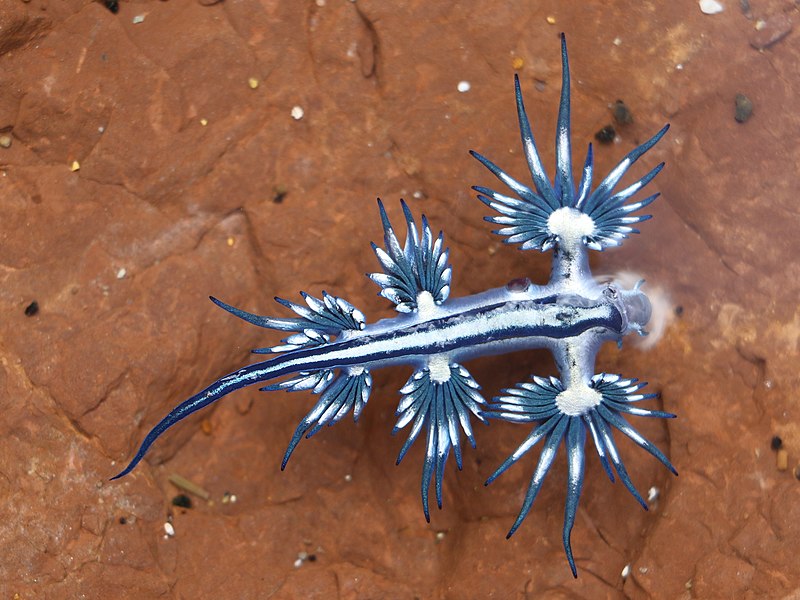
You see, Sea swallows specialise in eating dangerous jellyfish and similar creatures, especially the Portugese Man O' War. Not much wants to eat a Man O' War – it's a powerful predator and its sting is utterly debilitating to most creatures, known at times to kill humans. But for the little Sea slug, just a tenth as long as the Man O' War's swim bladder, that just seems to mean less competition in the food queue. The Sea swallow is immune to the stinging whips that hang down from the floating creature which is a key part of the feeding strategy... but not only that, the Sea swallow actively chooses to eat the stinging, venomous parts of its prey. Taking the most deadly of the little explosive cells, called Nematocysts, that deliver the Man O' War's sting, they store them and keep them active in specialised sacs at the end of their Cerata, the feathery fingers that extend from the Swallow's body. Indeed their sacs can concentrate the venom better than the original nematocyst structure, meaning the Sea swallow's sting can be more dangerous than the creature it got it from.
Or to cut the long description short – this tiny, beautiful Sea slug steals Jellyfish stings powerful enough to kill humans, and can and will sting you with them.
This is one of those creatures that's somehow got a strong sci-fi feel despite being very much real. I think that they're tricky in some ways to use narratively: they're hard for humans/terrestrial humanoids to encounter for the most part, and if you do encounter one you're either having bad luck or are going to be in a very dominant position – it's an "if you get bad luck it will do you huge damage, otherwise you'll be fine" creature when put in an antagonistic position, and its aquatic nature means it's hard to see any sort of intent involved (being dumped into a tank of Sea swallows by an archvillain might be incredibly dangerous, but it'd have to be a very particular villain to pull that off in a satisfying way). However, creatures based on them and their behaviours could work better – the concept of a creature that has evolved to steal and re-use another creature's killing or defense mechanism is definitely good – and the look would work broadly very well in a sci-fi setting.
Honey possum
Pollination, the movement of pollen grains between flowers, is one of the keys to life on earth as we know it. Required for the survival of many flowering plants, many insects and small flying vertebrates are key to carrying pollen around, usually lured into the plant by the sweet nectar available there. But there are almost no non-flying species that specialise in nectar drinking – to do so requires an area with flowers available most of the year, to allow such an animal to survive the winter. There is an exception though – the ngoolboongoor to give its proper name in the native Noongar language, or the Honey Possum to English speakers.

This tiny creature (six to nine centimetres combined head and body length) clambers around flowers in southwestern Australia, drinking nectar and moving pollen around between the flower heads, especially the huge candlestick-like flowers of the Biara tree Banksia attenuata. They can go into torpid states for some days at a time if food is short, but their body mass is too small to do this for an extended period.
Honey possums importantly play with people's expectations about how an ecosystem works – terrestrial mammals doing a role we expect to be performed by flying insects. They do also have spiritual significance to the Noongar, who have traditions of personal and family totem animals among which the little marsupials may feature. They're more an animal that can create colour and depth in the background of a setting than one that is going to be placed foremost, though somewhere with a lot of flowers could have that emphasised quite effectively by the presence of Honey possums as pollinators – given our mental associations, it gives a much better calm and relaxing feel to say "and his garden of a thousand flowers has tiny furry possums jumping between the to carry the pollen" than "you reach the garden of a thousand flowers and it is FULL OF BEES".
Wryneck
If you've ever read a fantasy book with much magic in it, there's a good chance someone has cast a jinx as a type of spell. Indeed if you grew up in an English-speaking environment, there's a good chance calls like "jinx – touch wood!" or the idea of "being jinxed" as a curse or after saying a word simultaneously will trigger something in your memory. But the name doesn't just arise from a strange big of magic related terminology - the Jinx, Jynx in Latin, or iunx in Ancient Greek, is the name of the wryneck, a smallish, well camouflaged brown bird closely related to Woodpeckers. So what connects these two things? Why did the name of an apparently normal bird become a byword for curses?

The Wryneck, it turns out, has a particular trick which has fascinated humans for all of recorded history and beyond. When threatened, it sticks its head up, and mimics a Snake with it. Its English name is based on the incredibly eerie twisting and turning motions that its head can undergo, contorting and wiggling at strange angles that along with strange hissing noises make the predator convinced that what they're facing is a much more formidable and more reptilian opponent than they'd bargained for. This incredible behaviour has been observed throughout human history and led to the continuous association of wrynecks with magic and witchcraft. Indeed, the "wry neck" gives them their English name, and their scientific name Jynx torquillalikewise references the torque of their twisting motions.
Iunx was also a nymph in Greek myth – a daughter of Pan and Echo, cursed by Hera to turn into the Wryneck after she cast a spell that caused Zeus to fall in love with Io, making her quite literally the wingman responsible for a lineage containing about half the major Greek classical heroes. Another tale suggests that instead she was the daughter of Pireus and the curse came after she and her sisters challenged the muses to a musical contest. Either way, the magical associations came early and continued. The Wryneck seems to have been especially associated with love magic at times, with particularly unfortunate birds apparently being captured and whirled around on a string as a charm to bring back an errant lover; the Greek poet Pindar has Jason (of Argonauts fame) using a Wryneck in magic to win the heart of Medea, too. The idea of "jinxing" someone seems to appear in English in the early modern period, maintaining some of its connections: a 1903 "Encyclopaedia of Superstitions" suggested that a young woman who sees a Wryneck on the morning of February 14th will remain eternally unmarried. I don't think I really need to go heavily into "how do I use the weird snake mimic magic bird that might be a transformed Nymph and can be used in witchcraft" from a narrative perspective beyond all that... there's just so much there!
Thank you for reading, as ever – I'm intrigued to know what you think, or if you have any good stories or folklore I've missed about any of these wonderful creatures. Do leave a comment below, and I'll see you for part five of the series at some point in the future!
Exilian Interviews: Kate Madison and Neil Oseman!
February 22, 2020, 11:10:02 PM
The fantasy webseries Ren is currently nearing the end of its Kickstarter for a second season - the team were guests at two of our three conventions to date, and are long standing friends of ours here, besides being awesome creators of great fantasy worlds. As such, of course we sent Jubal into the wildernesses of Ren's home kingdom of Alathia to find Kate Madison, the show's award-winning director and showrunner, and Neil Oseman, their (also award-winning) Director of Photography, to find out a bit more about what goes into a fantasy webseries and what we can expect from Season Two. After a couple of scrapes with the Kah'Nath and a few daring escapes through the forest, he finally caught up with them...
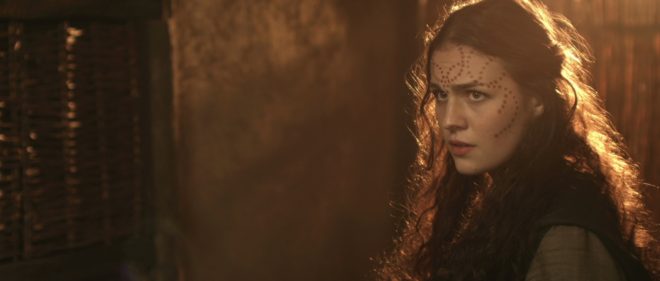
Ren, portrayed by Sophie Skelton in Season 1. A new actress will play her in Season 2.
Kate: Ren: The Girl with the Mark is an independent short-form fantasy series about a young woman whose life changes forever when she is "marked" by an ancient Mahri spirit. Now a fugitive from her world's ruling order, she is forced to flee the village she has lived in all her life, and journey across the land in the company of the outlaw Hunter to find the meaning of the mark she bears.
Jubal: Ren's first series has been very successful both in terms of YouTube views and awards – how have you both found the response to it since it came out in 2016?
Kate: I always hope when I create something that people will watch and enjoy it but it never ceases to amaze me the snowball effect that can happen when one person discovers something they love and shares it with others. I hoped for Ren to do well online and for people to love it but I never imagined that an original independent fantasy series would get millions of views as it has done. I also decided to enter the show into festivals as I wanted the cast and crew who did such an amazing job, to have the chance to be recognised for their achievements but the whirlwind world tour and multiple awards the show has received was still a surprise.
Neil: When we were getting ready to release the first season, a friend of mine told us about the "long tail" phenomenon, where internet content builds an audience over time rather than petering out rapidly after the release like a traditional film or TV show. I didn't really believe it at the time, but it was absolutely true for Ren. Thousands of new people are discovering the series every day. It's extremely gratifying and it's exactly why we want to make more, to carry on that story for all those people who've enjoyed it so far.
Jubal: You're now of course kickstarting Series Two. We last saw Ren riding out of her home village of Lyngarth with a hail of flaming arrows behind her – will we be exploring more parts of her world in the new series?
Neil: Yes, the plan was always to move away from the village and mirror Ren's figurative journey of discovery about herself and the Mahri spirit within her with a literal journey across the land to find the people and places that hold answers for her. I'm looking forward to putting some new locations on camera.
Kate: We plan to continue from where we left off, following Ren as she's pursued by the Kah'Nath while dealing with being wrenched from everything familiar. As she begins to come to terms with the circumstances she finds herself in, she will start to explore not only the physical world around her but the very fabric of society and the truths she has always been taught.
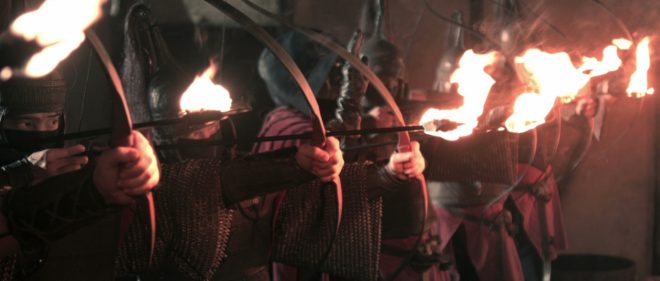
The Kah'Nath soldiers prepare a volley of flaming arrows...
Kate: Ren was torn away from her friends and family at the end of last season but that doesn't mean we'll never see them again, even if Ren herself may struggle to reconnect with some of them. Many of the main characters in season one play an important role in Ren's journey so although we will be focusing on Ren we will also learn the fates of others as we move forward. We even have some new characters to introduce as the story continues, some may be fleeting but others may become significant players in Ren's story.
Jubal: Moving on to stuff behind the camera, how did you both end up working together on fantasy webseries projects?
Kate: I've always been drawn to the more fantastical, and telling stories we can relate to or that inspire us but that are not set in our 'real' world really appeal to me. I also love the aesthetics of a historical type feel and for me fantasy works perfectly. You can shake off any expectations or restrictions that you'd have with a 'real' setting and can put your characters into any situation you can think of. I made my Lord of the Rings feature Born of Hope with hardly any filmmaking experience and have continued to enjoy boosting the quality of this genre.
Neil: In 2013 I shot The First Musketeer, a web series by Harriet Sams, and I really enjoyed it, so I was actively looking out for more web series to work on. I knew Kate a bit from Born of Hope, so that's how I got into the running for the director of photography position on Ren. After filming I felt so invested in the project and so keen for it to continue that I stayed on as a postproduction supervisor and even ended up on the writing team for the new episodes.
Jubal: Neil, as director of photography you're often more literally behind the camera. What makes working on fantasy projects like this particularly of interest for you?
Neil: I love the creative challenge of working with just fire, daylight and moonlight as the supposed light sources. At the same time you can create a more stylised image because you're not working in the real world. I'm a sucker for a nice shaft of light through a window, and with fantasy that's pretty much a requirement! I also like all the texture in the sets, locations and costumes. The modern world can be a little smooth and bland sometimes, but old stone walls, heavy embroidered fabrics and weathered wood are much more interesting. I find creating a sense of tactility and three-dimensionality on camera very satisfying, and these textured surfaces have a lot of scope for that.

The one thing Kah'Nath soldiers obey above even the Master - Kate with a clapper board.
Neil: I'm most proud of the scene in Karn's house in the first episode. It was a beautiful set made of real twisted willow, and I was able to shine a big arc light through the roof of interlocking branches to create a dappled sunlight effect. In combination with smoke to bring out the fingers of light, it made for a very magical atmosphere.
Jubal: Kate – you've been the driving force behind Ren as director, writer, and showrunner. What's the most important thing for you about Ren's story and what most drives you to want to make more of it?
Kate: I started Ren to create something for an online community of fantasy fans who, at least at the time, didn't have a whole lot of shows being made for them. This was our way to work independently from the Hollywood system and make high quality entertainment directly for our community who could help influence the story through their comments and interactions. It is a fan supported and creator distributed model. Ren was always intended to be an episodic story and there is so much to the world that we've created, some has been hinted at but others have not yet been explored at all. It would be a real shame to not finish Ren's story.
Jubal: In Born of Hope, you acted as well as directed, and your Ren co-writer Christopher Dane played Karn in series one: might we see you in front of the camera again at any point?
Kate: I would really love to play a role in Ren, it's just finding the right one that works for the story as I don't want to just crowbar one in. Interestingly in season one, although you don't really see me I am there. I'm a hand double for Ren, the voice of broom lady and even Dalia's singing voice!
Jubal: How much planning and effort has had to go into the current Kickstarter beforehand? Have you both been involved throughout that process?
Neil: Yes. We spent a year preparing for the Kickstarter, building a mailing list of supporters, building social media momentum, and of course writing the new episodes at the same time. There are a couple of other writers involved - Ash Maharaj and Claire Finn - but most of it was just Kate and I ploughing away! As we got closer we brought in Ben Dobyns of Zombie Orpheus Entertainment as our crowdfunding consultant. His input into the rewards, budgeting and the mailing list has been invaluable.

The mysterious woodsman Karn teaches Ren archery in S1 Ep 1.
Kate: We have seen a number of wonderful pieces of fan art and even a piece of creative writing. I'm always delighted to inspire other people to be creative even if it doesn't specifically become canon.
Jubal: Finally, if all the above has been exciting, where can our readers find out more?
Neil: Our Kickstarter page has plenty of info about the show, an embedded video of the complete first season, and all the details of the exciting rewards we're offering for backers.
Kate: If you'd also like to learn more about Ren, the world and making season one you can find all that on our website rentheseries.com!
Thanks again to Kate and Neil for chatting to us! You can follow Kate Madison on @actorsatwork on social media or check out katemadison.net and you can find Neil Oseman on @neiloseman and neiloseman.com. We hope to see more of Ren and Alathia soon - so a final reminder to back the Ren kickstarter, with just one week to go at the time of posting! If you've somehow been imprisoned by evil overlords for the last few years and not seen Series One yet, fear not, it's available on Youtube.
You can also discuss Ren on the forum, and contribute to the ongoing Wiki project for it. Thanks for reading, and see you next time!
Characters and Why They Work: Warhammer Fantasy
February 16, 2020, 06:27:50 PM
So, I came up with the idea for this article a while back and thought I'd finally get to writing it. I've not played Warhammer Fantasy since I was at school, I've never been the greatest lore expert (though I did make a fairly large game mod based on the setting), but nonetheless some characters from that game have really, really stuck with me, whilst others have been largely overwritten or are "yeah, that guy" memories that pale next to more exciting characters who I've encountered since. As such, here's an exploration of seven of the characters that I found most memorable, and what I think you can take from them when designing and writing similar ones. These are mostly the sorts of characters I'd expect as antagonists in most settings, but I think that's fairly inherent to Warhammer - most people in that setting are objectively horrible, and as it's a wargame most characters are really meant to be generals and power figures rather than solo adventurers. So let's see how some of them shape up:
Richter Kreugar
The tragic tale of Richter Kreugar, a gold-grabbing mercenary who betrayed his necromancer patron and was then cursed to roam the earth fighting for all eternity with a band of those he cut down while doing so, is... basically just absolutely fantastic.

There's a strong sort of folk-horror vibe about Kreugar, and for my money he's possibly the most horrifying character in WHFB. Sure, there are chaos horrors and spawn who lumber as horrendous balls of mutilated angry flesh, and there are great armies of zombies, but Richter and his band are worse for a couple of reasons. One of the key elements of horror is creatures that you don't want to be like, as much as creatures who are viscerally frightening for one reason or other. There are lots of examples of that in Warhammer though – aforementioned undead or chaos spawn, for example. What makes it worse with Richter Kreugar is that he is sapient and moreover got his curse doing an arguably good act. (Sure, he may only have switched sides and murdered his paymaster because of the promise of a big pile of gold, but even if he had done it for good reasons, the result would've been the same.) In the Warhammer setting, life is sometimes just horrible to you.
Richter Kreugar is also really easy to mythologise, far more so than most other characters in WHFB generally. Sure, your dwarfs might speak in awe of Thorek Ironbrow's runic talents, or your Brettonians might speak with hushed tones of the legends of the Fay Enchantress, but when it comes to telling tales in a smoky tavern late in the evening, Richter Kreugar provides a proper ghost story of the sort that's curiously lacking elsewhere in a setting that manages to have two entire factions of undead in it. You could even write a traditional UK-style folk ballad about him without any problems, a point that I can prove on account of literally having done so whilst writing this article. As such, I think he's a fantastic example of how to make a horror character who works in a fantasy setting and adventuring setup whilst still being horrifying - that folk-horror borderline is a good place to find things along those lines.
Aenur, the Sword of Twilight
Elves often aren't very exciting. There, I said it. And I didn't just say it because I'm a dwarf fan. In most fantasy settings, elves are fairly predictable – they hang around in woods or mysterious ancient cities, they are snooty or otherworldly or sometimes just Mary-sue level good, etc.
Now sure, Aenur, the one elf character in original Mordheim is still snooty and standoffish. But taking the elf out of the forest and putting him into a ruined city suddenly makes him actually far more interesting, as does making him a singular special character in the whole game. Being able to suddenly dart from the shadows, carve up some evildoers with his longsword (still elven, but none of that dainty ethereal bow nonsense), and then vanish again makes him a fanastic swashbuckling man of mystery.
I think this says a lot of useful stuff about how to make elves interesting. Making them rarer definitely helps a great deal, so you get the "oh, shoot, that's an *elf*" reaction appropriate for a dying cadre of superhumans rather than the usual groans you get when elves are just a slightly more annoying part of regular society. I'd even say there might be an advantage in cutting elves right down to the odd named character – you still get to display all the good stuff and it doesn't get wearing so fast. The other thing Aenur shows is that there's a lot of roles – in his case, ruined city's swashbuckling mystery hero – that elves are really cinematically good at but don't actually get put in that much because they're all pigeonholed into being wizards or rangers. A solid character all round.
Borgut Facebeater

Borgut is a good reminder that there's a certain level of charismatic leadership that needs a functional subordinate to really function – in this case, that of Grimgor Ironhide, the mightiest Orc in the Warhammer setting. Borgut is his second in command and general tough, enforcer, herald, go-between, etc. The concept of a bodyguard doesn't quite work for the greatest orc fighter of all time, but if Grimgor had one, it would be Borgut.
Borgut is a mighty warrior in his own right – savage in battle, tough as nails, brutally powerful – and, fundamentally, he's an orc's orc. By epitomising everything we think of as relating to orcs, he becomes the orc equivalent of an everyman character. In turn, then, Grimgor, despite in many ways being similar to Borgut in the role of "Orc turned up to eleven," gets his differences to other orcs and orc society displayed in ways that would be impossible if Borgut wasn't there. Borgut provides the layer and therefore the necessary distance between the practically worshipped figure of Grimgor and the ordinary greenskins of his horde, allowing the senior orc to seem further above his subordinates than would be the case otherwise. Grimgor's cunning and mythical status are greatly accentuated by the fact that he is able to remain somewhat distant – doubly so in orc society, where 'eadbutting your opponents into submission is a usual way of restoring order. Having someone powerful enough to do that all for you, who you have effective complete control over, is a power move beyond what orc social structures would usually allow.
Borgut is a really good example of how well written subordinates can really accentuate a leader's personal features: the purpose of subordinates shouldn't just be to be the weaker second challenge you take on first, it should be to underline who their leader is. By helping both prove Grimgor's toughness through comparison to himself, and allowing Grimgor's distancing from his horde and maintaining his mythos, Borgut Facebeater does that very well indeed.
Literally Any Blood Dragon Ever
Arguably it's cheating that this isn't an individual character, but the WHFB development of the vampiric bloodlines was genuinely, to my mind, very solid, and allowed them to explore different bits of the vampire archetype in a way that made some sense – the different lines had, passed down through them, different approaches to what it meant to be a vampire. The shady aristocratic Von Carsteins, the tragic ghoulish Strigoi, the mad magician Necrarchs, and so on.
And then there's the blood dragons, who've worked out that there is a way to stop craving human blood – and that's to drink the blood of a dragon. Now, the minus side of that is that it means killing a dragon, which isn't easy to do. The plus side of that is that bam, character motivation for training to be immensely good in combat duly established, and coupled with the sort of warped knightly order style they adopt, this makes for a very good alternative take on vampires.
Blood dragons may be evil, but their primary motivation is to relieve themselves of the curse: they're fighting you for the training challenge more than for domination or your blood. They can be given a sense of fair play that would be out of place with a Von Carstein/Dracula style vampire: if you're going to die easily, there's no point in fighting you to begin with, so a Blood Dragon will absolutely let you catch your breath and draw your sword before the combat starts. This also makes them antagonists who can be reasoned with – they have a deep inbuilt goal of their own which you might not necessarily just be there to hinder.
It's an idea, the vampire as honour code driven monster slayer, that's sufficiently non-standard that it works very well. One important thing I think we get from this is that secondary character goals shouldn't always be either for, or opposed to, those of the protagonists: some of the most interesting evil characters aren't those you obviously have to kill or be killed by, it's the ones who have their own goals which will entangle with yours in interesting ways.
Lumpin Croop
If you thought I was going to miss out the chance to talk about Lumpin Croop in this article, you have presumably either never met me or never heard of Lumpin Croop – and if you're in the latter category, let's change that fact. Lumpin Croop is a Halfling mercenary who leads a group of his species called the Fighting Cocks. Their banner is a weathervane, and they're just wonderful to place as models on a gaming table in front of a usually suitably bemused opponent.

Lumpin's backstory is as a poacher who, captured by a gang of gamekeepers, who got out of it by quickly spinning them yarns of adventure and a mercenary life, which they enthusiastically (and rather Tookishly) jumped at. Since then he's been trying to give them the slip and run away home, but this only hones their by now expert tracking skills.
The fun thing with Lumpin Croop is not that he's a different take on a Halfling, it's that he's an absolutely standard take on a Halfling in a setting that otherwise isn't sympathetic to that type of character at all. In a setting that pushes to a certain extreme, as classic Warhammer arguably does with pathetic-aesthetic horror and misery, being able to hold a character like Lumpin Croop up does two important things. Firstly, it holds a mirror up to the setting, and we can see how a relatively "ordinary" character survives in it. Secondly, it lightens the gloom. Both of these are important and good for helping maintain the connection between the user/player in the setting and the main body of the setting itself. We can imagine ourselves as Lumpin in a way that isn't true of, say, Karl Franz or Archaon the Everchosen or Greasus Goldtooth, and that to some extent both exacerbates and relieves the world around him.
Skarsnik and Gobbla
The Night Goblin warboss par excellence is Skarsnik, warlord of the former Dwarf hold of Karak Eight Peaks, who inflicts repeated defeats on the tiny dwarf garrison and keeps them effectively holed up in a tiny remnant of their former hold. In the chaos of Greenskins society, Skarsnik's rise from underling to the greatest goblin warlord the world has yet seen has been largely down to a mix of cunning and ruthlessness. Alongside him is a giant cave squig called Gobbla, who is his pet (for the uninitiated, squigs are large fungal bouncing balls of teeth which some particularly mad night goblins tame or even ride).
Gobbla is every bit as important as Skarsnik – and the lesson I'd take from this is that designing antagonist type characters as a team can really work. Gobbla tells us a huge amount about Skarsnik and about how he sees himself – this powerful warlord could have, say, an enslaved Black Orc, inverting the usual power divisions in Greenskin society. Or a giant underground spider, given a general creepiness feel (at least for most people – I find spiders cute, but I'm aware it's a minority view). But no, Skarsnik has this unpredictable ball of vaguely fungal mass with huge, huge teeth which he somehow keeps under control by feeding it on pretty much. It's that edge of psychedelic craziness that tells us a lot about Skarsnik: that he's very willing to dabble in the unpredictable and horrifying,
The good take-away here I think is that the monster is hugely relevant to the boss. A cunning goblin warlord is, in and of itself, not a surprising thing – "cunning" is pretty much the first goblin warboss trait in the book. Gobbla however gives Skarsnik his edge of night goblin mania. He's not a long term, calm strategist, he's not a revolutionary, he's directing the enraged, chaotic energy of his forces right in the moment with a skill and unpredictable frenzy that makes him the sort of character he is.
Borgio the Besieger
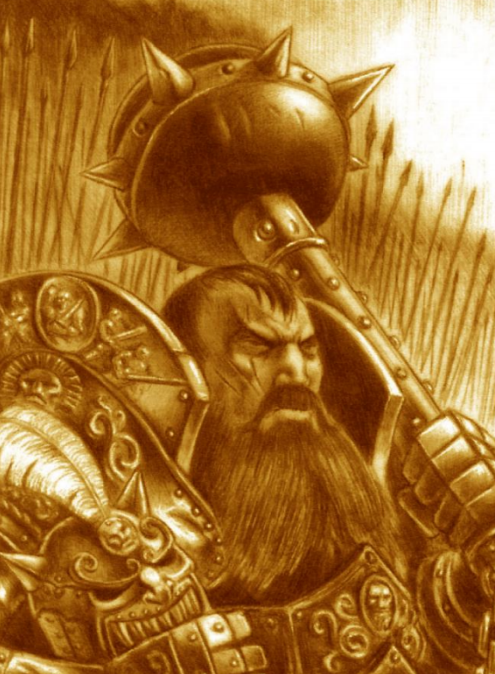
Absolutely hands down one of my favourite WHFB characters, and the one who inspired me to write this list. Borgio "the Besieger" of the northern Tilean city of Miragliano is a city-state general with a great expertise in siege warfare and a host of abilities making him difficult to kill. By and large a Renaissance Man on steroids apocryphally capable of riding and reading a book whilst technically asleep, and a general much beloved of his men, Borgio is an all round solid late-medieval-Italian archetype character, right down to finally eventually being killed in his bath with a poisoned toasting fork.
It's Borgio's mace that really gets to me as the thing that makes him a fantastic character, because it tells us so much about him. It's reportedly made of a cannonball that Borgio was hit by, but survived. That's a cool starting point of course, but you then realise that the meaning goes much deeper than Borgio being the tough that nails general that others aspire to be. The sort of person who gets hit by a cannonball and survives is one thing. The sort of person who has that cannonball forged into a mace, makes sure everyone knows the fact, and wields it very prominently, is someone who is concerned with actively building his own legend. Borgio the Besieger's actual toughness stat is a decidedly just-above-average four. His legend, however, is significantly bigger.
I think the interest in Borgio and characters like him comes from the fact that that they encourage us to separate thinking about a character's abilities from people's perception of their abilities, and realise that both things genuinely matter. Much of being the "world's greatest" at something is about being very good at it but also then promoting that very effectively. This is a trope about as old as history in some ways – most of Odysseus' classic adventures with the cyclops and so on are narrated in the Odyssey by the eponymous character itself – and I think considering how heroes construct or help construct their own legend often helps to make particularly prominent characters more interesting and helps readers or players question what they think they know about them.
I hope you enjoyed this quick run-down of these characters - please comment below if you have further thoughts, found this useful, or would like to see more articles like this! As ever, if you have something you could write for us, just check out our submission guidelines and give us a shout.
Exilian Interviews: Eric Matyas!
August 08, 2019, 04:47:53 PM
Eric Matyas is a long-standing Exilian member best known as founder of SoundImage, a website that provides a free to use archive of thousands of music files, images, and sound effect clips for use in games and other projects. We sent Jubal deep into the heart of SoundImage's archives to find Eric and ask him about how this huge library got started, some of the things that have happened on his journey since, and his thoughts on the future... read on!

Jubal: Firstly, tell us a bit about yourself and how you got into producing sounds and images for people to use.
Eric: I'm really an indie filmmaker at heart...one of my goals is to make my own sci-fi and fantasy films (and for them to actually be good...lol)...but I've been playing piano and creating music compositions since I was a kid. I got my first synthesizer, a Korg Triton, quite a few years ago and was interested in maybe making ambient albums although I had no idea how to go about it. So I concentrated on learning the synth, mostly by trial and error since there wasn't much online help available, and I started recording some few pieces which sat on my hard drive for a long time. Then the DSLR revolution hit...indie filmmakers could finally obtain really good images in a way that was cost effective...so I borrowed a friend's camera and started making nature documentaries. I had never tried scoring any of my own films so I looked around online for royalty-free music and discovered Kevin MacLeod's site where he allows people to use his tracks for free with attribution. I thought, "What a great idea...I wonder if I could do this?" I contacted Kevin with some questions and he was very encouraging, so I decided to give it a try.
I didn't know anything about making a website, especially not one for sharing music files, but I found an article in which another musician recommended creating a WordPress site. He mentioned that google likes WordPress sites so I thought maybe that would make it easier for people to find my music.
The site didn't get much traffic at first, so I joined some forums for indie filmmakers and began posting weekly announcements as I released new tracks. Then, somehow, indie game developers began to find my site and use my work. They started sending me links to their finished games and writing to thank me for making my music available. That's when I realized that there was a larger audience for this than indie filmmakers. Today, most of the people who use my tracks are indie game developers and they are a great community to be involved with.
As for the images, I've been slowly teaching myself 3D modeling and animation for several years and texture images are a big part of that so I started creating them on my own. Once the game developers found me, I thought that these images might be helpful as well so I began expanding the site to include them. They're really meant to be building blocks rather than finished textures.

The SoundImage homepage.
Eric: The vision of Soundimage has always been to make good-sounding music and other assets available to anyone regardless of their budget. Call me an idealist, but I think anyone should be able to produce quality creative work, connect with an audience and be paid for their efforts without having to raise enormous amounts of money to do so. Here in the U.S., popular media is controlled by a handful of mega corporations which, in my opinion, severely limits the range of content that's available for consumers. On a more philosophical level, we face many daunting problems as a species and I think the world needs more creative problem-solvers so I support anyone who is doing creative work.
Jubal: Did you have any idea when you started how big an archive the site was going to end up with?
Eric: I started the site with 100 tracks and tried to add one new track every day. I had looked at Kevin's site which had over 1000 tracks at the time and it really blew my mind so I decided to try to work toward that. Then I started adding other things, like texture images, and the site grew pretty rapidly. I think it's getting a bit out of control now... lol!
Jubal: Have you had any problems with capacity or hosting costs as the site has grown?
Eric: Not really. My hosting service doesn't limit the number of files I can upload, but they do restrict the file sizes. That's why my music tracks are in MP3 format...the original WAV files are usually too large.
Jubal: What's your favourite track you've composed, and why?
Eric: I don't really have a favorite, per se, but I like "Stratosphere" from my Aerial/Drone page a lot. I thought it came out really well.
Jubal: ...and what's the most surprising use you've seen someone put SoundImage's files to?
Eric: I don't know about surprising, but one of the projects I've seen that I feel the very proud about is a documentary about a struggling wildlife rehabilitation center in South Africa. Here's a link if anyone is interested:[/size]
Jubal: What other projects have you become involved in via SoundImage - have there been any particular highlights or failures of those?
Eric: Well, more and more indie game developers are hiring me to create custom music and sound effects for them because I can do it so affordably. The synthesizers I use (there are 3 of them now) are built for rapid music creation so tracks that might take days to create can be done in a matter of hours. In that sense, I guess the website is like a giant demo reel.
I'm very passionate about science, so I've been combining that with my love of filmmaking and creating short films that teach kids environmental stewardship in a fun way through stories and characters rather than as informational documentaries. In essence, I'm taking learning concepts and building stories around them that kids can relate to. I've done seven films so far and am working on two more this fall. The organization I made them for uses them all the time with visitors, but schools have started using the films in their classrooms as well which is really cool too. One school district even put together a team of educators and created their own curriculum based on the films. So now I'm working on creating my own activities and things to share with the rest of the world. Eventually I'd like to create software and make the whole thing an interactive learning world. It's all experimental at this point so it will be interesting to see where it leads, if anywhere, but I love the idea that the films can be used for years and years rather than being watched once and forgotten.

Three out of the many texture and image files found on SoundImage.
Eric: As I said, I do paid tracks as well, at pretty low cost, so I'm one of those smaller-scale paid composers. Do my free tracks take business away from my paid work? I honestly don't know, but a lot of folks who use my free assets seem to be indie game developers and filmmakers who are learning or just starting out...often one or two-person teams...and original custom assets can be prohibitively expensive for them...especially music. The current going-rate for custom music (I am told) is $100 per finished minute of music which, in my opinion, just isn't doable for a lot of people. I certainly couldn't afford it for my films. I'm not saying that composers shouldn't be properly compensated...they absolutely should...but content creators who are just starting out probably can't afford them anyway, so I don't see free music as taking away business. Looking to the future, I imagine there will always be people who will opt for free assets as well as those who will raise the necessary funds to pay for them.
Jubal: SoundImage has its own license which is a variant on a creative commons license - was it difficult for you to produce that, and what would you advise to anyone who might want to produce similar open-with-restrictions type licenses for their work.
Eric: My license was very easy to create because it was identical to the creative commons license...I simply added a restriction that prohibits my music and such from being used in works that are obscene or pornographic in nature. I think that anyone considering doing something like this should think about situations in which they don't want their work being used and be very clear about it.
Jubal: Do you think there's space for SoundImage's model to be used more widely and for more photographers and composers to start open media archives like yours? Do you think there'd be any scale issues if many more people tried to do so?
Eric: I think sharing assets is a great way to network with creative people. As for scale issues, I really don't know, but the internet is a pretty big place so I would hope that there's room for everyone.
[soundcloud]https://soundcloud.com/eric-matyas/still-of-night[/soundcloud]
One of Eric's tracks, Still of Night, from his Urban collection.
Jubal: Finally, any upcoming plans for SoundImage - what can we look forward to seeing more of?
Eric: Besides using my music in their games, developers have written to me and said they enjoy listening to my tracks while they work on their projects. Some have even said that my music inspired them or gave them ideas for games which is great. With that in mind, I may put together some albums and make them available for a small fee. I've also had requests for the original super high quality WAV recordings of my tracks, so I'm looking at doing something similar with those as well. If you think the MP3 tracks sound good, wait until you hear the original WAV versions!
As I said, I'm really a filmmaker at heart and shooting footage is something I love to do... whether it's for my own films or just to explore the world through my lens...so I'd like to see if there might be a need for that. I've visited some stock footage sites while working on my own projects and the prices seem pretty prohibitive so perhaps that's something I can help with in a way that's actually affordable.
On the graphics side of things, I've started experimenting with other kinds of game art besides textures...backgrounds and sprite objects mostly...but I'm always trying to find out what kinds of things might be useful to the community. If anyone has any suggestions, please let me know!
Jubal: It's been great talking to you! Thanks for doing this and best of luck with everything in SoundImage's future.
Eric: Thanks for having me on your website...I sincerely hope that some of my work is helpful to everyone. Keep being creative!
Eric Matyas' work is free to use with attribution in both commercial and non-commercial projects: non-attribution licenses can also be purchased. You can get updates on new work from Eric via his forum threads for music/sound effects, textures, and game art, or via his twitter @EricMatyas. We hope you enjoyed this interview, and do stay tuned for more interviews and other articles in the near future!
The Pararelational Paradox
June 06, 2019, 05:26:23 PM
By Jubal

Are creators becoming overloaded nodes in our social networks?
Examples of this are not hard to find, though there's clearly a spectrum both in how well different people can cope with pararelational situations and how heavily people lean on this as a marketing strategy. I've certainly seen successful creators whose social media has ended up 50% apologies for being unable to respond to the deluges of personal messages they get from fans and connections, but who still feel that the solution to this is to keep engaging those people with "hey everyone tell me what you're doing today" posts (as if this was something possible to keep track of for a person who's at the limit of Facebook friends or who has tens of thousands of Twitter followers). On top of that there's the pressure of being constantly accessible; whilst I'm sure some creators love being able to share good and bad news with the folk online who care about their work, others feel that they will be penalised for not explaining that no, they couldn't get a comic up this week due to a recurrent illness or a bad breakup – and that part of their job is not only to share their own lives but to directly care about and deal with the issues in the lives of their community of fans on an individual level. It's an impossible task.
I think this is genuinely primarily a tendency of the internet age: large numbers of people are now on the same social media services as creators they love, and this moves things from what in the old days would've been restricted to snail-speed fan mail (which few fans get the time and energy to write, except for e.g. world famous authors) to the point where a creator can tweet make a Facebook post and get two dozen replies within an hour. Broadcast social media such as Twitter and YouTube, which mostly function via open public posts, perhaps particularly encourage such a strategy, though Facebook tends to host the worst examples I've seen as the lure of being "friends" with a creator or commenting on their public posts seems to make people feel even more demanding of replies. Patreon and systems like it, whilst extremely good for the independent creative industries generally, also form a part of this, as one of the most standard marketing strategies is additional vlogposts, Q&As, and otherwise access to the creator in question.
So just to be clear here, I meant it when I used the term pararelational hell at the top of this post. I think pararelational marketing is exceedingly unhealthy. It screws over people who are unable or unwilling to participate in it by messing up audience expectations, burns out creators by getting them to effectively sell a huge amount of emotional labour along with their work, and leaves audiences understandably dissatisfied. The fact is that creators can't put in the effort needed to have several hundred (or more) good friends who they talk to all the time as well as buying their stuff. I don't say this at all as someone who feels like I'm immune to this sort of system – as you might guess from the fact I founded this website, I find creative people wonderful and interesting and want more chances to talk to them – but the extent to which we've normalised people being expected to lay their lives bare to those accessing their work I think is a problem, one that's hurting creators who participate in it and those who feel unable to alike.
So what are the solutions, if there are any? It's a difficult question to answer without trying to go through an unhelpful process of apportioning blame, which wouldn't, I think, help anyone – both creators and fans need to readjust their habits toward something more healthy and it's a question of how we put in systems to best help our communities do so. I think one big part is better community reporting and magazines in indie creative communities – they provide an alternative route for players and fans to find and appreciate creators' work. Good indie journalism, if supported well, might take pressure off creators. Sure, it takes time to do press releases and so on, but better hub systems for such releases and more journalists willing to go out and find stuff rather than just waiting for press releases to roll in would help share a load which is pushed far too much onto the creators right now.
Secondly, I think we need better fan communities per se that are built around appreciation for the work, not built around personal interactions with the creator of a work. This is a problem for social media design as well, which elevates personal and direct connections to an extent which can swamp people. Actually, we may need to rebuild fan communities and news outlets which allow the creator to retain or regain a little distance. The collapse of an effective "mid tier" of fandom consisting of interviewers, community admins and moderators, and suchlike has rolled too much of the work in many cases onto creators themselves, many of whom don't have the resources or experience to deal with it. We need to start valuing that interactivity in communities more, and see creative communities as, ideally, communities rather than just conversations. Connecting people up is not enough, and risks pressing creators to try and build the nexus of a community around themselves without the support that comes from taking a more workable, sustainable, communal approach.
All that said, I certainly don't have all the answers - I don't know what level of engagement is desirable or sustainable and I'm sure that this will vary hugely between people as it always does. But I do think the tendency to go pararelational, fuelled by a media sphere that emphasises individual connection over communal discussion, is something that we need to think about more, and I hope this has provided some thought on doing so - thankyou for reading!
Ritual and re-use: writing places that feel alive
April 27, 2019, 05:39:11 PM
It struck me recently that it'd be interesting to share some thoughts on place in writing and game design. Places are, to say the least, pretty vitally important to designing any setting. A good backdrop can really set the action of a plot into appropriately epic (or appropriately non-epic) context, and hugely affect the mood of an event: being charged by a troll when you're defending the gates of an ancient temple is a much more heroic feeling action than being charged by a troll in a large sewer tunnel, even if it's basically the same difficulty of encounter. More prosaically, places are often largely designed by means of function – there has to be a bunch of stuff in a place that does certain things.
Imagine a fantasy village called Isicando that we need a couple of rag-tag adventurers to visit. We'll probably give them a tavern, the Blue Rose, to refuel and meet people, some sort of economic functional stuff (for the sake of argument, llama farms), a leader who we'll call Ms. Marianda who can do local authority things, a temple, which can be to the air-spirits, and maybe a small fortified tower in case of attacks from the lizardmen. Boom, set of functions plus a not all that subtle Latin American evocation of place, and we have ourselves a settlement.

Function, however, is only a small part of what's important to us about places, and few places are solely important to people for their intended function. Re-using and repurposing places for different things, and attaching unintended meanings to them, is a pretty natural thing for people to do. Places, for us, aren't just about what you can do there, they're about the stories we attach to them and the unintended aspects of their existence that make them unique. I'm going to suggest that it can add a lot of depth to a fictional setting if you incorporate that into your place design.
We're already used to doing this a bit with taverns in particular – they're expected to double up as "the place where a mysterious stranger offers you a quest", rather than just being places to meet, eat, and drink. But even a tavern can have a lot of repurposing and additional meaning given to it as a place. Precisely which social circles meet at a particular tavern in any given town is important; does one guild favour one tavern and another their rivals, or perhaps a particular temple's followers have a certain tavern they go and sing songs at after services. Maybe it's the traditional gathering point for a certain ceremony or communal game, or hosts the village dances (with the result that about half the settlement's people got together with their spouses there). Perhaps it's not even humans who are repurposing the tavern – a particular tavern might be known for hosting a lot of birds' nests in its roof, say.
Ritual and linkages are two key things to think about here, and I'll talk about ritual first. In the previous paragraph I mentioned dances and ceremonies; settlements often have processions, carnivals, street parties, and other such events, and they're important in binding the people of that settlement together. They also often mark particular emotional moments for people in the settlement, because they're important in dealing with the major milestones of life, be that meeting partners, childbirth, marriage, coming of age, dying, and so on. Many of those rituals will not have discrete spaces in a typical settlement – trying to confine them all to "this is social stuff so it goes in a temple" is weird and just not how societies work. Instead, repurposed buildings and space inside buildings will double up as ritual spaces that tie everything together
That tying together leads us on to considering linkages between different societal functions. Take my example of a temple group going to the tavern to sing songs afterwards (perhaps keeping alive ones that have been removed from the official hymn book, a phenomenon that actually happened in real-world Sheffield). Or consider the relationship between governing figures and the military or economic aspects of a town – a small town leader is likely to have to take a hands on role in its economic life, and in lots of societies religious, secular, and military leadership roles could be doubled up in various combinations. Perhaps in this society the priest is required to be an active part of the garrison as the person most trusted with morality and virtue, while the town's secular leader is mainly in charge of running the market and collecting taxes. And of course, everyone needs to meet up and have a pint now and again. So we don't just want to think in terms of a functional model where place X hosts person Z who does thing Y – these functions and how places host them are an interlocking model, and how they interlock can be important.
Adding stories and purposes to buildings lets you promote or flesh out landmarks that are otherwise unremarkable. A village, to its inhabitants, is not simply comprised of some "function buildings" plus a few undifferentiated houses which may have different shapes or owners. Think about when you last spent time in an ordinary house in a game or story setting – it's actually a surprisingly rare occurrence given that houses are a huge percentage of buildings in total. I think one reason for that is that in the functionality paradigm, houses are inherently boring; they get reduced to places to store stuff, sleep, eat, and poop. In practice, though, our homes are a massive part of our lives, and have a huge number of auxiliary functions and stories attached to them.
Homes can certainly be meeting places: after all, any old adventurer could just walk in on you in the tavern, so actually a decent guild gathering might well be happening at a senior guild member's house, and even in humbler dwellings there'll be some people who particularly enjoy hosting friends for a bite and a cup of wine. Homes are landmarks and story vessels, too – there'll be the empty house where such-and-such who eventually ran away into the woods used to live, the house where someone got the door fixed wrong which is where you have to turn for the track down to the temple, the little white-polished house whose owner gets the job of keeping the town's well working in winter, and so on. Homes can also be important in certain ritual or even defensive contexts, as well – perhaps one older house is built of stone and can be barricaded whilst its surrounding ones are less defensible and more vulnerable to fire, or maybe one has a cellar that the villagers know can be used to hide from the invading lizardmen.

A noticeable tree can be a camping or meeting point with different social functions.
So to recap, let's look back at the Isicando we might have now. The air spirit temple is innately tied into the life of the tower garrison, which it operates. Its followers, after their weekly procession carrying offerings from the great boulder at the south end of the village up to the temple, are often to be found at the Blue Rose, singing the old songs that are no longer part of the official worship. Ms. Marianda mediates at times between a frustrated priest and his traditionalist flock, as well as leading some of the village's less religious aspects: she is well respected by the llama herders, for whom she throws feasts once or twice a year at her house to ensure their continued support, and she can often be found heading out to help rescue an errant livestock animal stuck in the mud of the nearby swamp. As she does so, she'll no doubt pass the well-house, a home on stilts built over the well to double up as its roof, and she'll pass Meadow Cottage, a now-ruined old dwelling in the fields just outside the village whose owner died some years ago – the tumbledown building is now the most popular playground among the village children. We still have the same basic structures of economy, politics, military, and social gatherings, but now the places and structures are all tied together with a web of connections that both physically and socially wraps the village together and perhaps also helps us start to think better about how this society would react to the sort of pressures and changes that come along with adventurers and heroes turning up!
I hope this piece has given you a few ideas for how to get beyond that basic "here's the menu of five places that do the things you want" system – I don't want to be too down on that idea as it is a starting point that helps you cover the basics, but if you want to create somewhere that's memorable and capable of sustaining the suspension of disbelief then starting to attach ritual, story, and tradition, even just occasional hints of them in the background, can go a long way towards building settlements that really feel alive.
The Betrayal of the Card
April 22, 2019, 11:59:11 PM

Permitted to gather wood - but for how long?
By rbuxton
They're the most important (or only) component in many games: randomisable, concealable, invertible, portable, rotatable, categorisable and packed with information. Cards have huge potential for a game designer, but my mechanics have always lacked something crucial. Take a look at these:
1. A combat system in which players use cards to increase their strength. Imagine a Risk variant in which the more cards you have, the more you can increase your die roll.
2. A second combat system in which strength is tied to how many action cards a player has used this round. Time your attacks for the end of the round for maximum effect.
3. A game in which "worker" pieces are placed on the board to collect resources. Some resources will be off-limits until you hold a certain number of cards.
Have you spotted it yet? I haven't really told you what those cards do because it is largely irrelevant. Only the number of collected cards matters – I might as well use boring counters instead. My playtesters are also getting frustrated by a lack of interesting cards:

Does it matter what's on the other side?
Quote"I completed my quest. What do I get?"
"You get a relic card!"
"Cool, which relic is it?"
"The relics are all identical, we only care about how many you've collected."
"That sucks. Couldn't it be a magical sword or something, which gives me new powers and makes everyone else afraid of me? Wouldn't that be exciting?"
".... I don't do exciting."
It's a good point, but for now I'm preoccupied with something else: Decks. Decks are to cards what cubes are to squares: much more complex, but with many characteristics in common. I recently improved a deck by splitting it into three smaller decks, which had to be used up one after the other. I put the strongest cards in the final deck – this meant that there were no over-powered upgrades appearing early in the game.
This change also allowed me to improve game flow by categorising cards as "weak" or "strong". If the weak version of a card was sitting unloved on the table, the strong card would eventually replace it. But there was another logical way of looking at this mechanic: perhaps the weak card was still present, it had simply evolved into the strong card.
So now we can imagine a new game in which weak cards are drawn early on, but bring with them a deck of two or three strong cards. Shuffle them up with your existing cards, draw them as the game progresses, control your deck so that the strong cards appear after the weak ones. Are you thinking what I'm thinking? That's right, watch this space for Pokémon, the Copyright Infringement Game...
Editor's note: You can read rbuxton's previous article, Game Design's Ultimate Challenge, here, which contains some of the mechanics discussed in this piece. All connected!
Welcome to Exilian Articles!
In this area of Exilian, we'll be providing regular, eclectic, creative, geeky articles and other such content for your reading pleasure. We want to provide a mix of humour, intros or spins on interesting academic subjects, ideas for creativity and project design, showcases of tools and resources, and original creative work.
Of course there'll still also be great content being made and written across the forum; Exilian Articles is generally for longer, article-type pieces, whereas game reviews and more high-detailed tutorials have places elsewhere.
If you want to write for us, just drop an email to megadux@exilian.co.uk and let us know!
Enjoy the articles, and let us know what you think.